
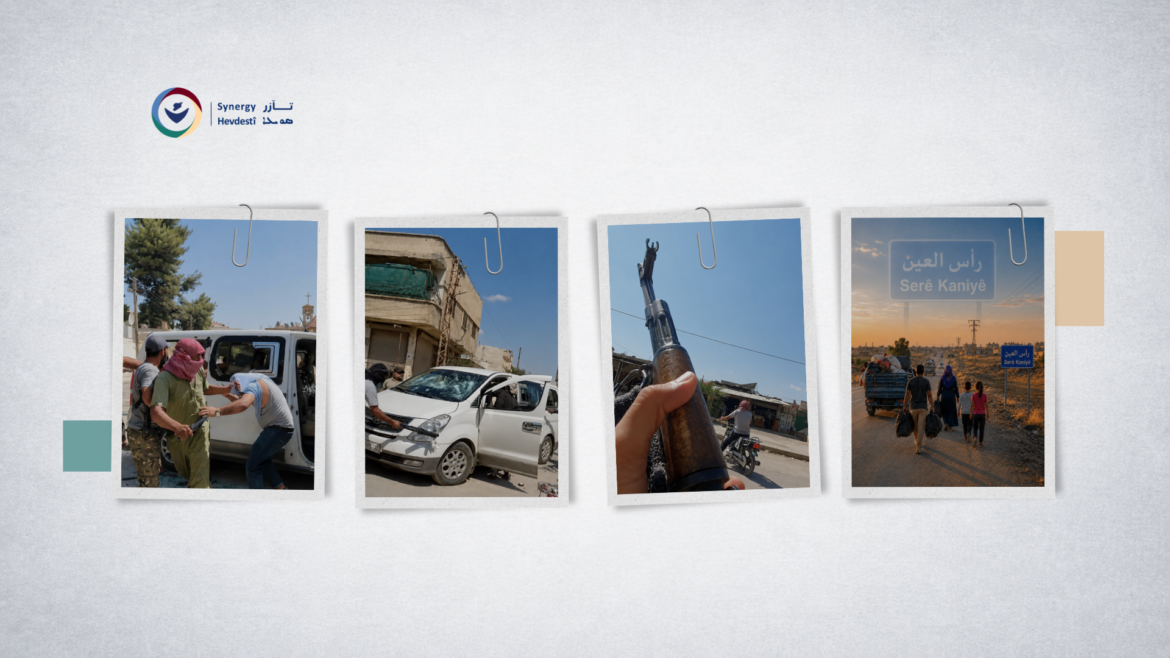
I. Executive Summary
This report documents the violations and security risks that accompanied the first return convoy of forcibly displaced persons to Ras al-Ayn/Serê Kaniyê on 10 August 2026, nearly seven years after their forced displacement. The incidents documented and verified by Synergy Association for Victims indicate that the convoy took place in circumstances where adequate safeguards were not in place to protect returnees or ensure their ability to remain safely, amid continuing gaps in protection, the rule of law, and access to remedies.
The convoy took place in the context of the implementation of the provisions of the 29 January 2026 Agreement between the Syrian government and the Syrian Democratic Forces. It comprised approximately 410 families, fewer than 40 of whom were Kurdish. The majority of returning families were from rural areas surrounding Ras al-Ayn/Serê Kaniyê, while approximately 50 families were returning to the city itself. This composition is relevant to understanding the incidents documented in this report, as the attacks documented by the Association occurred primarily inside the city and predominantly affected Kurdish returnees.
Synergy Association for Victims documented 23 incidents involving attacks against returning civilians, including two elderly persons, two women, and one child. The incidents included beatings and physical assaults, damage to vehicles and property, gunfire, threats and intimidation, as well as damage to nine vehicles. The documentation was based on 12 direct testimonies from members of returning families and witnesses, an analysis of 13 video recordings and more than 10 photographs, as well as open-source information and statements by relevant authorities. The Association assessed each incident on the basis of the available evidence, distinguishing between incidents that could be verified and information that requires further verification.
On the same day, the Internal Security Forces Command in al-Hasakah Governorate stated, in a statement to Syrian News, that its forces had intervened in Ras al-Ayn/Serê Kaniyê to disperse what it described as a “brawl” related to the return of displaced families to their homes “without prior coordination,” and the dispute that subsequently arose with those residing there.This account is inconsistent with the information documented by the Association, which indicates that an armed group, estimated by witnesses to comprise more than 30 individuals, moved through the city’s streets on motorcycles while carrying weapons and attacked returnees and vehicles associated with the return process at multiple locations. Witnesses reported that members of the group were searching for Kurdish returnees and vehicles bearing unfamiliar license plates. Some incidents also contained indications that individuals were targeted on the basis of their identity or presumed political affiliation, including threats directed at Kurds. The Association continues to verify the sequence of events, the nature of each incident, and the motives behind them.
Most of the documented attacks targeted Kurdish returnees. In two cases, the attacks also affected Arab individuals who were accompanying Kurdish families. Through direct communication with the families, Synergy Association for Victims verified the departure of approximately 50 families that had arrived in Ras al-Ayn/Serê Kaniyê as part of the first return convoy. Forty-two families reported that fear was the reason for their departure as a result of violations and risks they had experienced or witnessed, including 12 families whose members had been directly subjected to attacks.
A comparison of these incidents with the findings of a previous assessment conducted by Synergy Association, covering 607 forcibly displaced persons from Ras al-Ayn/Serê Kaniyê and Tall Abyad/Girê Spî, shows that the security concerns expressed by forcibly displaced persons prior to return remained present as the convoy began. Some 79.2% identified security stability as a key condition for return, 68.9% identified the protection of rights and reparations as a priority, while 53.7% emphasized the importance of an independent mechanism to monitor the return process and protect residents’ rights.
The experience of the first convoy, in light of the documented incidents, points to a broader concern regarding the extent to which the rule of law and effective protection are in place in Ras al-Ayn/Serê Kaniyê. The return and continued presence of residents require institutions capable of protecting civilians, preventing the proliferation and unlawful use of weapons, responding promptly to incidents, conducting independent and effective investigations, holding those responsible accountable, and enabling victims to file complaints and access effective remedies.
Accordingly, Synergy Association considers that any subsequent phases of return should be preceded by verifiable safeguards relating to protection, security, and the rule of law; the prevention of threats, discrimination, and reprisals; and the protection of Housing, Land and Property (HLP) rights, alongside independent monitoring and effective mechanisms for investigation, accountability, and redress. The Association therefore recommends that no new collective return operations be organized or supported until it has been verified that these safeguards are in place.
The Association also calls for the establishment of an independent and sustainable mechanism to monitor the situation of returnees, receive complaints, and verify violations, while ensuring the participation of forcibly displaced persons and victims’ associations in the design, monitoring, and evaluation of return policies.
II. Introduction and Context
Nearly seven years after the forced displacement from Ras al-Ayn/Serê Kaniyê, the first return of forcibly displaced persons to the city since 2019 began on 10 August 2026. For displaced families, the return was particularly significant as it represented an opportunity to reclaim their homes, restore family life and social ties, and reconnect with the place from which they had been separated as a result of displacement.
The return took place in the context of the implementation of the provisions of the 29 January 2026 Agreement between the Syrian government and the Syrian Democratic Forces. It raised questions about the conditions that should accompany the return process, including security and protection, the restoration of rights, and returnees’ ability to remain in their places of origin in safe and stable conditions.
Prior to the start of the return, Synergy Association for Victims conducted an assessment of the needs and priorities of forcibly displaced persons from Ras al-Ayn/Serê Kaniyê and Tall Abyad/Girê Spî, based on 607 survey responses. The assessment examined factors influencing decisions to return, including security and protection, the protection of rights and reparations, Housing, Land and Property (HLP), and the existence of an independent mechanism to monitor the return process. The findings showed that the decision to return depends on a range of conditions and safeguards that go beyond simply reaching the area, including the ability to remain there safely, restore rights, and resume life in stable conditions.
As the convoy arrived in Ras al-Ayn/Serê Kaniyê, the Association received testimonies and information concerning attacks against a number of returnees inside the city. It began collecting, verifying, and documenting these accounts, alongside reviewing video materials, open-source information, and statements by relevant authorities.
These incidents raise questions about returnees’ ability to remain safely in the city, exercise their rights after arrival, and obtain protection when subjected to threats or violations. They also raise questions about the effectiveness of protection and law enforcement institutions, including their ability to prevent and respond to violations, investigate them, hold those responsible accountable, and ensure access to remedies for victims.
This report examines these developments by documenting the incidents related to the first return convoy for which the Association was able to gather sufficient information and conduct verification. It also examines their impact on returnees, particularly the families that subsequently left the city, and assesses the extent to which the safeguards required for a voluntary, safe, dignified, and sustainable return were in place, with a particular focus on protection and the rule of law.
III. Documentation Methodology and Sources of Information
In preparing this report, Synergy relied on direct documentation, as well as the monitoring and analysis of open-source information, to document and verify incidents related to the first return convoy to Ras al-Ayn/Serê Kaniyê and assess their impact on returnees.
The documentation process included collecting 12 direct testimonies from returnees, members of their families, and witnesses to the incidents under review; monitoring and analyzing 13 video recordings and more than 10 photographs; reviewing open-source information, as well as statements and releases issued by the authorities concerned with the events; and, where possible, cross-checking information obtained from multiple sources.
The Association assessed each incident on the basis of the available evidence, distinguishing between incidents supported by multiple testimonies or sources and information requiring further verification. The Association does not attribute any incident, or responsibility for it, to a specific party beyond what is supported by the available evidence. In doing so, it takes into account the temporal and geographical context and, where possible, cross-checks the information against independent sources. The documentation process also took into account the protection, safety, and privacy of victims and witnesses. Relevant materials were preserved in accordance with the Association’s established documentation procedures.
IV. The First Return Convoy: What Happened?
On 10 Aug 2026, the first convoy of forcibly displaced persons from Ras al-Ayn/Serê Kaniyê entered the city, marking the first return to the area since the forced displacement in 2019.
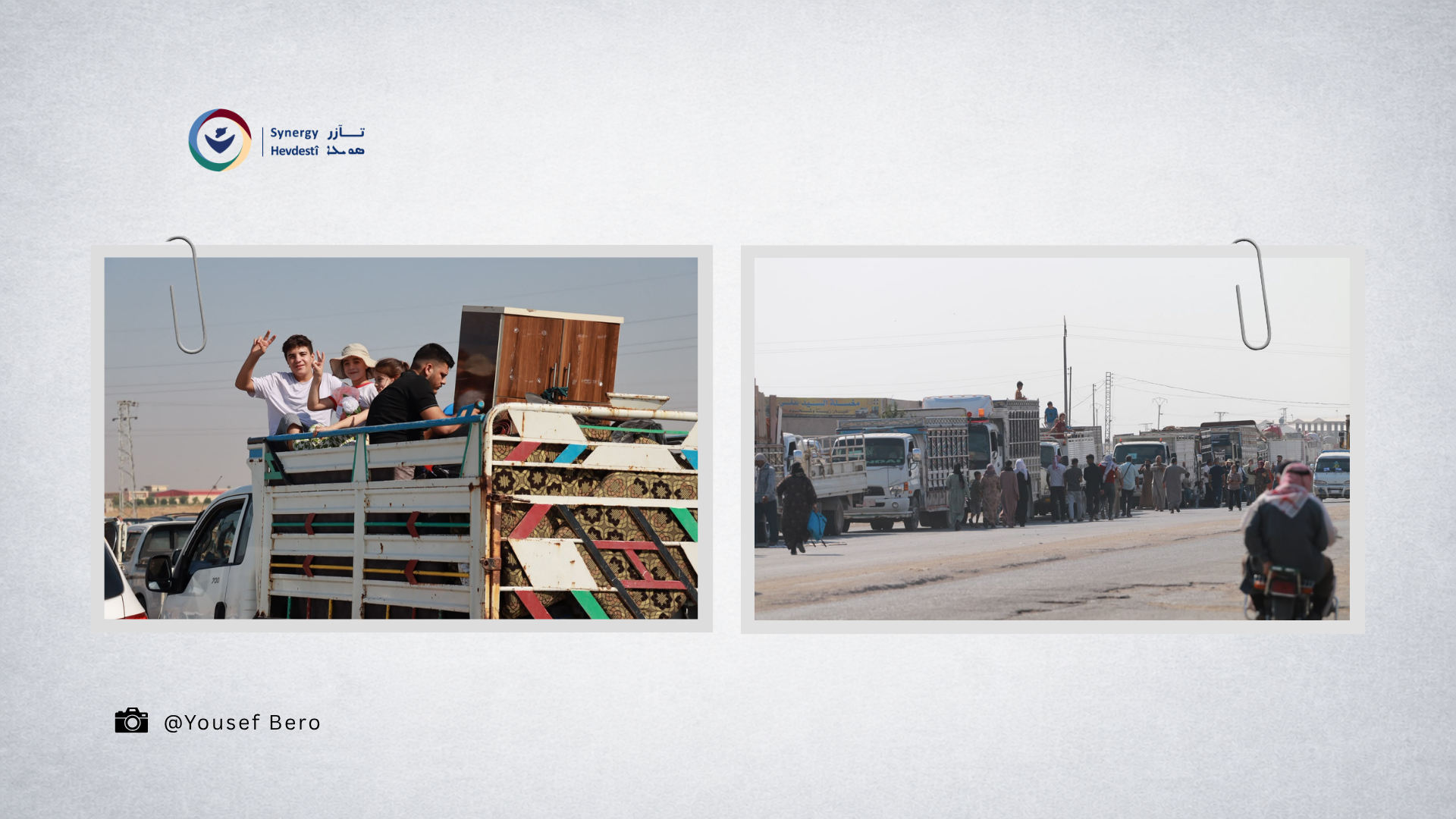
The return convoy departing from al-Hasakah toward Ras al-Ayn/Serê Kaniyê on 10 Aug 2026. Photo: Yousef Bero.
Following the convoy’s arrival, Synergy Association for Victims received testimonies and information concerning attacks against a number of returnees. The accounts included incidents of beatings and physical assaults, damage to vehicles, gunfire, threats, and intimidation. Some incidents occurred while families were inside their vehicles, while others took place as they attempted to leave the city.
Some elements of these testimonies were corroborated by video materials monitored and analyzed by the Association. The footage showed attacks against returning civilians, damage to vehicles associated with the return process, and movements of armed groups travelling on motorcycles, as well as gunfire heard during some of the incidents.
On the same day, the Internal Security Forces Command in al-Hasakah Governorate stated that its forces had intervened in Ras al-Ayn/Serê Kaniyê to disperse a “brawl” related to the return of displaced families to their homes “without prior coordination,” and the dispute that followed with those residing there. This characterization differs from the incidents documented by the Association. The testimonies and materials reviewed by the Association indicate that an armed group moved through the city’s streets, with its members attacking returnees and vehicles associated with the return process at multiple locations, including locations away from the returnees’ homes. The Association continues to verify the sequence of events, the nature of each incident, and the identities of those involved.
Some testimonies indicate that the majority of the armed group’s members were not originally from Ras al-Ayn/Serê Kaniyê and that some were residing in homes owned by displaced original residents. The Association treats this information as testimony requiring further corroboration and does not consider it sufficient to establish the identities of the group’s members, their legal status, or their responsibility for the properties in which they were residing.
Subsequent follow-up showed that approximately 50 families arrived in Ras al-Ayn/Serê Kaniyê as part of the first return convoy and subsequently left the city. The Association was able to contact these families and verify their departure. In some cases, returnees sought shelter with relatives or other civilians after being subjected to or witnessing acts of violence, while others requested security escorts when leaving the city. Forty-two families reported that fear was a reason for their departure as a result of violations and risks they had experienced or witnessed. The Association was able to directly link the departure of 12 families to attacks against members of those families.
V. Documented Patterns of Violations
Testimonies verified by Synergy Association and video materials it analyzed reveal violations against civilians returning to Ras al-Ayn/Serê Kaniyê, including physical assaults, damage to vehicles and property, threats, intimidation, and gunfire, with indications that some returnees may have been targeted based on their identity or presumed political affiliation.
The Association documented testimonies concerning a number of returnees who were beaten and physically assaulted by armed individuals using their hands, sticks, and rifle butts, as well as subjected to insults and threats. The incidents involved individuals who were inside their vehicles or attempting to leave the city.
In one case, a family member who entered the city as part of the first return convoy reported that a group of masked and armed young men stopped the vehicle he was travelling in with his family and assaulted several people. The group then smashed the vehicle’s windows while the family was inside, injuring a ten-year-old girl and her mother. The family left the city the following day and returned to al-Hasakah.
In another incident, a driver participating in the convoy reported being beaten after dropping off a family in Ras al-Ayn/Serê Kaniyê and beginning to leave the city. According to his testimony, an armed group travelling on approximately 20 motorcycles and carrying rifles, pistols, and sticks stopped him, beat him, and smashed the windows of his vehicle. He was able to leave the area with the assistance of another person present at the scene.
Another returnee reported witnessing a group of masked young men on motorcycles attack a returning family, smash their vehicle, and fire at its tires before attempting to attack and insult him. He said that the incident prompted him to seek shelter with relatives before leaving the city with his family.
Some of these testimonies were corroborated by video materials analyzed by the Association, showing physical assaults against civilians returning to Ras al-Ayn/Serê Kaniyê.
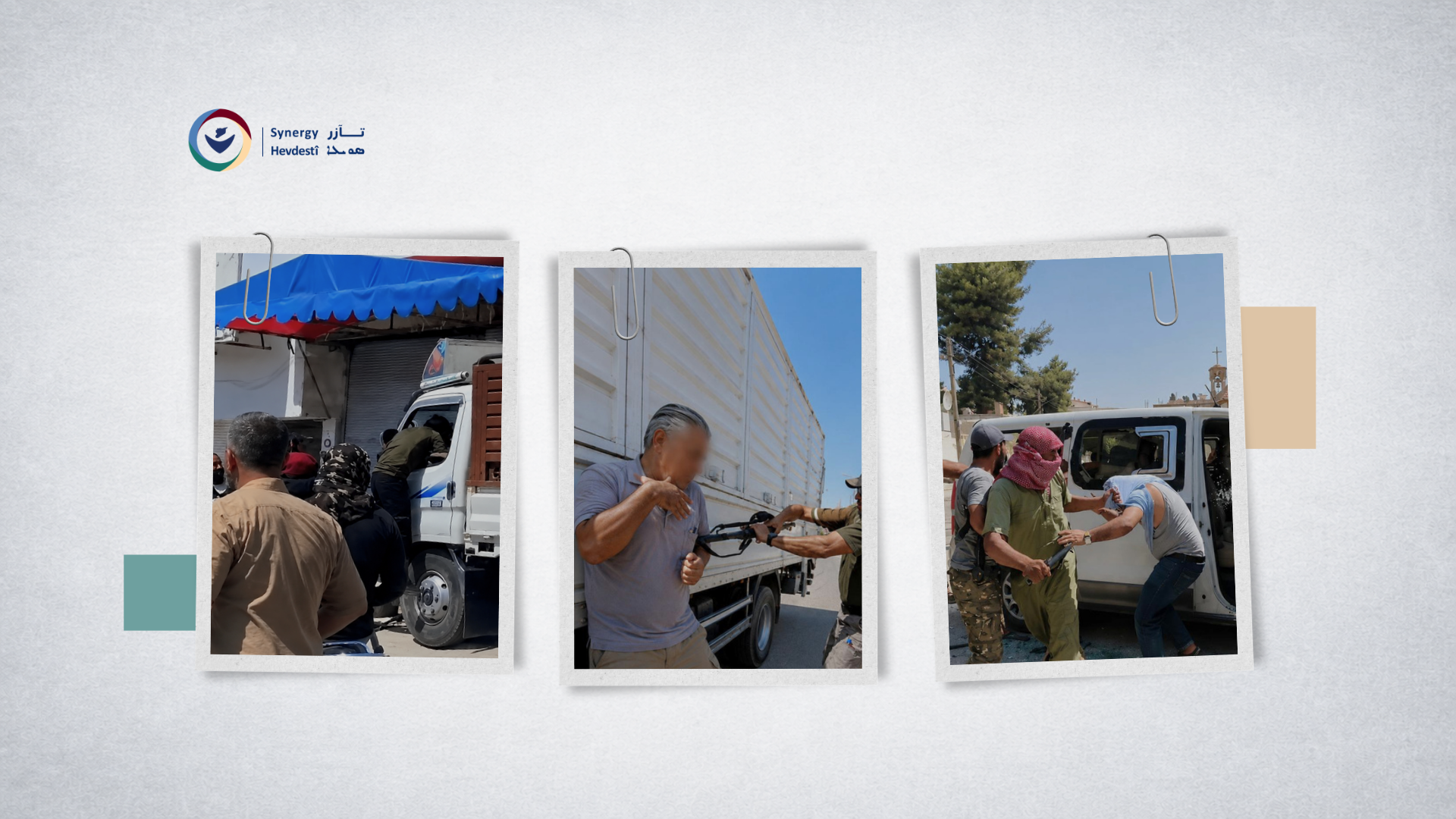
Stills from video materials documenting physical assaults against returnees during the first return convoy to Ras al-Ayn/Serê Kaniyê on 10 August 2026. The footage was enhanced using AI tools without altering its content.
The Association documented damage to nine vehicles associated with the return process, including smashed windows, gunfire directed at tires, and attempts to damage or set vehicles on fire.
In one case, a returnee reported that a group of masked and armed individuals travelling on motorcycles smashed the windows of his vehicle, a Mitsubishi light-duty truck, fired at its rear tires, and then attempted to set it on fire. He said that local residents and neighbors intervened and prevented the vehicle from being set on fire, after which he left the city.
In another incident, a driver participating in the convoy reported that the group that assaulted him smashed the windows of his vehicle as he was leaving the city. He said that, upon reaching the Public Security checkpoint at the entrance to Tal Halaf, he saw another vehicle carrying two people and was told that they too had been assaulted.
These testimonies were consistent with video materials showing damage to vehicles associated with the return process and movements of armed groups travelling on motorcycles. The Association also received information concerning damage to or loss of some personal belongings. It continues to verify this information before classifying it as substantiated.
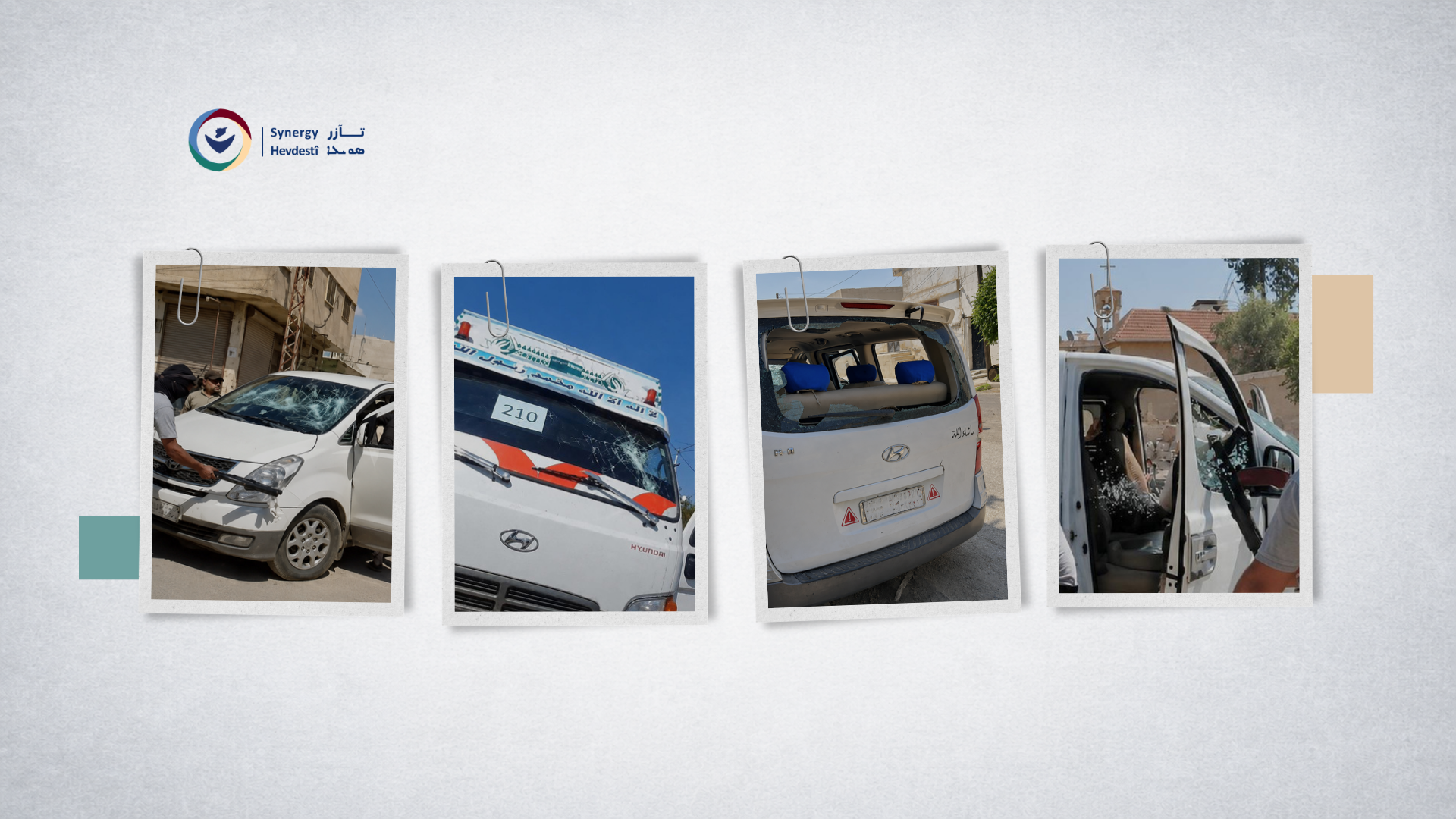
Images and stills from video materials showing attacks against vehicles associated with the first return convoy to Ras al-Ayn/Serê Kaniyê and documenting the damage they sustained on 10 August 2026.
The testimonies and materials reviewed by the Association included incidents involving threats, intimidation, and gunfire accompanying the return of forcibly displaced persons to Ras al-Ayn/Serê Kaniyê. Some of the materials showed armed groups travelling on motorcycles, accompanied by gunfire and threats relating to the return of original residents.
In one video recorded on 10 August 2026, a group of more than 30 people, including armed individuals, can be seen travelling on motorcycles through the streets of Ras al-Ayn/Serê Kaniyê. A member of the group can be heard saying:
“No Kurd or SDF member is allowed to return to Ras al-Ayn.”
The Association also reviewed video footage of a protest in Ras al-Ayn/Serê Kaniyê during which one participant spoke and presented his remarks as a message from the “revolutionaries in Ras al-Ayn” concerning the return of residents from other areas of al-Hasakah Governorate to their places of origin. Referring to the return of Kurds to Ras al-Ayn/Serê Kaniyê, he stated:
“We do not accept Kurds returning to Ras al-Ayn. Let the people of al-Hasakah return, let the people of Ghweiran return, and let every displaced person return to their home. We do not accept or agree to this. Anyone Kurdish in Ras al-Ayn, we will drive them out. This is a promise of honor from us.”
The testimonies collected by the Association also included incidents of gunfire, threats, and intimidation accompanying some attacks against returnees and their vehicles, including gunfire directed at vehicle tires and attempts to attack and threaten individuals in the vicinity of these incidents.
Taken together, these materials and incidents indicate the presence of public rhetoric calling for the return of Kurds to be prevented and for Kurdish residents to be expelled from Ras al-Ayn/Serê Kaniyê. Some incidents also raise concerns about the possible targeting of individuals because of their Kurdish identity or presumed political affiliation. The Association continues to verify the nature of these incidents, the motives behind them, and the relationship between them.
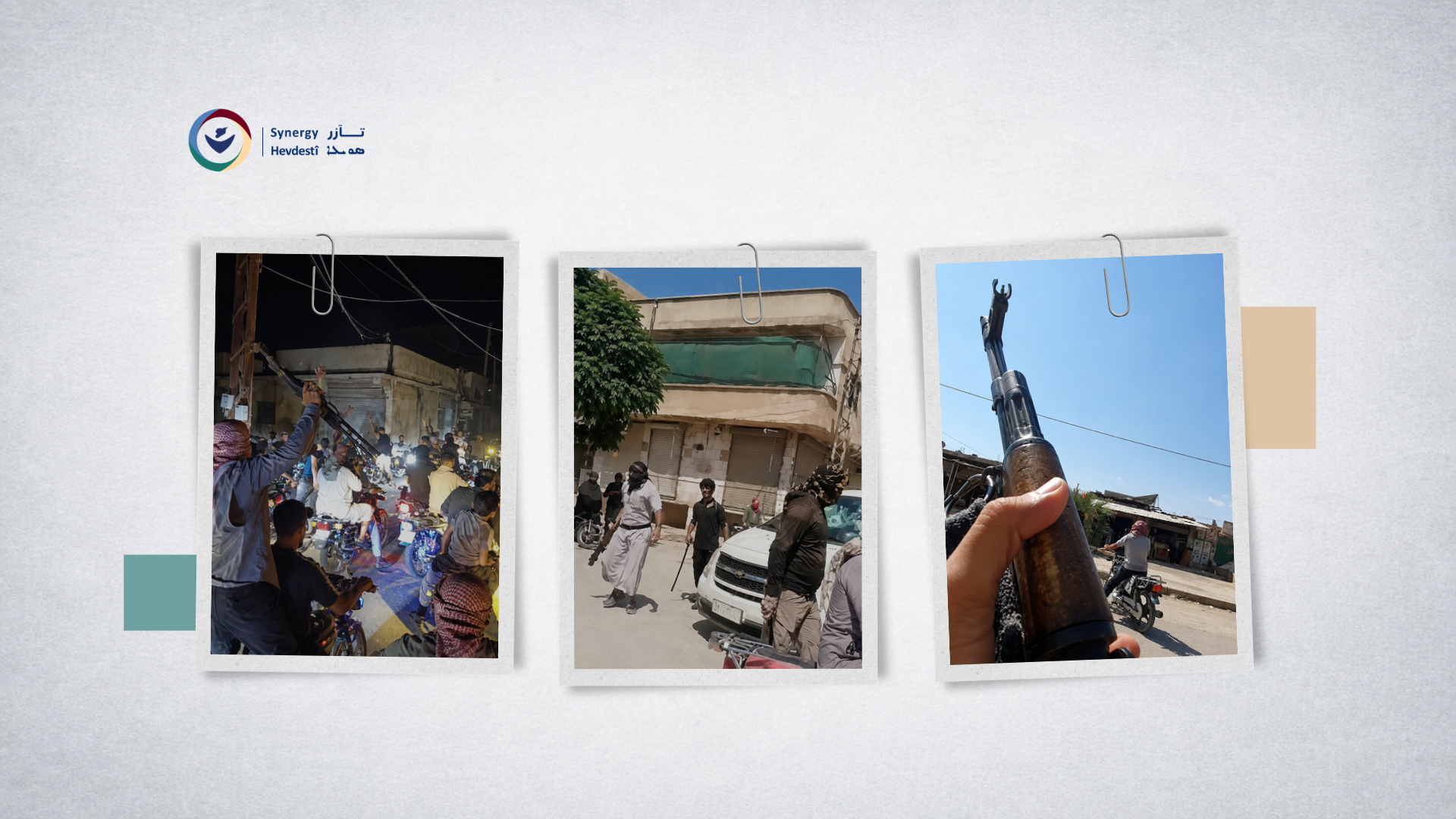
Stills from video materials showing the movements of armed groups, visible weapons, and threats associated with the events surrounding the first return convoy to Ras al-Ayn/Serê Kaniyê on 10 August 2026.
VI. From Return to Departure Again: The Impact of Violations on Families’ Ability to Remain
Through direct communication with families who returned to Ras al-Ayn/Serê Kaniyê, Synergy Association for Victims verified that approximately 50 families left the city after arriving as part of the first return convoy. Forty-two families reported that fear was a reason for their departure, following violations and risks they had experienced or witnessed.
In 12 cases, the Association was able to directly link the families’ departure to attacks against members of those families. In one case, a family left the city the day after an attack inside their vehicle that, according to their testimony, resulted in injuries to a child and her mother. In another, a returnee left with his family after witnessing an attack against another family and being subjected to an attempted assault. A driver who had participated in the convoy also left after being beaten and having the windows of his vehicle smashed.
In some cases, returnees sought shelter with relatives or other civilians, while others requested security escorts when leaving the city. These incidents show that, in some cases, fear was linked to direct exposure to attacks, while in others it resulted from witnessing acts of violence or being subjected to threats, contributing to a sense of insecurity.
These findings show that reaching one’s place of origin does not necessarily mean being able to remain there. Sustainable return depends on families’ ability to remain safely, access their homes and property, and carry out their daily lives in conditions that ensure protection and dignity.
The departure of families shortly after their arrival raises questions about the safeguards in place to protect them, the ability of security and law enforcement institutions to prevent and respond to attacks, and victims’ ability to access complaint mechanisms and remedies. It also underscores the need to monitor families’ circumstances after arrival and ensure their rights to return, Housing, Land and Property (HLP), and access to remedies.
VII. The Gap Between the Conditions for Return and the Reality on the Ground
Before the first convoy set out, Synergy Association for Victims conducted an assessment of 607 forcibly displaced persons from Ras al-Ayn/Serê Kaniyê and Tall Abyad/Girê Spî to identify the conditions they considered essential to their decision to return.
The assessment showed that displaced persons’ decisions to return were linked to the availability of practical safeguards relating to security and protection, rights, Housing, Land and Property (HLP), and monitoring mechanisms. Some 79.2% of participants identified security stability as a key condition for return, 68.9% identified the protection of rights and reparations as a priority, and 53.7% emphasized the importance of an independent mechanism to monitor the return process and protect residents’ rights. Meanwhile, 48.1% considered the restoration of Housing, Land and Property rights a key condition for deciding to return.
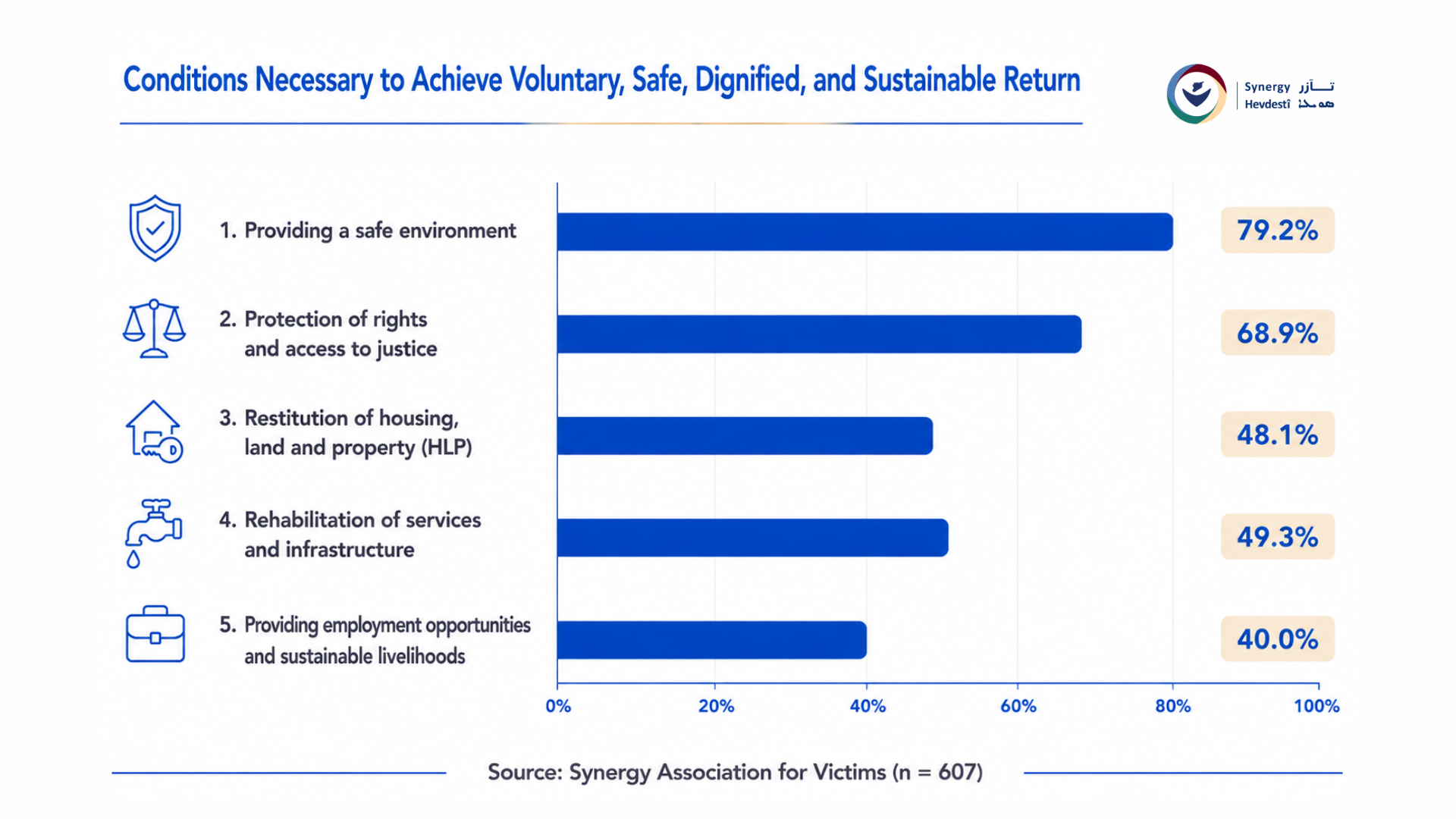
The incidents documented by the Association during the first convoy reveal a clear gap between these conditions and the circumstances faced by some returnees. The return period was marked by physical assaults, damage to vehicles, gunfire, threats, and intimidation, while some families were forced to seek shelter or leave the city after their arrival. The Association also verified the departure of approximately 50 families from the city and documented a direct link between their departure and incidents that some families had experienced or witnessed.
Security is particularly significant in this comparison. Some 79.2% of participants identified security stability as a key condition for return, while the documented incidents indicate that security risks persisted, including physical assaults, threats, gunfire, and attacks against vehicles, as well as instances in which returnees had to seek shelter or request security escorts to leave the city.
The importance of an independent and effective monitoring mechanism is also evident. Some 53.7% of participants considered such a mechanism an important factor in their decision to return. The experience of the first convoy demonstrated the need for an entity capable of receiving complaints, verifying incidents, responding to risks, and monitoring the situation of families facing threats or being forced to leave. This indicates that independent monitoring should form part of return arrangements from the point of arrival and continue thereafter.
Return is also closely linked to the protection of Housing, Land and Property (HLP) rights. Some 48.1% of participants considered the restoration of these rights a key condition for return. In light of the incidents documented by the Association, assessments of return conditions should therefore consider families’ ability to access their homes and property and remain there safely, as well as their ability to seek recourse through independent legal mechanisms to address any attacks, disputes, or violations affecting these rights.
The previous assessment provides an important framework for understanding the experience of the first convoy. A comparison between the assessment of forcibly displaced persons prior to return and the incidents documented during the convoy indicates that several of the risks identified by displaced persons in advance remained present when the return process began, including security risks, the need for effective protection, and the absence of independent mechanisms for monitoring and response.
Accordingly, planning for any subsequent phases of return should be based on regular assessments of conditions on the ground and verifiable safeguards relating to protection and the rule of law, the prevention of discrimination and reprisals, the protection of Housing, Land and Property rights, investigation and accountability, and the participation of forcibly displaced persons and victims in monitoring and evaluating the process.
VIII. Legal Framework: Responsibility to Protect Returnees and Investigate Violations
The protection of civilians and returnees in situations of conflict and displacement is governed by a range of obligations under international human rights law and international humanitarian law, depending on the applicable legal context and the nature of effective control over the area. These obligations include protecting civilians from violence and threats, taking appropriate measures to prevent and respond to violations, investigating incidents that occur, holding those responsible accountable where supported by the available evidence, and ensuring access to remedies and reparations for victims.
In the context of return, these obligations are particularly important because returnees may face heightened risks as a result of their previous displacement, their limited ability to protect themselves, and disputes relating to housing, land, and property. Safe and dignified return therefore requires effective protection arrangements from the moment of arrival and throughout returnees’ stay, ensuring that they can access legal protection when their rights are violated.
Voluntary return requires individuals and families to be able to make the decision to return freely, without coercion or threats, and for conditions to be in place after arrival that enable them to remain in the place to which they have chosen to return. The Guiding Principles on Internal Displacement affirm the responsibility of the competent authorities to establish conditions and provide the means that enable internally displaced persons to return voluntarily, in safety and dignity, and to protect them from discrimination or unequal treatment on the basis of their displacement.[1]
The incidents documented by the Association show that some returnees were subjected to attacks, threats, and security risks that led them to seek shelter or leave the city. In 12 cases, the Association was able to directly link the decision to leave to attacks against members of the families concerned.
These incidents warrant an assessment of the preventive measures that accompanied the convoy, the ability of the competent authorities to protect returnees and respond promptly to incidents, and whether independent and effective investigations are being conducted into violations that occur.
Non-discrimination is a fundamental principle in protecting the rights of returnees. It requires that returnees enjoy protection and equal access to their rights without discrimination on the basis of race, ethnicity, language, political opinion, or any other status protected by law.[2]
Some of the materials monitored by the Association contain threats and public rhetoric calling for the return of Kurds to be prevented and for Kurdish residents to be expelled from Ras al-Ayn/Serê Kaniyê. Some incidents also raise concerns about the possible targeting of individuals because of their Kurdish identity or presumed political affiliation. The nature of these incidents, the motives behind them, and the relationship between them require further verification. If individuals are found to have been targeted on the basis of their identity or political affiliation, this would be inconsistent with the requirements of a safe and non-discriminatory environment for return.
Return is closely linked to Housing, Land and Property (HLP) rights, particularly for persons who have experienced forced displacement. The Pinheiro Principles on Housing and Property Restitution for Refugees and Displaced Persons emphasize the importance of providing fair, independent, transparent, and non-discriminatory mechanisms for the restitution of housing, land, and property, with compensation provided where restitution is not possible.[3]
Synergy’s previous assessment found that 48.1% of participants considered the restoration of Housing, Land and Property rights a key condition for return. In this context, issues of property ownership, restitution, and compensation require independent mechanisms that enable returnees to submit their claims and have them considered fairly and transparently, while protecting these rights from dispossession, deprivation, or reprisals.
The incidents documented in this report raise a broader question about the extent to which the rule of law is upheld in Ras al-Ayn/Serê Kaniyê. Protecting returnees requires institutions capable of preventing violence and threats, responding to incidents, enforcing the law equally, investigating violations and holding those responsible accountable, and enabling victims to file complaints and access remedies.
The rule of law is particularly important in the context of return, as families’ ability to remain depends on their ability to rely on protection and justice institutions when their lives, safety, or property are at risk. This includes regulating the use of weapons outside legal frameworks, preventing armed groups from committing acts of violence or intimidation against civilians, and ensuring that returnees can access the competent authorities when their rights are violated.
The information documented by the Association indicates that, in some cases, security authorities intervened after attacks had occurred, including by providing medical assistance to victims and facilitating the departure of some returnees from the city. These interventions represent one aspect of the response that should be assessed alongside the preventive measures taken before, during, and after the attacks. At the same time, attacks, movements of armed groups, and gunfire occurred in areas where civilians and returnees were moving, warranting an independent assessment of whether the measures taken were adequate to protect them from risks that could reasonably have been anticipated in the context of the return.
The responsibility to respond also entails a duty to investigate violations that have occurred. Investigations should be effective, independent, and impartial, and should seek to establish the circumstances of the incidents and identify those responsible, while taking the necessary measures to preserve evidence and protect victims and witnesses from reprisals or further harm.[4]
Returnees who have been subjected to attacks or threats, or who have lost property as a result of such incidents, should have access to complaint mechanisms, protection, investigation and accountability mechanisms, and reparations, as appropriate to the circumstances and applicable rules.
Depending on the nature of each case, remedies may include investigation, truth-seeking, accountability, restitution, compensation, reparation, and guarantees of non-recurrence, alongside measures to protect victims and witnesses and preserve evidence.[5]
Safe and dignified return requires conditions that allow returnees to reach their places of origin, remain there, and live their lives without being subjected to violence, threats, or discrimination, while retaining access to their rights and remedies. Return should therefore be understood as an ongoing process that begins before arrival and continues thereafter. Arrival in the city is only an initial stage; the sustainability of return depends on families’ ability to remain safely, access their homes and property, obtain protection when needed, and address violations they may experience.
Accordingly, any subsequent phases of return should be based on continuous assessments of security and human rights conditions and accompanied by independent mechanisms for monitoring, protection, receiving complaints, investigation, and accountability, with the participation of forcibly displaced persons, victims, and their representatives in monitoring and evaluating the process.
IX. Conclusions
The incidents documented by Synergy Association for Victims during the first return convoy to Ras al-Ayn/Serê Kaniyê show that the return took place amid security risks and violations affecting a number of returning civilians, with consequences for some families’ ability to remain in the city. The documented incidents included physical assaults, damage to vehicles and property, threats, intimidation, and gunfire, as well as indications of public rhetoric calling for the return of Kurds to be prevented and Kurdish residents to be expelled. The Association continues to verify certain aspects of the alleged targeting and the motives behind it.
Follow-up showed that approximately 50 families arrived as part of the convoy and subsequently left the city. Forty-two families reported that fear was a reason for their departure, following violations and risks they had experienced or witnessed. In 12 cases, families directly linked their departure to attacks against members of their families. Some returnees sought shelter with relatives or other civilians, while others requested security escorts to leave the city.
A comparison of these incidents with the Association’s previous assessment, which covered 607 forcibly displaced persons from Ras al-Ayn/Serê Kaniyê and Tall Abyad/Girê Spî, shows that several of the risks identified by displaced persons prior to return remained present when the process began. Some 79.2% of participants identified security stability as a key condition for return, 68.9% identified the protection of rights and reparations as a priority, while 53.7% emphasized the importance of an independent mechanism to monitor the return process.
These findings indicate that several of the conditions necessary for a safe, dignified, and sustainable return were not sufficiently in place during the first phase of the return process. These included protection from violence and threats, the ability to access the competent authorities when needed, access to protection following incidents, and effective mechanisms for filing complaints, conducting investigations, and ensuring accountability.
The rule of law in Ras al-Ayn/Serê Kaniyê is of particular concern. Protecting returnees and enabling them to remain in the city requires an environment in which civilians can rely on institutions capable of preventing violence, regulating the use of weapons, enforcing the law equally, investigating violations and holding those responsible accountable, and enabling victims to access justice and remedies. The protection of Housing, Land and Property rights likewise requires independent, fair, and transparent legal mechanisms through which returnees can seek to protect and restore their rights.
The incidents also point to the need to investigate the indications of identity- or presumed political affiliation-based targeting, and to take effective measures to prevent discrimination and reprisals and protect returnees from any rhetoric or practices intended to prevent them from returning or threaten their presence in their places of origin.
Accordingly, the Association considers that any subsequent phases of return should be preceded by an independent and ongoing assessment of security and human rights conditions, together with verifiable safeguards relating to protection and the rule of law, the prevention of discrimination and reprisals, the protection of Housing, Land and Property rights, investigation and accountability, and effective access to complaint mechanisms and remedies. Forcibly displaced persons, victims, and their representatives should also participate in monitoring and evaluating the return process.
X. Recommendations
Based on the incidents documented by Synergy Association for Victims and the findings of its assessment of the conditions for return to Ras al-Ayn/Serê Kaniyê, the Association makes the following recommendations:
A. To the Syrian Government and Relevant Security and Judicial Authorities
- Refrain from organizing or supporting any new return convoys or collective return operations to Ras al-Ayn/Serê Kaniyê until an independent assessment has verified that the conditions for voluntary, safe, dignified, and sustainable return are in place, and clear and effective protection arrangements have been established for both the pre-return and post-arrival stages.
- Strengthen the rule of law in Ras al-Ayn/Serê Kaniyê by ensuring that all individuals and armed groups are subject to the law, preventing the carrying and use of weapons outside lawful frameworks, and taking effective measures to prevent attacks against and intimidation of civilians.
- Conduct independent, effective, and impartial investigations into the violations that accompanied the 10 August 2026 return convoy, including physical assaults, damage to vehicles and property, gunfire, threats, and intimidation, and identify and hold those responsible accountable on the basis of the available evidence.
- Take immediate measures to protect returnees and other civilians inside the city, ensure their ability to access and safely remain in their homes and property, and respond promptly to any threats or attacks.
- Investigate indications of identity- or presumed political affiliation-based targeting and take effective measures to prevent discrimination, threats, reprisals, or incitement aimed at preventing residents from returning to their places of origin.
- Establish an independent and effective mechanism to monitor the return process, receive complaints from returnees, verify violations, follow up on the situation of families at risk, and ensure the participation of forcibly displaced persons, victims, victims’ associations, and civil society organizations.
- Protect returnees’ Housing, Land and Property (HLP) rights and establish independent, fair, and transparent mechanisms for adjudicating property restitution claims and resolving related disputes, while ensuring compensation and reparation where restitution is not possible.
- Ensure continued protection and access to remedies for families that have subsequently left the city, and ensure that their departure is not treated as a waiver of their right to return or of their Housing, Land and Property rights.
B. To the United Nations, International Organizations, and Donors
- Support the establishment of an independent and sustainable mechanism to monitor the return process and the situation of returnees in Ras al-Ayn/Serê Kaniyê, including documenting and verifying violations, receiving complaints, and following up on cases, while ensuring the participation of forcibly displaced persons, victims, and their organizations.
- Support an independent investigation into the violations that accompanied the 10 August 2026 return convoy, protect evidence and witnesses, and ensure that documented information can be referred, where appropriate, to relevant accountability mechanisms.
- Condition any support or funding for return operations on the existence of verifiable safeguards for voluntary, safe, dignified, and sustainable return, including effective protection and the rule of law, measures to prevent discrimination and reprisals, and access to remedies.
- Support programs for the restoration of Housing, Land and Property, the rehabilitation of basic services and livelihoods, and measures that enable returning families to re-establish stable lives in their places of origin.
- Support reparation and rights-restoration programs for families affected by displacement and violations related to return, including legal assistance in Housing, Land and Property matters.
- Ensure the meaningful participation of forcibly displaced persons, victims, and their organizations in the design, implementation, monitoring, and evaluation of return policies and programs, including both pre-return and post-arrival stages.
C. To Civil Society Organizations and Victims’ Associations
- Continue monitoring the situation of returnees and families that have subsequently left the city, and document the violations and risks they face in accordance with professional standards of verification and the protection of victims and witnesses.
- Strengthen documentation of Housing, Land and Property issues related to displacement and return, and support families in preserving documents and other evidence relating to their rights.
- Strengthen legal assistance for returnees and forcibly displaced persons affected by violations, particularly in cases involving assaults, threats, property disputes, restitution, and reparation.
- Strengthen advocacy against organizing or supporting return operations where safeguards for protection, safety, dignity, sustainability, and the rule of law are not in place, and ensure that any subsequent phases are contingent on verifiable safeguards.
- Strengthen the participation of forcibly displaced persons and victims in dialogue and decision-making on return, and ensure that the voices of families who returned and subsequently left reach the relevant actors responsible for designing and monitoring return policies.
- Continue monitoring and documenting the impact of risks and violations on families’ decisions to remain or leave, in order to assess the sustainability of return and identify measures needed to prevent further departures driven by fear or threats.
The full report (21 pages) is available in PDF format at the following link:
[1] The Guiding Principles on Internal Displacement, Principle 28, states that the competent authorities have the primary duty and responsibility to establish conditions and provide the means that allow internally displaced persons to return voluntarily, in safety and with dignity, to their homes or places of habitual residence, while facilitating their reintegration and ensuring their participation in the planning and management of their return.
[2] The International Covenant on Civil and Political Rights, Articles 2(1) and 26, requires States to respect and ensure rights without discrimination and recognizes equality before the law and the right to equal protection of the law. The Human Rights Committee has affirmed that prohibited grounds of discrimination include, among others, race, colour, language, religion, political or other opinion, national or social origin, and other status.
[3] The United Nations Principles on Housing and Property Restitution for Refugees and Displaced Persons (Pinheiro Principles), in particular Principle 2 on the right to housing, land, and property restitution, and Principles 12 and 13 on establishing fair, independent, non-discriminatory, and accessible mechanisms and procedures to consider restitution and compensation claims.
[4] Article 2(3) of the International Covenant on Civil and Political Rights requires an effective remedy where rights recognized under the Covenant have been violated. The Human Rights Committee has affirmed that States must investigate allegations of violations promptly, thoroughly, and effectively through independent and impartial bodies, and that failure to conduct an adequate investigation may itself constitute a violation of the Covenant. See also General Comment No. 31, in particular paragraphs 15 and 16.
[5] See the Basic Principles and Guidelines on the Right to a Remedy and Reparation for Victims of Gross Violations of International Human Rights Law and Serious Violations of International Humanitarian Law, adopted by the United Nations General Assembly in Resolution 60/147 (2005). Forms of reparation may include, depending on the circumstances, restitution, compensation, rehabilitation, satisfaction, and guarantees of non-recurrence.