
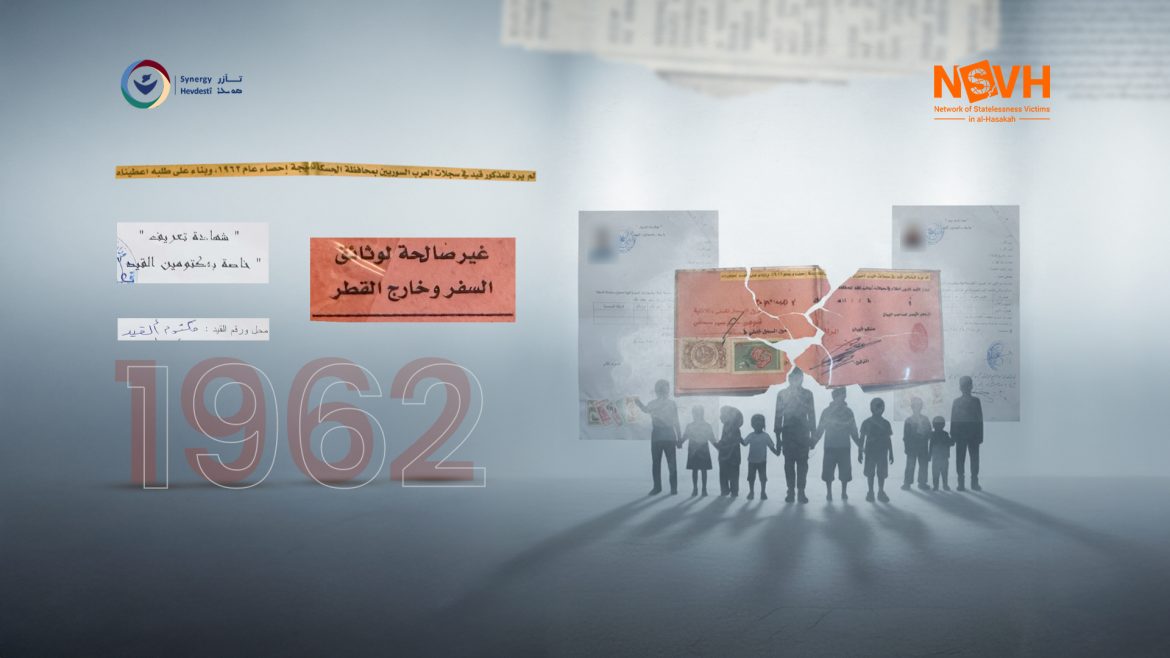
First: Executive Summary
This paper narrates a prolonged story of a very fundamental right; the right to be born recognized. It highlights how an extraordinary census conducted in al-Hasakah in 1962 became a long-lasting legal and social wound. On October 5, 1962, tens of thousands of Syrians —most of them Kurds—were stripped of their citizenship through an arbitrary administrative and political measure, resulting in their arbitrary deprivation from the “legal personality” and the rights connected to it, including education, health, employment, property ownership, freedom of movement, and political representation. Although a partial corrective measure was introduced in 2011, major gaps remained, and tens of thousands of people continued to suffer. Thousands of families have inherited the consequences of this deprivation across generations.
Where Do We Stand in Facts and Figures?
- The Beginning of the Tragedy: Under Legislative Decree 93/1962, a “Special Census” was conducted in al-Hasakah in a single day, specifically on October 5, 1962. It imposed harsh proof-of-residency requirements that ignored demographic realities and patterns of population movement (such as the demand to prove residence prior to 1945), coupled with weak notification and preparation. This caused an unjust legal exclusion that stripped thousands of families of civil recognition and created two categories of stateless persons: (1) Ajanib al-Hasakah (“foreigners”): those issued red identity cards labelling them as “foreigners” in their own homeland; and (2) Maktumeen al-Qayd (“unregistered”): those left entirely outside the civil registry, without any documents to prove their legal existence.[1]
- The Widening Impact Over Time: Initial estimates in 1962 indicate that around 120,000 people were stripped of their nationality. Over the following decades, and by 2011, more than 517,000 Syrian Kurds had been recorded as stripped/deprived of citizenship, including over 171,000 categorized as Maktumeen al-Qayd (unregistered). Following Legislative Decree of 49/2011, most of the Ajanib al-Hasakah (foreigners) regained their nationality, while more than 150,000- mostly Maktumeen al-Qayd- remained without citizenship.[2]
- Affected Groups Expanded after 2011: Beyond the Kurds, the risks of statelessness also extended to other components: children of Syrian mothers when the father’s lineage is unknown or cannot be proven; children born abroad or in areas outside government control; unregistered marriages, certain nomadic communities with seasonal mobility, families of the missing, and survivors of sexual violence. The common thread among these cases is the convergence of incomplete legal provisions, an overburdened bureaucracy, and a legacy of stigma—factors that ultimately converge on the child.[3]
What Are the Implications of Statelessness in Everyday Life?
Statelessness is not merely a matter of missing documents; it is the story of a child denied a school seat or a diploma because they are unregistered, of a mother unable to pass her nationality to her children, of a young man forced into the shadow economy because regular employment requires official papers, and of a family living in a “paperless” (legally unregistered) home, constantly fearing to lose it at the first dispute. The consequences of statelessness extend to every aspect of life:
- Law and Identity: The absence of the “legal personality” obstructs access to justice, and turns basic procedures—such as registering births or deaths, and documenting marriages or divorces—into difficult processes filled with obstacles and long waits.
- Education and Health: The lack of legal recognition prevents enrollment in schools and universities, obtaining degrees, accessing vaccines and health services, and registering vital events.
- Employment, Ownership, and Movement: Lack of legal recognition blocks access to regular employment and social insurance, prevents property ownership or validation, complicates obtaining passports and cross-border documents, and results in full exclusion from political participation and public representation.
- Derivation is Inherited Across Generations: children enter the world invisible to the system, trapped in a cycle of unrecognized births, missing records, and denied rights. No birth registration → No civil records → No nationality → Compounded denial of rights.
What Do International Standards Require, and What Gaps Exist in National Legislation?
Legally, such structure contradicts the state’s obligations to ensure non-discrimination, recognition of legal personality, the right to nationality, and the protection of children from statelessness. The gaps are evident: there are no preventive safeguards against statelessness at birth, inequality persists between men and women in conferring nationality, civil transactions are subject to undue security interference, and appeal procedures remain ineffective.
The paper proposes a guiding principle with two complementary approaches:
- An Immediate Executive Path: Adoption of a legal rule prohibiting statelessness at birth; full equality in conferring nationality; a collective “correction window” for the Maktumeen al-Qayd allowing the use of alternative evidence; broad recognition of documents issued abroad; deployment of mobile registration teams; introduction of a “temporary civil number” for children to secure access to education and health services; establishment of a specialized judiciary and provision of free legal assistance; and the removal of “security” interference from civil status matters.
- A Transitional Recognition Path: Integrating the issue into a broader transitional justice process, including formal recognition of victimization, collective reparations, and institutional reforms with guarantees of non-recurrence.
Statelessness in al-Hasakah is a longstanding wound that can be remedied with political will, bold legislative reform, and an administration that prioritizes people’s rights. Progress requires protective laws, an enabling administration, an impartial judiciary, and a public narrative free of stigma. Recognition is the first step, and reparation is the bridge to a future where no child is born without a name or a homeland.
Second: Introduction
“Even if nationality is restored, it will not undo the years lost. My sole concern now is to ensure that my children do not inherit this deprivation,’’ said a blind father from Ras al-Ayn/Serê Kaniyê describing decades of exclusion. Another woman from Qamishli, who was unable to register her marriage for years, added: “All I want is to officially register my children so they can attend school like every other child.” These two testimonies capture the essence: statelessness is not a statistical file, but a life obstructed at every turn.
The 1962 “Special Census” in al-Hasakah was not an accidental measure, but a deliberate, systematic pattern of exclusion confined to a single province, where strict proof requirements were imposed and effective avenues for appeal were lacking. This led to arbitrary deprivation in violation of the principles of non-discrimination and the right to nationality. Successive policies reinforced its impact—particularly against the Kurdish population—through administrative isolation, linguistic and cultural barriers, and spatial arrangements associated with the so-called ‘Arab Belt’. What began as a temporary measure thus evolved into continuous structural marginalization.[4]
This paper, issued by Synergy Association for Victims and Network of Statelessness Victims in al-Hasakah (NSVH), aims to provide a detailed documentary account and a comprehensive legal and human rights analysis of the statelessness issue in al-Hasakah since the 1962 Special Census and its aftermath. It also addresses the impact of the armed conflict after 2011, legislative and administrative gaps, and obstacles to accessing justice. Its purpose is twofold:
- Providing a well-founded reference for policymakers, judicial and administrative authorities, civil society organizations, and international actors;
- Supporting advocacy and reparation efforts with factual, accurate, and content for practical use.
Similar issues exist in several countries: The Bidoon in the Gulf, the Rohingya in Myanmar, and descendants of Haitian immigrants in the Dominican Republic following judicial and legislative changes. While the contexts differ, the “mechanisms” are strikingly similar: collective stripping through imposing incapacitating proof requirements, shifting the burden of proof onto the victims, and making access to “correction” highly complex—leaving long-lasting social scars. The overarching lesson is clear: effective solutions have followed a three-pronged approach, combining comprehensive legislative reform, administrative simplification through the removal of arbitrary restrictions, and reparation programs that place people at the center (through documentation, access to services, and public acknowledgment of historical injustices).
To Whom Is This Paper Addressed?
The paper is directed primarily to civil registry offices, judicial authorities, and relevant ministries, followed by UN agencies, donors, human rights organizations, legal aid providers, journalists, and researchers. Each party has a specific role: civil registry offices to simplify procedures, the judiciary to promote equitable rulings, advocates to draft legal arguments and campaigns, and international partners to align support with actual needs.
What is the Scope of the Paper?
It begins with a systematic and conceptual definition to clarify key terms, followed by a detailed historical and legal background dating back to the 1950s, along with a precise timeline. The paper then analyzes the sectoral impacts on education, health, employment, property, civil status, and public participation, and highlights other groups threatened or affected after 2011. The main body concludes with a legal analysis identifying gaps in national law relative to international standards, accompanied by measurable and practical recommendations for implementation.
Work Methodology:
The paper is based on a desk review of laws, decrees, and human rights reports, complemented by a comparative analysis of similar cases. Evidence was triangulated across published statistics, official documents, and testimonies. Where figures differ, we present estimated ranges, highlighting discrepancies and the limitations of the sources. The aim is to provide as reliable an assessment as possible without implying certainty beyond what the data can support.
Key Terms and Definitions:
- De Jure Statelessness: Not recognized as a national by any state under its laws.
- Ajanib al-Hasakah: Registered as Syrian “foreigners” after the 1962 Census, holding red cards.
- Maktumeen al-Qayd: The entirely omitted from the Civil Registry, with no documents proving their legal existence. They may hold local “identification certificates,” which do not confer legal personality.
- Civil Registration/Vital Events: Recording births, deaths, marriages, and divorces for legal recognition.
- Recognition of Legal Personality: A principle acknowledging that every person has legal status before the state, judiciary, and administration.
Ethical and Security Considerations:
- Do No-Harm and Confidentiality: Refrain including details that could identify individuals unless the information is publicly available and consent has been obtained.
- Safety: Recognize the sensitivity of individuals in relation to official authorities; avoid giving guidance that could put anyone at risk; refer sensitive matters to legal experts.
- Non-Stigmatizing Language: Avoid language that demonizes any group or reinforces discrimination; focus on empowering victims rather than reducing them to their suffering.
The Geographical-Demographic Context of al-Hasakah:
Al-Hasakah is an ethnically and religiously diverse province, home to Kurds, Arabs, Syriacs/Assyrians, Armenians, Yazidis, Chechens, and others. This diversity underscores the need for a civil registration system that is fair and inclusive, as it directly affects the social security and rights of all communities. Any administrative or political shortcomings in legal recognition therefore create compounded harms that are difficult to remedy later.
Transitional Justice and Reparation:
The paper relies on a systematic distinction between: (a) Political/security decisions that created or perpetuated the dilemma; (b) the administrative barriers that exacerbated the harm (disparities in application, bureaucracy, and corruption). This analytical chapter supports the design of comprehensive solutions: legislative measures to eliminate the root causes, administrative reforms to remove practical obstacles, and social justice initiatives to provide reparations and prevent recurrence.
The paper frames statelessness as a “systematic violation with collective impact,” deserving a clear place in any transitional justice process. Reparation here goes beyond recovering documents, encompassing formal recognition, symbolic and material compensation, institutional reforms (especially within the Civil Registry Directorate), and guarantees of non-recurrence—such as constitutional or legal provisions that prevent collective deprivation of nationality and ensure equality in passing on nationality.
Considerations on the Quality of Evidence and Methodological Limitations:
- Differences in figures over the years reflect limited access to official data and variations in counting methodologies.
- Victims’ testimonies consistently highlight obstacles and impacts, but they do not constitute a representative survey.
- International comparisons are intended as illustrative, not prescriptive; institutional and political differences are always taken into account.
Gender Perspective and Vulnerability:
- Women face double restrictions due to unequal passing of nationality to their children, as well as greater barriers to movement and access to administrative offices.
- Stateless children are more vulnerable to school dropout and forced labor.
- Persons with disabilities encounter additional obstacles in both physical and procedural access to services.
In short, this paper frames the statelessness in al-Hasakah as a compound historical-legal phenomenon, and develops a practical, solution-oriented analysis. Its objective is to transform the phrase “no child is born without a name and a homeland” from a moral slogan into a concrete legal and procedural obligation.
Third: Background
- Historical Overview: From the Formation of the State to the Eve of the Census
Following the independence in 1946, Syria entered the early years of statehood, with its institutions changing alongside successive regimes, and the definition of “who is a citizen’’ repeatedly reshaped, according to shifting political agendas. In the 1950s, the rise of Arab nationalist discourse heightened the state’s sensitivity to ethnic and linguistic diversity, leading to policies that gradually limited recognition of Kurdish identity and non-Arab cultures in the public sphere. With the formation of the union with Egypt in 1958, followed by its dissolution in 1961, rapid legislative changes combined with institutional instability, weakening safeguards for equality and due process, and enabling exceptional measures that had discriminatory effects in practice.
Under these circumstances, the al-Jazira region—with al-Hasakah at its center—became a testing ground for administrative and security measures affecting language, culture, transportation, housing, and the organization of the civil registry. Later, the region was further shaped by spatial policies such as the “Arab Belt.” By the eve of 1962, the state’s procedural requirements, evidentiary standards, and administrative jurisdictions shifted in ways that magnified disparities, placing a disproportionate burden on the most vulnerable groups to prove their legal status. This set the stage for exceptional procedures in al-Hasakah, leaving lasting structural effects on the recognition of legal personality and the right to nationality for subsequent generations.
- Immediate Context 1961-1962: From “Rabid Organizing” to Exceptional Measures
In August 1962, the Legislative Decree 93 was issued to conduct a Census in al-Hasakah province “in one single day”, the date of which would be determined by an executive decision. While the official aim was to standardize and expedite procedures, in practice it shortened notification periods, increased compliance costs, and heightened the risk of errors—particularly affecting the poorest, nomadic populations, and those lacking historical property or residence documents. In addition, residents were required to provide proof of residency dating back to before 1945—a condition that failed to account for the historical mobility of populations in the al-Jazira region or the limited scope of civil registration at the time. As a result, thousands of families were unable to produce “sufficient evidence” within the tight timeframe, leaving many at risk of exclusion from the civil registry.
- Breaking Point: The Rise of Two Legal Categories
The Census ended up creating a legal hierarchy within the society itself: (1) Ajanib al-Hasakah: Individuals registered in special records and holding red cards as “foreigners” within their own homeland, while also facing incomplete civil rights, including restrictions on property ownership, movement, and regular employment. (2) Maktumeen al-Qayd: Those entirely omitted from the civil registry, lacking a civil number, official recognition, or any documents proving their legal existence.
Out of these two categories, distinct subgroups emerged in practice. Children born to two «Ajanib» parents were generally registered in the “foreigners” records. However, many others became “Maktumeen al-Qayd” because their parents’ marriage was not officially recorded (even if both were “Ajanib”), due to mixed parental status (one Maktum, one Ajanib), or because documents were lost and proof could not be provided within the census period. Moreover, under the nationality laws at the time— which granted nationality primarily through the father—many children were left stateless if their father was from Ajanib al-Hasakah, a Maktum, or legally unrecognized/unknown, even when their mother was a Syrian citizen.
Through this process, administrative classification became a continuous source of deprivation: a child born without registration is denied access to education, healthcare, and formal employment, and the cycle repeats in the next generation—until clear and accessible pathways are established to regularize marriage, parentage, and civil registration.
Among the figures stripped of their nationality were Tawfiq Nizam Eddin, a former Syrian Army Commander, and his brother Abdel Baky Nizam Eddin, who held several ministerial positions between 1949 and 1957.[5] [6]
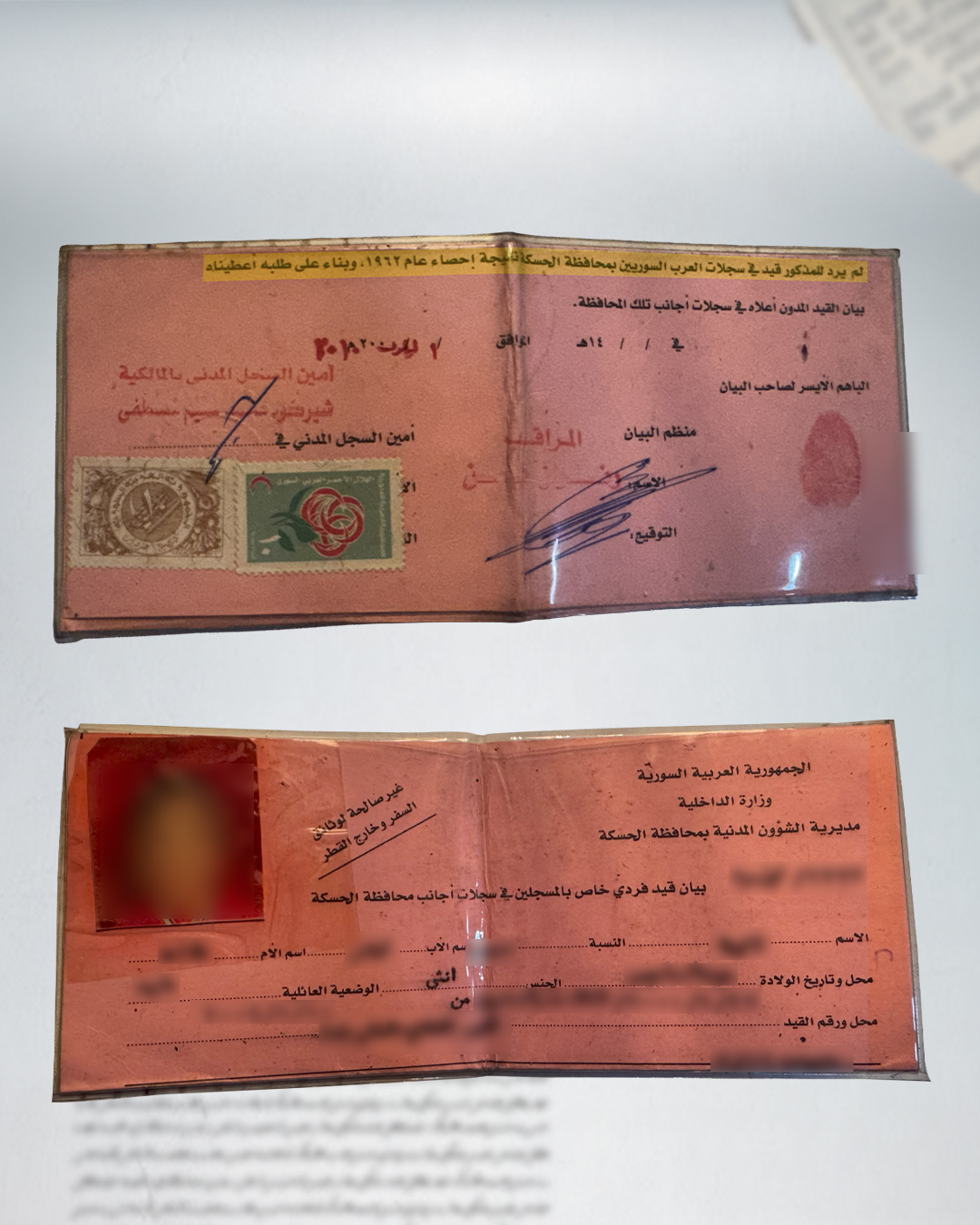
Red card issued to victims in the Ajanib al-Hasakah (“foreigners”) Category, classifying them as foreigners in their own country. Officially titled “Special Individual Registration Statement for those registered in the Registers of the Foreigners of al-Hasakah Governorate”, it bore the notice: “Not valid as travel documents for travel outside the country”. The card also stated that no record of the holder was found in the Syrian Arab Registers of al-Hasakah Governorate as a result of the 1962 Census.
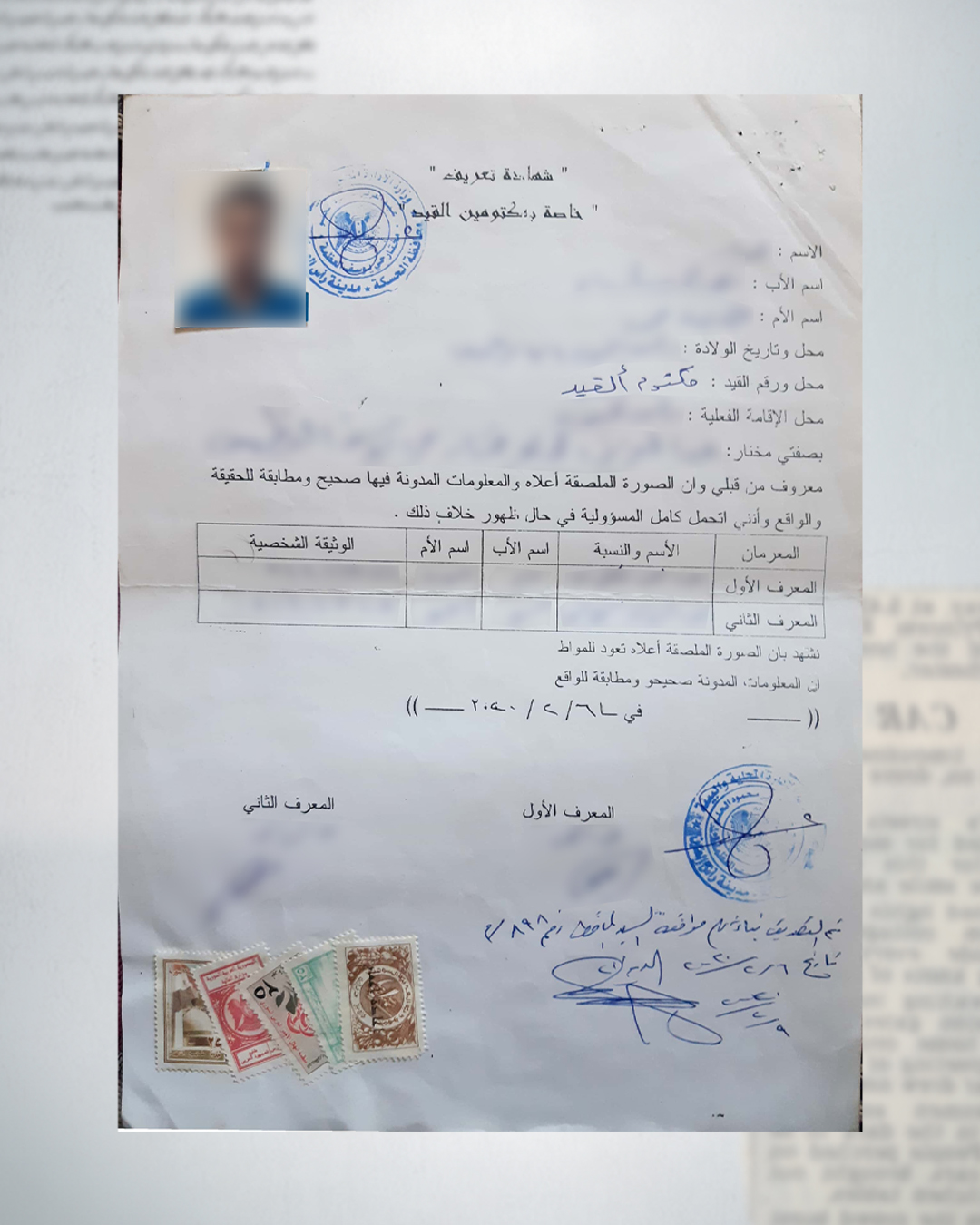
Identification certificate issued to the victims in the Maktumeen al-Qayd (“unregistered”) Category, typically provided by the neighborhood mukhtar (local headman), under the title “Identification Certificate for Maktumeen al-Qayd”, with two witnesses attesting to the holder’s identity. It serves only as proof of identity and does not establish legal status, leaving the “unregistered” entirely outside the civil registry, without a civil ID number or official recognition.
- Post 1963: Entrenchment and Expansion of Impact
With the change of power in 1963, discrimination became entrenched through spatial and identity-based policies, including projects such as the “Arab Belt”, which intensified administrative isolation as well as cultural and linguistic restrictions. Rather than addressing the underlying institutional flaw of the extraordinary Census, the issue was managed through limited, localized measures that produced no structural change. Consequently, what was initially a temporary administrative exception effectively evolved into a long-term system of exclusion.
- Decree Number 49 of 2011: A Partial Correction Window
On April 7, 2011, the Legislative Decree 49 opened the path to restoring citizenship for the “Ajanib al-Hasakah”, allowing tens of thousands to apply and many to regain their nationality. However, the decree did not cover “Maktumeen al-Qayd”. In practice, the process was marked by inconsistencies between directorates, the need for “security approvals,” and procedural complications that led to the dismissal of many applications without clear justification. While the decree remedied part of the problem, significant gaps and exclusions remained.
- Post 2011: The War Deepens the Vicious Circle
Years of armed conflict have further compounded the impact. Civil Registry Directorate locations were moved, and their services disrupted. Authorities proliferated, and their instructions often conflicted. Access became more difficult due to checkpoints and security risks. Many births occurred in areas outside government control or in countries of asylum; documents were lost during displacement, and applications were frequently subjected to “security approvals” rather than legal procedures. Together, these factors created new cases of legal non-existence and obstructed the restoration of citizenship.
Fourth: The Enduring Aftermath of Statelessness: A Record of Lived Experience, Not Assumptions
Statelessness is not purely the absence of an identity document; it represents a continuous system of complex deprivation affecting the “chain of rights” across generations. The following are not theoretical possibilities, but real experiences endured by victims in al-Hasakah and surrounding areas over decades—from birth to school, university, work, housing, mobility, and family formation, all the way to old age and social security.[7]
- Education: From an Empty Desk to a Delayed Diploma
Thousands of children were turned away from schools because their names were not registered and their families lacked valid documents. Many missed official exams and secondary or university certificates, and even in cases where nationality was later restored, years of interrupted education could not be fully recovered. This led to early school dropouts and the loss of skills that cannot be compensated by documents issued retroactively.
- Health: Incomplete Vaccinations and Missing Records
When births go unregistered, vaccination schedules are left incomplete, health checks cannot be officially documented, and chronic illnesses or disabilities remain unrecorded. This administrative gap has created long-standing care deficiencies affecting both children and adults.
- Employment and Livelihood: A Life in the Shadow Economy
Without a valid identity, regular employment contracts or social security contributions cannot be obtained. Thousands were pushed into informal jobs with lower wages and higher risks, while regulated professions— such as medicine, engineering, and law—remained largely inaccessible. Even when their status was later corrected, many continued to bear the long-term consequences of lost career opportunities.
- Ownership, Housing and Land: NO Documents, NO Security
Informal contracts without official registration, obstacles to inheritance, and difficulties in mortgaging or obtaining housing/agricultural loans have compounded housing insecurity and passed legal poverty from one generation to the next: a home’s rights can collapse at the first dispute or administrative change.
- Civil Status and Legal Identity: Today’s Request Turns into Months
Procedures that should have been resolved in days took months and years due to the intrusion of “security approvals”, varying implementation process between directorates, and the loss of documents during displacement. Even after their status was “corrected,” some identity cards carried numerical codes marking their administrative history—leaving a persistent obstacle that complicated future transactions.
- Mobility and Public Participation: Confined Spaces, Silenced Voices
Without verifiable identity or travel documents, people’s mobility was restricted to their neighborhood or district. Opportunities to study, seek medical treatment, or work in jobs requiring travel beyond the region were lost. At the civic level, victims were entirely excluded from voting and political representation, further widening the gap between citizens and the state.
- Impact Inherited Across Generations: The Cycle “No Registration → No Civil Status → No Nationality”
Children born without a valid birth certificate inherited legal uncertainty and a compounded chain of deprivation. Correcting a parent’s status was not enough, as the child often remained off the record. Even when nationality was granted, it brought little relief unless its rights were fully activated in schools, hospitals, and the labor market.
- Double Gender Impact on Women
Under the nationality law, which prioritizes the father’s lineage, mothers faced severe restrictions when the father’s identity was unknown or could not be confirmed. Women encountered additional obstacles in movement and access to civil directorates, bearing a double burden—both social and legal—when registering their children.
- The Most Vulnerable Children
Children among the stateless were the most at risk of school dropout, malnutrition, and child labor, particularly those born in asylum countries or from unregistered marriages. These cases are not isolated; they form a recurring pattern over the years.
- People with Disabilities and Groups with Seasonal Movement
The lack of civil registration further complicated both physical and procedural access to services for people with disabilities. For some nomadic clans, the traditional mobility of their communities clashed with fixed registration systems, causing registration gaps to recur repeatedly along their movement paths.
- The Security Dimension: When the Exception Overcomes the Rule
Requiring a “security approval” for purely civil transactions turned registration applications into a nightmare for many, leaving hundreds of files indefinitely labeled as “pending scrutiny.” In practice, the right to registration lost its substance and became a privilege that could be withheld arbitrarily.
- Brief Numerical Narrative (For Confirmation, Not Stripping)
Between 1962 and 2011, more than 517,000 people were recorded stripped or deprived from nationality, among them more than 171,000 were “Maktumeen al-Qayd’. After 2011, up to 375,000 people regained their citizenship, yet over 150,000—mostly Maktumeen—still lack a resolution. These are not mere numbers; each represents a life put on hold.
Fifth: Other Groups Affected by or at Risk of Statelessness
While the 1962 Census primarily affected the Kurds in al-Hasakah, the years of conflict since 2011, combined with longstanding legislative and administrative imbalances, have created a wider range of groups affected by—or vulnerable to—statelessness across different areas. This does not erase the historical oppression of the Kurds; rather, it highlights that the “right to nationality” is a universal human rights issue that extends beyond any single group.
The following reflects real hardships experienced by people in directorates, schools, hospitals, and checkpoints—not hypothetical scenarios.
- Children of Syrian Women from Foreign/Unknown Fathers:
In the early grades, the phrase “the child’s name is not in the registry” was heard repeatedly. Mothers were shocked to learn that their own names alone were not enough to grant their children a national ID number or passport. Without an official number, vaccinations were delayed, school enrollment was interrupted, and children remained for years with temporary ID cards that did not open all doors.
- Children Born in Asylum Countries or Outside Government-Controlled Areas:
Families returning with foreign-accredited birth certificates often could not register their children. As one clerk explained, “They cannot be entered now.” Consequently, the child remained officially “born abroad” and absent from the local registry. School enrollment and vaccinations were delayed, and the child’s records continued to circulate between offices.
- Unregistered or Unconfirmed Marriages (Customary, Early, or Sectarian Difference):
Although the marriage is recognized in practice, it is not officially documented. When children are born, authorities first request “proof of marriage.” Years can pass between courts, religious authorities, and Civil Status Directorates, leaving children growing up without a valid registry entry or a complete birth certificate.
- Nomadic Clans and Groups with Seasonal Movement:
Seasonal migration often collided with the limited operating hours of Civil Status offices. Local teams documented frequent missed appointments for birth registration and vaccinations, as families’ travel routes did not align with office schedules. As a result, these families left gaps in the official registry.
- Palestinians-Syrians (A Special Case):
Although their legal status as refugees remained unchanged, the reality on the ground was different: missing records, interrupted or transferred services, and administrative processes requiring documents that were difficult or impossible to obtain. Many experienced a vulnerability resembling statelessness when accessing services, despite their official status remaining the same.
- Children of Foreign Fathers “Combatants” or Unknown Identity or Fate:
In many cases, the question “where are the father’s documents?” blocked registration. The father’s absence or inability to prove his nationality left children in limbo: schools required civil registration, clinics requested unavailable documents, and daily life became burdened by administrative obstacles.
- Children Born of Sexual Violence (Rape) or to Unmarried/Unknown Fathers:
Fear of stigma led some births to go unreported at the time. When families later attempted registration, discriminatory notations or treatment often appeared in the records or in interactions with staff. Children carried the impact of this stigma into their classrooms and communities, not just into official statistics.
- Families of the Missing Persons:
Mothers and relatives of the missing found themselves without “legal status” allowing them to manage family affairs. Birth and inheritance transactions halted, and school and hospital decisions suspended because the judiciary had not ruled on the life or death of the missing person, leaving the family in a legal vacuum.
- Those Pending “Security Approvals”:
Complete registration files were placed on the “under consideration” board, leaving families waiting for months—or even years—without any explanation. For them, this was not a routine procedure, but a disruption of life: employment contracts delayed, surgeries postponed, and university registrations missed.
- Those Who Lost Documents Due to War, Fire, or Displacement:
Homes—and with them, all personal documents—were destroyed and burned. Without a family archive, proving basic facts became a battle relying on witnesses, old photographs, and scattered statements. Some families had to rebuild their lives from scratch in a country that required evidence lost in the bombardment.
- Those Returning from Asylum with Foreign Documents:
They returned with valid documents issued abroad, but these were “not recognized here” without lengthy administrative procedures. Marriages went unregistered, births remained unrecorded locally, and children continued to wait for registration to secure a permanent school seat.
These events, with their small and repeated details, demonstrate how the question of the “right to nationality” has moved beyond a narrow local issue to a national concern affecting a wide range of people. It is not merely a matter of gaps in regulations, but of everyday life disrupted—in schools, hospitals, streets, and homes.
Sixth: Legal Analysis
The issue is not solely a dispute over a missing document, but about the legal recognition of a human being. The right to nationality, protection from arbitrary deprivation, recognition of legal personality, and non-discrimination are not “interpretive luxuries,” but explicit obligations under international human rights law, generating legislative, administrative, and judicial duties for the state. This section places the scale of the law over the realities in al-Hasakah since 1962 and thereafter.
- International Framework: Rules That Cannot Be Overlooked
The analysis is based on four pillars: (1) Article 15 of the Universal Declaration of Human Rights (UDHR), affirms that everyone has the right to a nationality, and prohibits arbitrary deprivation of it; (2) The International Covenant on Civil and Political Rights, guarantees recognition of legal personality (Article 16), prohibits discrimination (Articles 2 and 26), and protects privacy and family life, which underpin civil registration (Article 17); (3) The Convention on the Rights of the Child (CRC), requires that the child shall be immediately registered after birth, to have a name, and to acquire a nationality, and prohibit statelessness, while making the child’s best interests a primary consideration; (4) The 1954 and 1961 Conventions Relating to the Status of Stateless Persons, which establish minimum definitions and standards for protection and the prohibition of the emergence of new situations, when the State is not a party of the Covenant. The principles of preventing childhood statelessness and prohibiting arbitrary deprivation are now well-established standards in the interpretation of the treaty bodies.[8] [9] [10] [11] [12]
- National Framework: The Law as Applied in Practice
Al-Hasakah Census (Decree 93/1962) was limited to a single province and carried out in “one single day,” with a requirement to prove residency prior to 1945. This condition disregarded the historical mobility of the population and the limitations of the Civil Registry at the time.
As a consequence, two legal categories were created: “Ajanib al-Hasakah/foreigners who hold red cards in their own homeland, and Maktumeen al-Qayd/those off the records. Later, Decree 49/2011 partially addressed the problem by restoring nationality for many Ajanib, but it left the issue of the “Maktumeen” unresolved and subjected applications to security requirements and inconsistencies between directorates. Two gaps remained at the core of nationality law: the predominance of paternal lineage (discriminating against mothers in passing nationality) and the absence of safeguards to prevent statelessness at birth.
- Conflict Map: National vs. International:
The most prominent contradiction is fourfold: First, the “one day” procedure, combined with the excessive proof requirements, effectively discriminated against poorer or more mobile groups, violating the principles of equality and non-discrimination. Second, sorting into two categories -“Ajanib” and “Maktumeen”- undermined recognition of legal personality and the rights derived from it, including access to education, health, and employment. Third, requiring “security approvals” in purely civil transactions infringes on fundamental rights and fails the tests of necessity and proportionality. Fourth, the inequality between men and women in passing nationality, along with the absence of safeguards preventing statelessness at birth, conflicts with the Convention on the Rights of the Child (CRC), CEDAW, and international standards for reducing statelessness.
- The Test of “Necessity and Proportionality”: Were the Measures Justified?
The objective declared in 1962 was to “purify the records and control immigration”. But does this justify a one-day Census with proof requirements that do not take into account the reality? Under international standards, the registration shall be accessible, easy and non-discriminatory. When the administrative design renders compliance almost impossible for a large scale, then the action is disproportionate, and the discriminatory effect becomes legal evidence of unlawfulness. The same applies today on “security approvals” in the Civil Status: they are not necessary to achieve a legitimate interest, and their harm exceeds any alleged benefits.[13]
- Due Diligence Obligations for the State: Prevention, Protection, and Redress
Under international law, the state is bound by three interrelated obligations:
- Prevention: Closing legislative gaps to prevent statelessness, including explicit provisions protecting children from statelessness, ensuring equality between men and women in passing nationality, and prohibiting arbitrary deprivation.
- Protection: Eliminating unnecessary restrictions, such as security approvals, standardizing procedures across all directorates, and providing effective and immediate appeal mechanisms.
- Reparation: Officially recognizing victimization, establishing collective remedies, offering symbolic or service-based compensation, and ensuring guarantees of non-recurrence.
This “triple” obligation is not a moral recommendation but a legal requirement whenever widespread harm results from actions attributable to the authorities.
- Legislative Alignment Pathways: How Can the Legal Gap Be Bridged?
The key lies in the Nationality Law: by establishing a rule preventing statelessness at birth—any child born in the territory who does not acquire another nationality automatically acquires Syrian citizenship—ensuring full equality between men and women in passing on nationality to their children, and setting strict safeguards for any revocation of nationality, including narrow justifications, a reasoned judicial decision, the right to appeal, and prohibitions on retroactive or collective deprivation. These adjustments transform the law from a potential source of harm into a protective framework.
- Procedural Alignment Paths: How Can the Right Be Practically Accessible?
Reforming the Civil Status system entails removing security approvals from civil transactions and adopting “reasonable evidence”—such as witness statements, school and health records, and religious or local documents—to establish facts when official papers are lost. This should be complemented by assigning unique identifiers to link directorates, setting maximum deadlines for decisions, and recognizing birth and marriage documents issued abroad through clear accreditation procedures and mutual recognition agreements where feasible. Without compassionate and rational administration, even a well-designed law can turn into a burden.
- Available Judiciary and Effective Oversight: The Path to Individual Fairness
Compliance with international standards requires specialized chambers for nationality and civil status, a simplified procedure, and free legal assistance, alongside a unifying jurisprudence and an independent complaints mechanism for victims of administrative discrimination, capable of binding decisions and compensation. A good law without an accessible becomes advice, not a right.
- Available Judiciary and Effective Oversight: The Path to Individual Fairness
Compliance with international standards requires specialized chambers for nationality and civil status, a simplified procedure, and free legal assistance, alongside harmonized jurisprudence and an independent complaints mechanism for victims of administrative discrimination, capable of issuing binding decisions and providing compensation. Even a sound law becomes mere advice, not a right, without an accessible judiciary.
Seventh: Practical Recommendations in the Context of Syrian Transformations and the Transitional Justice Process
These recommendations are grounded in the understanding that statelessness is both a structural legacy dating back to the 1962 Census and a transitional justice issue, touching on the right to legal recognition, equality, reparation, and guarantees of non-recurrence. They are formulated across integrated levels: legislative, executive/administrative, judicial/oversight, societal, and international.
- Recognition, Truth and Memory
- An official recognition that the 1962 Census caused mass violations and deprived tens of thousands of their citizenship, coupled with a clear political commitment to remedy the harm.
- Preparing a national truth report on the Census’s statistics and subsequent policies (including the “Arab Belt”, cultural/linguistic restrictions, and administrative discrimination) through an independent committee that listens to victims and opens relevant archives.
- Protecting archives: halting any destruction or alteration of civil status records, Census books, and executive decrees, while initiating secure digitization with strong privacy safeguards.
- Reparation (Immediate, Transitional and Structural)
People need more than citizenship restored on paper. Reparation means formal recognition of their victimization, exemptions from accumulated fees and fines, and practical priority in accessing basic services, such as education, healthcare, and official documents. Reparation is not a favor—it is the rectification of the long-term consequences of a public wrong.
- Guarantees of Non-Recurrence (Legislation and Institutions)
- In the Nationality Law: Enacting a rule prohibiting statelessness at birth, complete equality between genders in transferring nationality, prohibiting arbitrary deprivation, allowing it only through a reasoned judicial decision subject to appeal, while banning retroactive and collective deprivation.
- In Civil Status and Administration: Abolishing “security approvals” for civil transactions, accepting reasonable evidence when documents are missing, digitizing and linking registry offices, and setting clear deadlines for decisions.
- In the Judiciary and Oversight: Establishing specialized chambers for nationality and civil status cases with simplified procedures and free legal assistance; and create an independent complaints mechanism with binding authority and the power to award compensation.
- A Transitional Justice Process Specialized in Addressing Statelessness
- Integrating the issue into political roadmaps as a widespread violation that requires redress, along with mechanisms for periodic accountability.
- Bringing justice closer to the people: deploying mobile teams for registration and documentation in villages, camps, and hard-to-reach areas; and organizing field days where on-site civil transactions can be completed.
- Protecting children: ensuring immediate registration of births, facilitating record-based family reunification inside Syria, and establishing a dedicated communication line for cases involving unregistered marriages or unknown paternity—always prioritizing the best interests of the child.
- Stakeholder Roles
- Legislative and Executive Authority: Amending the Nationality and Civil Status Law, introducing a specific provision to regularize the status of the “Maktumeen al-Qayd”, and allocating budgets for digitization, mobile teams, and exemptions.
- Judicial Authority: Establishing specialized directorates and expedited courts for civil status matters, and provide training to judges on non-discrimination standards and children’s rights.
- Security Parties: Removing the issue entirely from the security cycle. Any verification should only be carried out through a reasoned judicial order in specific cases, with accountability for any administrative interference.
- Civil Society Organizations and Victims’ Associations/Initiatives: Providing mobile legal clinics, systematically documenting personal narratives, conducting awareness campaigns on registration, ensuring victims’ representation in relevant committees, and establishing referral mechanisms for women, children, and survivors of violence.
- United Nations and Donors: Providing flexible funding for digitization, mobile teams and documentation, offering technical support for criteria of accepting proofs, and inclusion the “risk of statelessness” as a key protection indicator in education, health and protection programs.
Ending the legacy of 1962 is not a matter of compiling documents—it is about restoring citizenship. The cycle of statelessness can be broken within a single generation if recognition and truth are paired with immediate reparations, meaningful legislative, judicial, and administrative reforms, and robust guarantees of non-recurrence. Success depends on clear political will, streamlined procedures, transparency, and genuine representation of victims. When families no longer need to gather “evidence of their existence” and can instead focus on collecting photos of schools, clinics, and workplaces, the issue will have shifted from an endless bureaucratic struggle to a fully realized right, integrated into daily life.
To view the full paper (22 pages) in PDF format, please click this link.
————————–
[1] “Syrian Citizenship Disappeared” How the 1962 Census destroyed stateless Kurds’ lives and identities”, report by Syrians for Truth and Justice (STJ), issued on September 15, 2018. Accessed on September 27, 2025. https://stj-sy.org/en/745/
[2] Ibid
[3] Statelessness in Syria: An Enduring Dilemma, a report by STJ, issued on October 5, 2022. Accessed September 27, 2025. https://stj-sy.org/en/statelessness-in-syria-an-enduring-dilemma/.
[4] The “Arab Belt” Project in Syria: 51 Years of Structural Discrimination and Denial of Justice, A Facts Sheet Marking the Passage of 51 Years Since the Launch of the Discriminatory Project on June 24, 1974, published by Synergy Association on June 24, 2025. Accessed September 27, 2025. https://hevdesti.org/en/the-arab-belt-project-in-syria-51-years-of-structural-discrimination-and-denial-of-justice/
[5] Syrian Citizenship Disappeared: How the 1962 Census destroyed stateless Kurds’ lives and identities, a report by STJ, published on September 15, 2018. Accessed September 27, 2025. https://stj-sy.org/en/745/.
[6] Also look “Ajanib Syria (the Bidoon), A Ticking Bomb”, Elav Website, December 29, 2007 (Archive). It includes an overview of the career of Tawfiq Nizam al-Din and his brother Abdul Baqi Nizam al-Din and the positions they both held, with reference to the context of the decisions to stripping nationality in 1962 against Syrian Kurds. Accessed: September 27,2025). https://elaph.com/Web/NewsPapers/2007/12/291884.html?tsectionarchive=AsdaElaph
[7] Human Rights Watch: “The Silenced Kurds: Documenting the history of stripping and its practical impacts on access to education/registration, with references to security requirements, October 1, 1996. To read the whole report (https://www.hrw.org/report/1996/10/01/syria-silenced-kurds). Accessed September 27, 2025.
[8] The Universal Declaration of Human Rights, UN official website. To read the whole Declaration, https://www.un.org/en/about-us/universal-declaration-of-human-rights. (Last accessed September 27, 2025).
[9] The International Covenant on Civil and Political Rights, UN official website. To read the whole declaration: https://www.ohchr.org/en/instruments-mechanisms/instruments/international-covenant-civil-and-political-rights (last accessed: September 27, 2025).
[10] Convention on the Rights of the Child, UN. To read the whole Covenant: https://www.ohchr.org/en/instruments-mechanisms/instruments/convention-rights-child (last accessed September 27, 2025).
[11] The United Nation Human Rights Office of the High Commissioner, “Convention relating to the Status of Stateless Persons”, 1954. To read the Convention: https://www.ohchr.org/en/instruments-mechanisms/instruments/convention-relating-status-stateless-persons (last accessed September 27, 2025)
[12] The United Nation Human Rights Office of the High Commissioner, “Convention on the Reduction of Statelessness” 1961, to read the who Convention, https://www.ohchr.org/en/instruments-mechanisms/instruments/convention-reduction-statelessness (last accessed September 27, 2025)
[13] Guidelines on Statelessness No. 4 (2012)– UNHCR: “Ensuring Every Child’s Right to Acquire a Nationality through Articles 1-4 of the 1961”- A full text on Refworld, with an alternative copy on UNHCR website. For reading the whole report, https://www.refworld.org/policy/legalguidance/unhcr/2012/en/105120. Accessed September 27, 2025.