
Introduction:
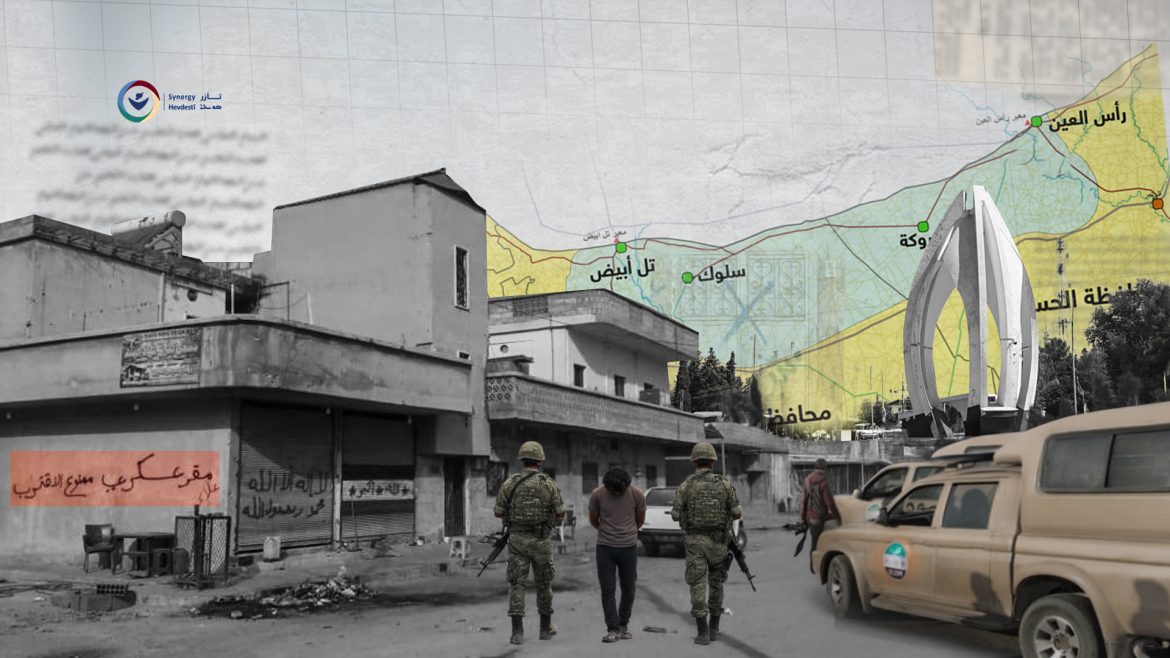
Every year on 9 October, the displaced residents of Ras al-Ayn/Serê Kaniyê and Tall Abyad/Girê Spî commemorate the fall of their two cities under Turkish occupation, carried out with the participation of Syrian armed factions affiliated with the Syrian National Army (SNA), following the military offensive known as “Peace Spring Operation”, which was promoted under the pretext of creating a “Safe Zone”. Yet from the very first days, the reality on the ground revealed catastrophic consequences: erosion of security and stability, and the continuation of grave human rights violations amid an effective absence of the rule of law and the lack of any effective accountability mechanisms.
Despite the major political and security transformation the country has undergone since the fall of the “Assad regime” on 8 December 2024, and the formation of the Transitional Government—which were accompanied by the return of more than 1.76 million Internally Displaced Persons (IDPs) to their areas—over 150,000 of the original inhabitants of Ras al-Ayn/Serê Kaniyê and Tall Abyad/Girê Spî remain forcibly displaced. Around 40,000 of them continue to live in deteriorating humanitarian conditions in camps and collective shelters that lack UN recognition and support. They remain unable to return due to ongoing violations committed by SNA factions, under the watch, and in some cases with the participation, of Turkish forces.
Over the past six years, systematic and widespread violations of the International Humanitarian Law (IHL) and the International Human Rights Law (IHRL) have been perpetrated by Turkish forces and the Syrian factions they back. These violations include extrajudicial killings, summary executions, arbitrary arrests, torture and other forms of ill-treatment, in addition to widespread seizure of property belonging to original residents—Kurds, Arabs, Armenians, Syriacs/Assyrians, Yazidis, Chechens, and others.
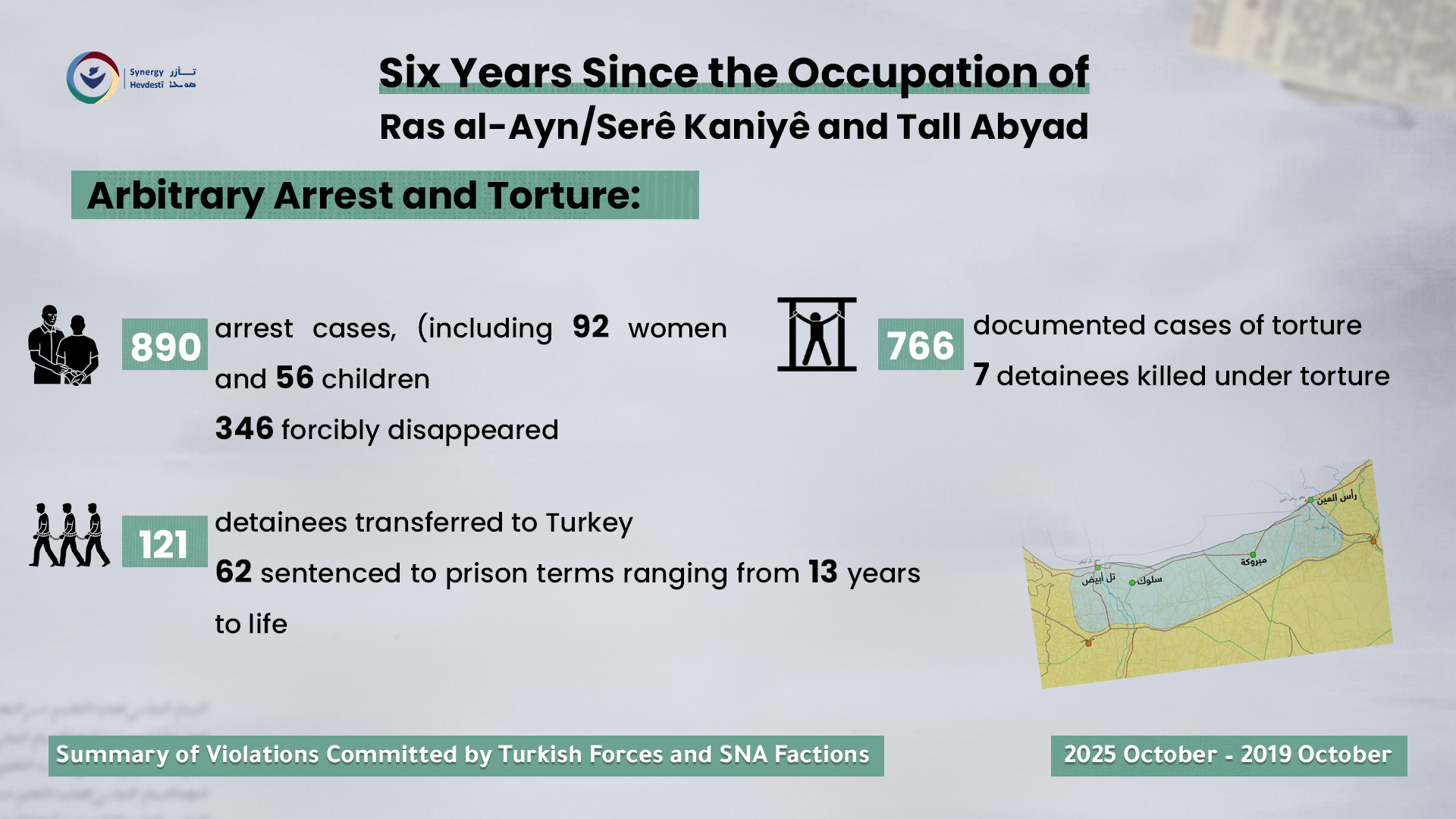
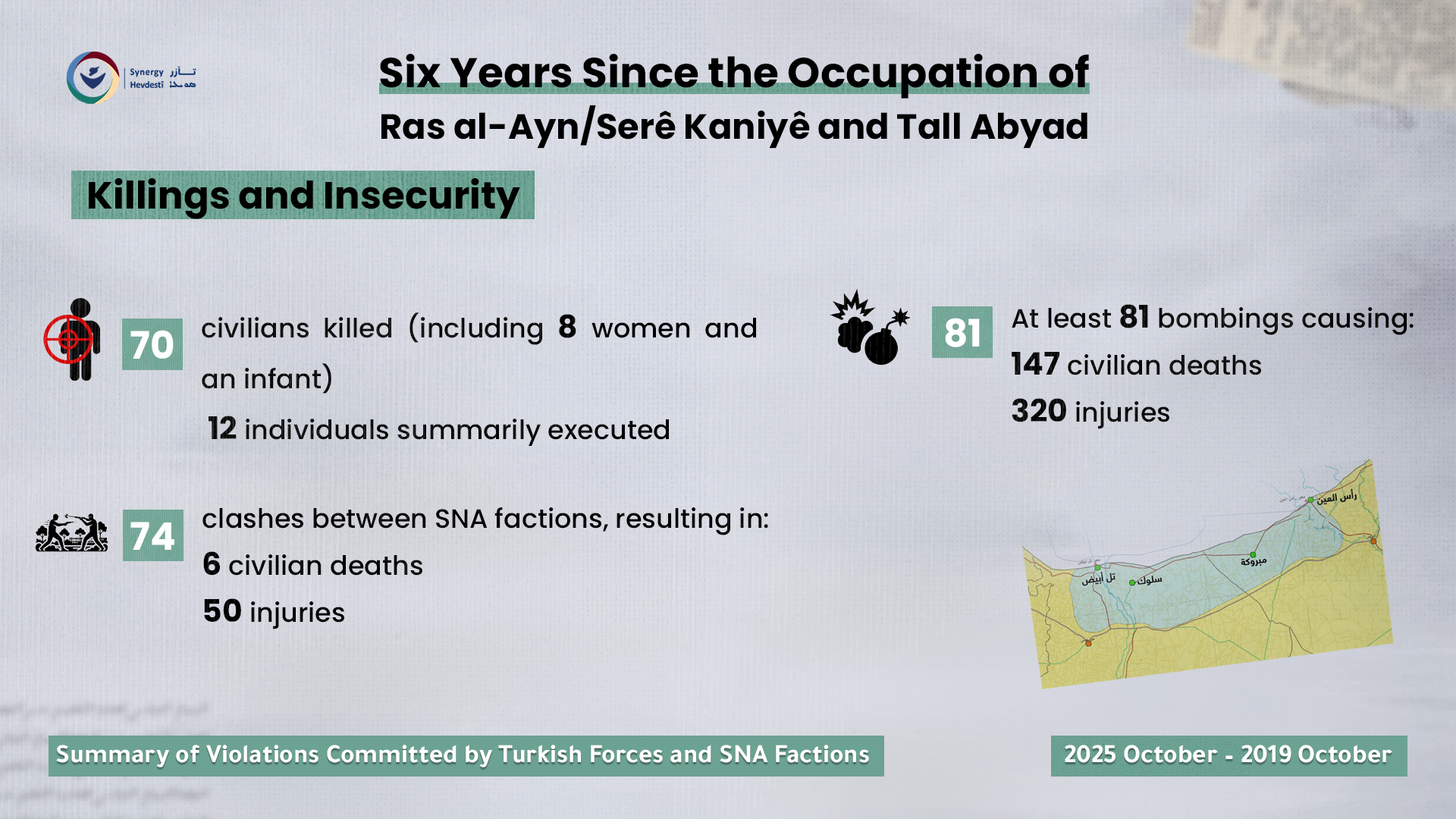
Between October 2019 and October 2025, Synergy Association for Victims documented the killing of 70 civilians—including 8 women and an infant—the arrest of at least 890 persons, including 92 women and 56 children, and the torture of 766 detainees, 7 of whom died as a result. The Association also recorded 346 cases of enforced disappearance, the fates of whom remain unknown. During this period, the area further witnessed 81 bombings that killed 147 civilians and injured 320 others, as well as 74 armed clashes/internal conflicts among SNA factions, resulting in the deaths of 6 civilians and injuries to more than 50 others.
Alongside these developments, profound demographic changes have undermined one of the key pillars of diversity in the two areas. More than 85% of the population of Ras al-Ayn/Serê Kaniyê was forcibly displaced; the Kurdish population declined from roughly 70,000 people to fewer than 50 individuals; the presence of Armenians, Syriacs/Assyrians, and Yazidis dwindled to just a handful. The Arab presence was also noticeably affected. In Tall Abyad/Girê Spî, the Kurdish presence contracted to a few families after having constituted close to 30% of the population.
Despite growing hopes following 8 December 2024 for the gradual return of displaced persons to several Syrian areas (Rural Damascus, Idlib, Homs, Aleppo, among others), such returns did not include Ras al-Ayn/Serê Kaniyê and Tall Abyad/Girê Spî (nor Afrin and other areas). These regions have remained excluded from the conditions necessary for a voluntary, safe, and dignified return that safeguards rights and dignity, due to the persistence of violations and the absence of effective guarantees for the restitution of housing, land, property, and protection.
Return of the Displaced: A Declared Commitment, Yet Ongoing Obstruction
Upon signing the 10 March 2025 Agreement between the Syrian Transitional Government and the Syrian Democratic Forces (SDF), Clause V enshrined a moral and political commitment to the return of all displaced persons to their towns and villages, and their protection ensured by the Syrian state. But turning this commitment into reality has lagged far behind six years of suffering: there are no safe access arrangements, no protective environment, and no effective mechanisms for reclaiming homes or property.
Seven months after the agreement, the absence of tangible progress regarding the displaced from Ras al-Ain/Serê Kaniyê and Tell Abyad/Girê Spî underscores the urgent need to prioritize a safe, dignified, and fair return—irrespective of political bargaining or temporary security arrangements
In practice, both areas remain under the control of Turkish forces and their allied factions—formally incorporated into the structure of the new Syrian Ministry of Defense, yet effectively supported and directed by Ankara. This reality has left the Transitional Government with limited real authority in these areas, while no concrete measures have been taken to secure housing and property rights or to prepare the conditions for a safe return.
The impact of these violations extends far beyond the two areas, affecting the entire al-Hasakah Governorate through the weaponization of water. Since Turkish control of the area in October 2019, Alouk Water Station, East of Ras al-Ayn/Serê Kaniyê has been deliberately and repeatedly shut down, depriving around 800,000 residents of al-Hasakah and its countryside of potable water and sanitation services—a flagrant violation of the population’s right to safe drinking water and adequate sanitation.
Legal Framework and Responsibilities
- The Syrian Transitional Government
The Transitional Government bears a direct responsibility towards protecting the fundamental rights of original residents and displaced by ensuring their security, preventing violations, and conducting effective, independent investigations that hold perpetrators accountable and provide redress to victims. Simultaneously, it must create conditions for a safe and dignified return through reliable access arrangements, guarantees of individual and collective protection, and expedited mechanisms for the restitution of housing, land, and property (HLP).
The Syrian Government must also ensure effective administrative and service access to Ras al-Ayn/Serê Kaniyê and Tall Abyad/Girê Spî, in coordination with the Autonomous Administration of North and East Syria (AANES) and relevant regional and international actors. It should provide essential services—including water, healthcare, and education—without discrimination, and integrate the violations committed into transitional justice processes. These processes should encompass victim recognition, truth-seeking, reparations, and guarantees of non-recurrence, in accordance with Syria’s human rights obligations. Moreover, local residents should be empowered to manage their own affairs through inclusive, elected local structures that foster trust and reinforce the rule of law.
- The Turkish Occupying Authorities:
Turkey, by virtue of its effective control, is an occupying power and therefore is obligated under Article 43 of the 1907 Hague Regulations and the 1949 Fourth Geneva Convention to take all feasible measures to restore public order and safety, protect the civilian population, and ensure respect for the IHL and human rights law. Ankara also committed, under the Ceasefire Agreement with the United States (17 October 2019), to safeguard human rights and the safety and welfare of the population and to avoid harm to civilians and civilian infrastructure.
Nevertheless, no concrete and effective measures have been taken to halt violations or protect civilians. The lack of accountability has contributed to the spread and persistence of abuses. In the absence of conditions for voluntary, safe, and dignified return consistent with UN standards, the two areas remain currently unfit for return—underscoring the need to place their situation squarely on the national agenda for transitional justice and reparations.
Ending the Turkish occupation of Ras al-Ayn/Serê Kaniyê and Tall Abyad/Girê Spî; ensuring a safe and dignified return for the displaced; providing reparation and compensation; holding perpetrators accountable; and guaranteeing non-recurrence are not merely political demands. They are legal imperatives essential to achieving a comprehensive and sustainable peace that restores rights to their holders and protects their dignity.
Ras al-Ayn/Serê Kaniyê and Tall Abyad/Girê Spî: Areas Rife with Human Rights Violations (2019–2025)
Since October 2019, the areas of Ras al-Ayn/Serê Kaniyê and Tall Abyad/Girê Spî—under the control of Turkish forces and SNA factions—have witnessed systematic and widespread patterns of violations against original inhabitants, including Kurds, Arabs, Armenians, Syriacs/Assyrians, Yazidis, Chechens, and others.
These violations include extrajudicial killings; arbitrary arrest and enforced disappearance; torture and ill-treatment; looting and confiscation of property; forced displacement; obstruction of civilian returns; alongside policies of Turkification and demographic change. The absence of accountability has enabled the persistence of these abuses, further exacerbating the suffering of local communities.
Synergy Association for Victims based its documentation—covering developments up to October 2025—on a network of field researchers; in-person interviews with victims, survivors, their families, and eyewitnesses; as well as verification against publicly available sources (open-source information) and the triangulation of material evidence and corroborating indicators. All work adhered strictly to standards on informed consent, data protection, and trauma sensitivity. The figures presented reflect only what could be documented and verified; actual numbers are likely higher due to access constraints and the continued commission of violations.
Killings and Arbitrary Detention:
Since the occupation of Ras al-Ayn/Serê Kaniyê and Tall Abyad in October 2019, Synergy has documented the killing of 70 civilians—including 8 women and an infant—and the arrest of at least 890 persons, including 92 women and 56 children, by Turkish forces and Turkish-backed SNA factions.
According to the documentation, 766 detainees were subjected to torture, 7 of whom died as a result. Synergy also recorded 346 cases of enforced disappearance whose fates remain unknown. In addition, Turkey was found to have transferred at least 121 detainees from northeast Syria into its territory, 62 of whom received arbitrary sentences ranging from 13 years to life imprisonment.
Forced Displacement and Property Seizure:
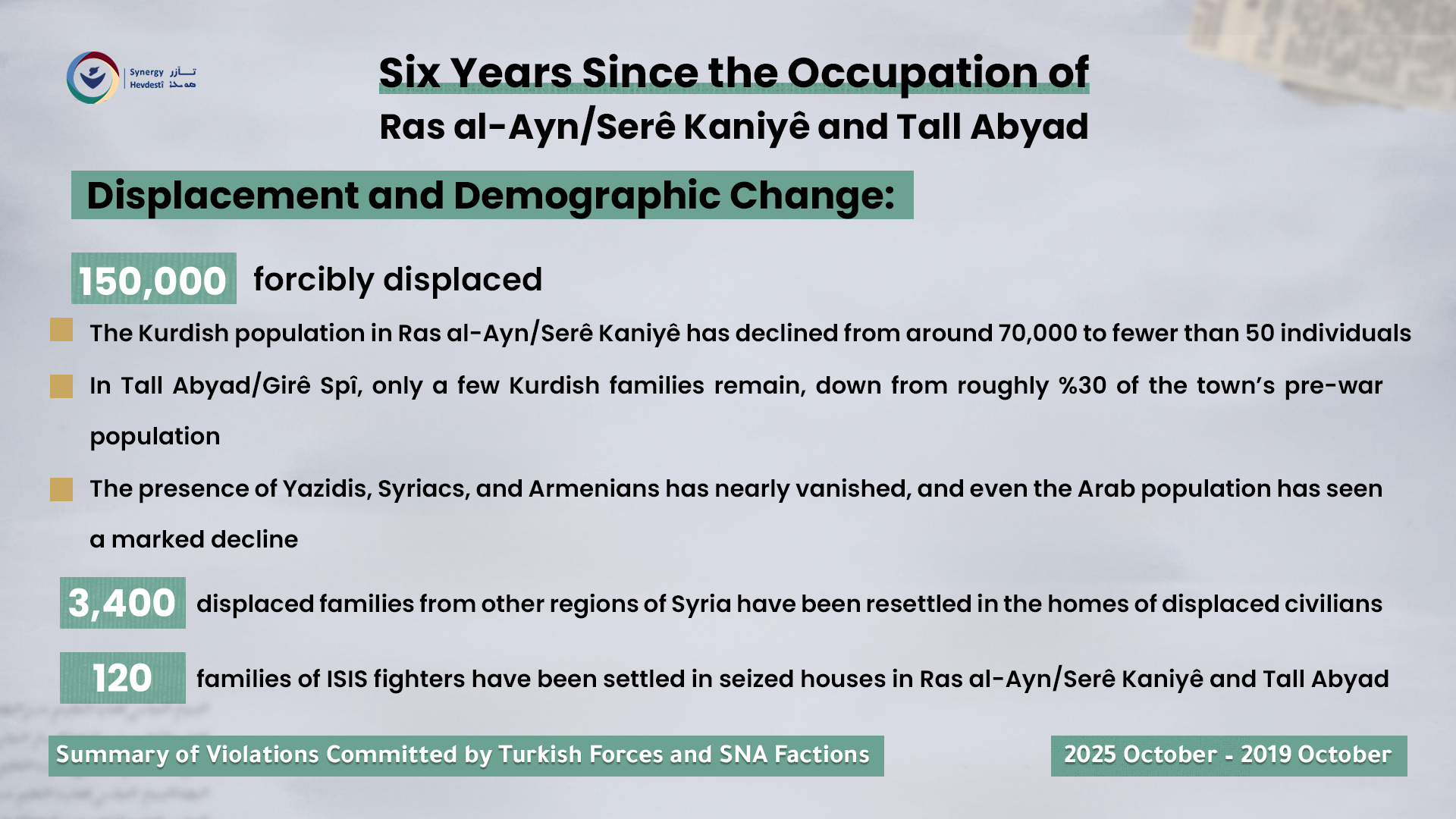
The occupation has thus resulted in the continued displacement of over 150,000 original residents from Ras al-Ayn/Serê Kaniyê and Tall Abyad/Girê Spî, while more than 3,400 displaced families from other parts of Syria have been settled in the homes of those forcibly uprooted.
Synergy verified that at least 120 families—comprising women and children of Islamic State (ISIS) fighters, the majority of whom are Iraqi—have been housed in seized residences within Ras al-Ayn/Serê Kaniyê and Tall Abyad/Girê Spî.
More than 85% of Ras al-Ayn/Serê Kaniyê’s residents remain forcibly displaced. The Kurdish community there has been reduced from approximately 70,000 people to fewer than 50 individuals; the presence of Armenians, Syriacs/Assyrians, and Yazidis has dwindled to a handful of persons; and the Arab presence has also been noticeably affected. In Tall Abyad/Girê Spî, the Kurdish presence has shrunk to a few families, after previously constituting close to 30% of the population.
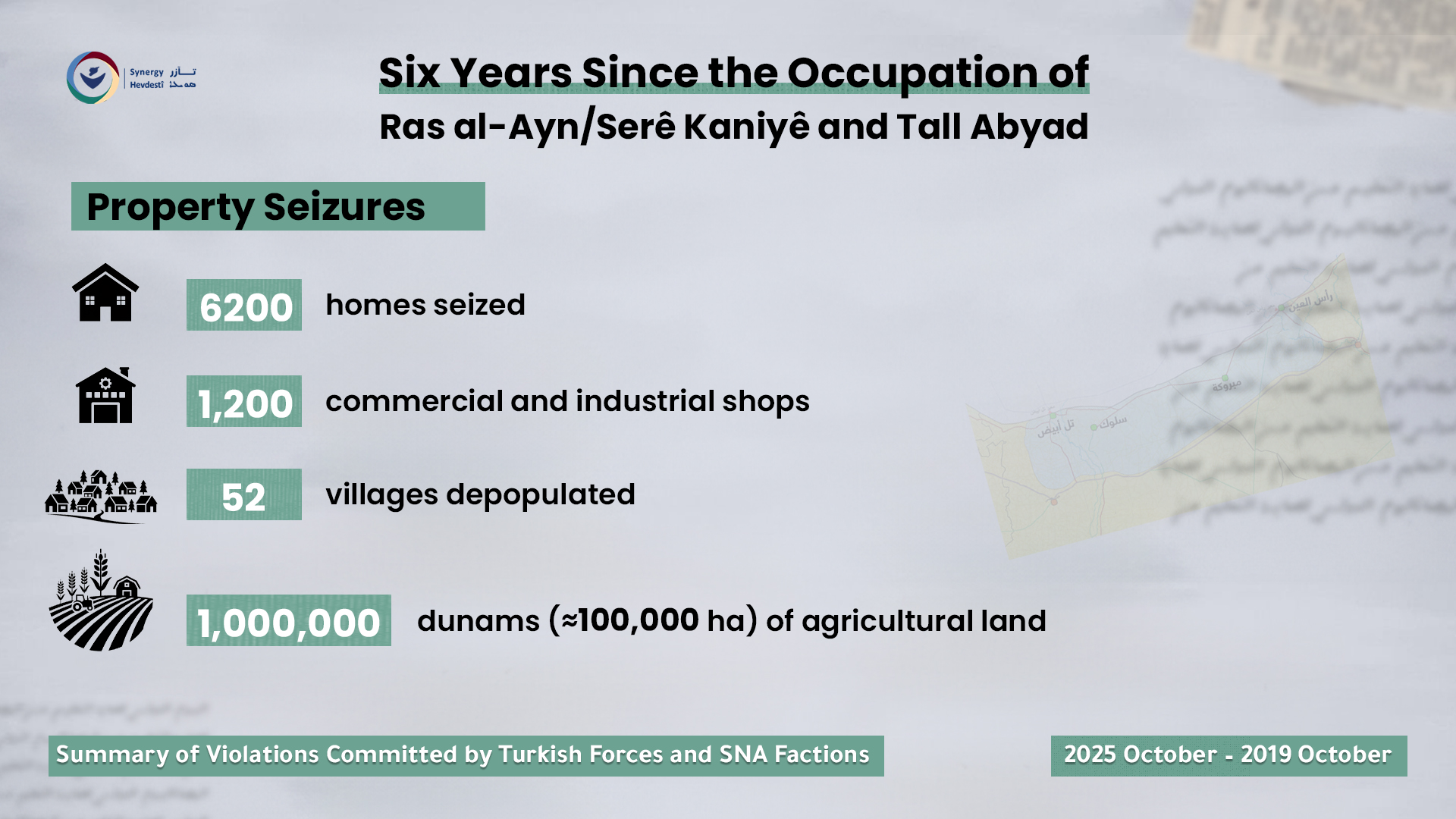
Synergy also documented the confiscation of more than 6,200 homes, 1,200 commercial and industrial premises, and approximately one million dunams (100,000 hectares) of agricultural land, in addition to the depopulation of 52 villages of their original inhabitants.
From a humanitarian perspective, approximately 40,000 displaced individuals are living in dire conditions in camps and collective shelters that fail to meet even minimum standards and lack UN recognition or support.
These include: Washo Kani (al-Tuwaina), which hosts 16,250 people (2,260 families); Serê Kaniyê (al-Tala’i), which hosts 16,691 people (2,615 families) in rural al-Hasakah; and Tall al-Samen, which hosts 6,960 people (1,247 families) in Raqqa.
Although Rukban Camp (housing around 10,000 IDPs) was fully closed on 7 June 2025, and roughly 130 smaller camps in Idlib were shut down after 8 December 2024, the displaced from Ras al-Ayn/Serê Kaniyê and Tall Abyad/Girê Spî continue to live in tents, collective shelters, towns, and villages across North and East Syria, awaiting a safe and dignified return.
Proliferation of Arms and Insecurity:
Contrary to the Turkish narrative of establishing a “Safe Zone,” no genuine measures were taken to ensure security and public safety. Turkish forces also turned a blind eye to infighting among SNA factions and to the spread and use of weapons among civilians amid a vacuum of accountability and continued impunity.
Between 9 October 2019 and 9 October 2024, Ras al-Ayn/Serê Kaniyê and Tall Abyad/Girê Spî experienced at least 81 bombings, resulting in 147 civilian deaths—including women and children—and 320 injuries, alongside 74 incidents of intra-factional fighting that killed 6 civilians and injured over 50 others. These figures highlight a lawless security environment, making a safe return in line with international standards unattainable to date.
Recommendations:
Synergy Association for Victims stands in solidarity with the displaced of Serê Kaniyê/Ras al-Ayn and Tall Abyad/Girê Spî, and with all victims and displaced persons in Syria. The Association calls upon the international community, the Syrian Transitional Government, the Autonomous Administration, the Turkish Government, and all relevant parties to:
- Guarantee Return: Ensure the safe, dignified, voluntary, and immediate return of all persons displaced from Ras al-Ayn/Serê Kaniyê and Tall Abyad/Girê Spî, in accordance with international protection standards.
- Restore Rights and Property: Restore the rights of affected individuals, including the return of arbitrarily seized property, and establish effective mechanisms for compensation and reparations.
- Transitional Justice: Integrate the violations committed in the two areas into national transitional-justice programs, ensuring recognition of victims, truth-seeking, accountability, reparation, and guarantees of non-recurrence.
- Political Guarantees and Local Governance: Ensure that any negotiation process includes explicit guarantees for the return of the displaced, and empower local residents to manage their communities through inclusive, elected governance structures that foster trust and uphold the rule of law.
- Water Resources Protection: Safeguard water and natural resources from political manipulation, ensure the uninterrupted operation of the Alouk Water Station, and refrain from using water as a tool of leverage against local communities.
- Recovery and Reconstruction: Include Ras al-Ayn/Serê Kaniyê and Tall Abyad/Girê Spî in early-recovery and reconstruction plans, without exclusion from essential investments and services, in order to restore conditions for a dignified life and strengthen local stability.
To view the full report in PDF format, please click this link.