
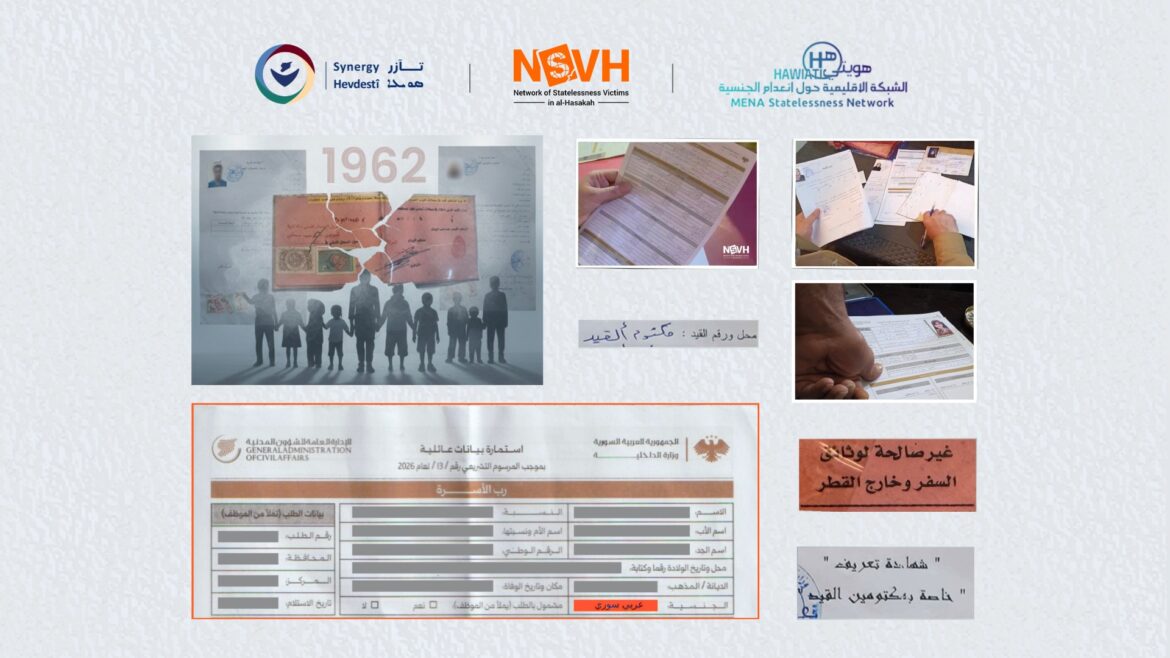
Executive Summary
Decree No. 13 of 2026 marks a long-awaited step toward addressing one of Syria’s most protracted and complex statelessness situations: the deprivation of nationality affecting tens of thousands of Syrian Kurds as a result of the 1962 Exceptional Census in al-Hasakah Governorate. The consequences of these measures have extended across successive generations, affecting hundreds of thousands of people over more than six decades, during which they were denied legal recognition and equal access to fundamental rights and essential services.
As part of efforts to remedy this longstanding injustice, Article 4 of Decree No. 13 of 2026 repeals the exceptional measures arising from the 1962 Exceptional Census and provides for the restoration of Syrian nationality to Kurdish individuals affected by those measures, including Unregistered Persons (Maktoumeen al-Qayd), while affirming their full equality in rights and obligations as Syrian citizens. Committees tasked with receiving nationality applications from Kurdish Unregistered Persons began accepting submissions on 6 April 2026 for an initial period of thirty days. Following calls from local communities and human rights actors, the application period was subsequently extended by an additional fifteen days to enable a greater number of eligible individuals to benefit from the process.
According to an announcement issued by the Ministry of Interior on 22 May 2026, the official committees received 2,892 family applications, including legal authorizations covering 10,516 individuals. These figures reflect both the accumulated demand for nationality restoration and the strong willingness of affected persons to regularize their legal status. At the same time, estimates by the Network of Statelessness Victims in al-Hasakah indicate that significant numbers of persons eligible under the Decree remain outside the registration process, particularly refugees and Syrians residing in neighbouring countries and across Europe, whose numbers are expected to amount to several thousand families.
On 11 June 2026, the General Administration for Civil Affairs announced the completion of the application submission process and the commencement of the review of applications by the competent committees, as a preparatory step toward completing the nationality restoration process. It also announced the scheduling of applicant interviews and granted an additional deadline for persons residing abroad whose applications had been submitted by relatives, enabling them to complete the required procedures.
This report is based on field monitoring, interviews with Unregistered Persons (Maktoumeen al-Qayd) and their family members inside and outside Syria, observations from registration centres, and a legal analysis of the procedures in place. It assesses the opportunities and challenges associated with the implementation of Article 4 of Decree No. 13 of 2026 concerning the restoration of Syrian nationality to stateless Kurds affected by the exceptional measures linked to the 1962 Census, and evaluates the extent to which current procedures are able to reach all eligible persons in a fair, effective, and inclusive manner.
The consequences of statelessness have affected nearly every aspect of daily life, including access to education, healthcare, freedom of movement, property rights, and civil registration. Those affected have faced persistent barriers to obtaining documentation, accessing public services, and managing legal and economic affairs, with particularly severe consequences for women, children, and generations born into statelessness.
Interviews and field observations revealed a sense of hope among many participants, particularly compared with previous initiatives that were often marked by complexity or limited results. Participants reported that registration procedures were generally more accessible and that officials in several centres demonstrated cooperation and organization, helping to build confidence in the process and renew hope for the restoration of rights long denied.
At the same time, monitoring findings identified several practical and procedural challenges that may affect the inclusiveness, fairness, and effectiveness of the process. These included difficulties in proving residence or family ties, particularly in situations of displacement, lost documentation, or differing legal classifications within the same family. The report further documented cases in which Kurdish applicants were recorded as “Syrian Arabs” in official application forms before this classification was discontinued and replaced with “Syrian” following objections from affected persons. The situation of Syrians residing abroad remained a major concern, given the requirement for personal attendance at registration centres and the associated financial and logistical burdens.
Interviews also revealed uncertainty regarding the stages following registration, including application reviews, personal interviews, expected decision timelines, and procedures for obtaining civil documentation after approval. Limited public information contributed to anxiety and uncertainty among many applicants and their families.
The report further documented variations in implementation across registration centres, including differences in the information provided to applicants, the documents accepted, and the organization of procedures. These findings highlight the need for clear and consistently applied implementation guidelines. Interviews also recorded instances of financial exploitation, varying fees for required documents, and the circulation of inaccurate information and unlawful offers targeting Syrians residing abroad.
The report concludes that Article 4 of Decree No. 13 of 2026 represents a historic opportunity to address one of Syria’s most enduring and complex statelessness situations. Its success, however, will depend on the ability of the relevant authorities to ensure equal access to procedures for all eligible persons, enhance transparency, promote consistent implementation, and address the barriers faced by persons residing abroad, older persons, and persons with disabilities.
Addressing the legacy of more than six decades of statelessness requires more than the formal restoration of nationality. It requires measures to resolve the accumulated legal, civil, and administrative consequences of statelessness and to ensure effective access to documentation, public services, and the rights associated with citizenship. Such efforts are essential to rebuilding trust in public institutions and advancing equality, non-discrimination, the rule of law, and inclusive citizenship for all Syrians.
Introduction and Background
The situation of Kurdish Unregistered Persons (Maktoumeen al-Qayd) and other forms of statelessness resulting from the 1962 Exceptional Census remains one of the most significant unresolved human rights issues in Syria. Conducted on 5 October 1962 in al-Hasakah Governorate, the census deprived tens of thousands of Syrian Kurds of their nationality and created two principal categories of stateless persons: Hasakah Foreigners (Ajanib al-Hasakah), who were registered in special records as “foreigners” within their own country, and Unregistered Persons (Maktoumeen al-Qayd), who were excluded entirely from civil registries and denied any form of legal recognition.
The denial of nationality and official documentation restricted access to fundamental rights, including education, employment, healthcare, freedom of movement, civil registration, property ownership, and participation in public life. The effects of statelessness were also passed on to children and grandchildren, significantly expanding the number of affected persons across successive generations.
United Nations and international sources, including UNHCR, estimated the number of stateless Kurds in Syria from the categories of Hasakah Foreigners and Unregistered Persons at approximately 300,000 by 2011, while estimates by local human rights organizations and Kurdish political groups suggested that the figure exceeded 500,000. This disparity largely reflects the absence of reliable and up-to-date official data on stateless populations in Syria.
Although Legislative Decree No. 49 of 2011 provided for the granting of Syrian nationality to individuals registered as Hasakah Foreigners, tens of thousands of Unregistered Persons remained outside the framework of Syrian nationality. According to UNHCR data, approximately 160,000 stateless persons remained in Syria by the end of 2015 despite the naturalization measures that followed the decree.
The situation of Unregistered Persons and the consequences of statelessness nevertheless remained largely unaddressed in the years that followed. In 2026, Decree No. 13 was issued, and Article 4 repealed the exceptional measures arising from the 1962 Census in al-Hasakah Governorate and granted Syrian nationality to citizens of Kurdish origin affected by those measures, including Unregistered Persons (Maktoumeen al-Qayd), while guaranteeing their full equality in rights and obligations.
The success of this measure depends on effective and inclusive implementation that reaches all persons covered by Article 4 without discrimination, including those residing outside Syria, while upholding the principles of transparency, accountability, and the rule of law. Against this backdrop, this report assesses the implementation of Article 4 of Decree No. 13 of 2026 by examining the experiences of affected persons and the challenges and opportunities arising from the procedures in place.
Methodology
This report employs a qualitative human rights monitoring methodology, combining individual interviews, direct field observation, and legal and procedural analysis of Article 4 of Decree No. 13 of 2026 and the procedures adopted for its implementation.
Between 6 April and 22 May 2026, Synergy Association for Victims and the Network of Statelessness Victims in al-Hasakah (NSVH), in cooperation with the MENA Statelessness Network (Hawiati), conducted 18 individual interviews with Kurdish Unregistered Persons (Maktoumeen al-Qayd) and their family members from different areas of al-Hasakah Governorate, including al-Hasakah, Qamishli, al-Malikiyah/Derik, and Ras al-Ayn/Serekaniye. Additional interviews were conducted with individuals residing outside Syria, including in the Kurdistan Region of Iraq and Türkiye. The sample included persons who had successfully submitted applications under Article 4 of Decree No. 13 of 2026, as well as others who were unable to apply or complete the required procedures for various reasons.
The report also draws on first-hand accounts from persons affected by statelessness, focusing on the consequences of nationality deprivation, their experiences with the current registration process, and the challenges encountered in obtaining documentation, registering, and following up on their applications.
In addition, the report incorporates field observations collected during visits to registration centres for Unregistered Persons in al-Hasakah Governorate. These visits examined operational procedures, levels of organization, accessibility of services, and challenges faced by applicants. The analysis is further informed by expert legal assessments of the procedural and implementation aspects of Article 4 and the extent to which its practical application is consistent with relevant legal principles.
The report focuses on assessing the practical and human rights dimensions of implementing Article 4 of Decree No. 13 of 2026 and documenting the challenges faced by affected persons during the registration process, with a view to supporting efforts to enhance the effectiveness, inclusiveness, and fairness of the procedures.
To protect participants’ privacy and mitigate any potential adverse consequences arising from their participation, pseudonyms have been used for all individuals whose testimonies are cited in this report.
First: The Impact of Statelessness on Fundamental Rights
Statelessness deprived Kurdish Unregistered Persons (Maktoumeen al-Qayd) of legal recognition and access to essential identity documents, while restricting their enjoyment of a broad range of civil, economic, social, and cultural rights. Interviews conducted by Synergy Association for Victims and the Network of Statelessness Victims in al-Hasakah (NSVH) indicate that the consequences of statelessness extended far beyond legal status, affecting nearly every aspect of daily life, including education, healthcare, freedom of movement, property rights, and civil registration.
Education was among the rights most severely affected by statelessness. Many Unregistered Persons faced difficulties enrolling in school or continuing their education due to the lack of official documentation required for registration and their inability to obtain recognized educational certificates.
Roj Amin, an Unregistered Person from the countryside of al-Malikiyah/Derik, explained:
“When my child went to school, we faced the same problem. We were asked to provide a family booklet, which we did not have. We were also asked to submit other forms of proof, but we did not possess any of those either.”
Some individuals left school at an early age after realizing that the absence of legal recognition severely limited their educational and professional prospects. Rezan Mohammed reported that he dropped out of school because he could neither obtain recognized academic certificates nor access formal employment opportunities, forcing him to work to support his family.
Statelessness also had a direct impact on access to healthcare, particularly in cases requiring travel for treatment or specialized medical care outside a person’s area of residence.
Eva Hemo described one such experience:
“My father-in-law became seriously ill, and I was supposed to accompany him. We had already purchased our tickets, but I was not allowed to leave Qamishli Airport because I did not have a personal identity document.”
Shiyar Jamal similarly reported that his family faced major obstacles transferring his father, who had cancer, to Damascus for treatment because family members lacked identity documents. He also highlighted difficulties accessing accommodation and healthcare facilities. In addition, he noted that his two daughters require regular medical appointments in Damascus, but his status as an Unregistered Person limits his ability to accompany them.
The absence of official documentation imposed significant restrictions on freedom of movement, both within Syria and across borders. Many individuals faced the risk of detention, questioning, travel restrictions, and barriers to accessing services.
Rezan Mohammed recalled:
“Whenever we wanted to visit our relatives in al-Malikiyah, we faced multiple problems. We were often stopped and questioned before being allowed to continue our journey.”
Testimonies also indicate that these restrictions persisted after displacement and migration, with many affected individuals encountering additional difficulties obtaining residency permits or regularizing their legal status because they lacked identity documents.
The denial of nationality limited the ability of Unregistered Persons to register property and manage their legal and financial affairs independently, undermining the economic security of affected families and weakening the protection of their property rights.
Shergo Mousa stated:
“Our homes in the areas from which we were displaced are not registered in our names.”
Similarly, Mohammed Youssef explained:
“Even our house was, and still is, registered in my mother’s name because she was the only member of the family who held Syrian nationality.”
Interviews indicate that many families were forced either to register property in the names of relatives who held Syrian nationality or to forgo formal registration altogether, creating legally and economically precarious situations that persisted for years.
The lack of civil registration was among the most complex and enduring consequences of statelessness, resulting in the accumulation of legal problems affecting family relationships and associated rights.
Nalin Yezda, a widow from the Unregistered Persons category, stated:
“The challenges I faced became even greater after my husband’s death, particularly because I did not have a family booklet documenting my marriage and my children.”
This case illustrates how the absence of legal recognition of marriages and births has disproportionately affected women and children, creating persistent barriers to accessing rights and essential services.
The testimonies documented in this report demonstrate that statelessness gave rise to a range of interconnected restrictions and rights violations affecting education, healthcare, freedom of movement, property rights, and civil registration. The consequences of these policies were also passed on to children and grandchildren, entrenching patterns of legal, social, and economic exclusion that have persisted for more than six decades.
Second: Assessing the Implementation of Article 4 of Decree No. 13 of 2026
Article 4 of Decree No. 13 of 2026 represents an important step towards addressing the long-standing consequences of the 1962 Exceptional Census and the statelessness it imposed on hundreds of thousands of Kurds in Syria over several decades. For many victims and affected persons, the launch of the registration process was welcomed as a long-awaited opportunity to restore Syrian nationality and secure legal recognition of their rights.
At the same time, field monitoring and interviews conducted by Synergy Association for Victims and the Network of Statelessness Victims in al-Hasakah (NSVH) identified a number of encouraging developments alongside practical and procedural challenges that continue to affect the inclusiveness, consistency, and overall effectiveness of the process.
1) Positive Developments
Several aspects of the registration process were viewed positively by affected individuals and communities. The establishment of dedicated registration centres enabled thousands of people to submit nationality applications, while the volume of applications received within a short period underscored both the scale of unmet need and the strong demand for legal recognition among those affected.
Most interviewees described the registration process as more accessible and straightforward than previous attempts to restore nationality or regularize legal status. Participants also reported that staff in several registration centres were cooperative and responsive, helping applicants navigate the process and address basic procedural questions. These developments helped foster initial confidence in the process and renewed hope among families who had spent decades waiting for a meaningful opportunity to obtain Syrian nationality.
Mohammed Youssef Ibrahim described his experience as follows:
“This was the easiest attempt so far. The treatment was respectful and positive, especially because the people working at the centre were from the local community rather than outsiders.”
2) Practical and Procedural Challenges
a. Establishing Residence and Family Links
Although the registration process was generally perceived as more accessible than previous initiatives, some applicants faced difficulties obtaining documentation required to prove residence or family relationships, particularly where displacement or conflict-related document loss had occurred. Decades of incomplete civil registration have also complicated efforts to establish family lineage and legal family ties, especially in households that include members classified under different legal categories, such as Hasakah Foreigners (Ajanib al-Hasakah) and Unregistered Persons (Maktoumeen al-Qayd).
b. Persons Residing Outside Syria
The situation of Syrians living outside Syria emerged as one of the most significant concerns raised during interviews and field monitoring. Several participants reported that current procedures require applicants to appear in person at registration centres in Syria, creating a substantial barrier for thousands of individuals residing in the Kurdistan Region of Iraq, Türkiye, Europe, and elsewhere.
In this context, Dilovan Berazi, who resides in the Kurdistan Region of Iraq and travelled to Syria to submit his application, explained:
“I have no information about when the final interview will take place, nor do I know how long I will need to remain in Syria. This could put my job at risk.”
Interviewees highlighted how travel costs, difficulties entering Syria, and obligations related to employment or legal residency in host countries have limited the ability of many individuals to benefit from the current process. Some also expressed concern that travelling to Syria to complete the procedures could jeopardize their ability to return to their country of residence or resume their employment.
In this context, Sherko Mousa noted:
“My father lives in Türkiye and is afraid to return because he fears he may not be able to leave again.”
These challenges highlight the need for more flexible arrangements that would allow Syrians residing abroad to access registration procedures on an equal basis, in line with the decree’s objective of resolving the situation of all eligible individuals.
c. Transparency and Access to Information
Several applicants reported that publicly available information focused primarily on application requirements and supporting documentation, while later stages of the process remained unclear. Common questions concerned the expected timeframe for reviewing applications, the nature of personal interviews, decision-making procedures, and the steps required to obtain civil documentation following approval.
In this context, Shiyar Jamal Ali stated:
“We are waiting for the final interview, but we have no information about the type of questions that will be asked or when it will take place.”
Participants also highlighted the limited availability of information regarding the implementation of the process, including the functioning of the committees responsible for reviewing applications and conducting interviews, the criteria guiding their work, and the expected timeline for subsequent stages. This lack of clarity contributed to uncertainty and anxiety among some applicants, particularly those residing abroad or those required to incur additional costs in order to pursue their applications.
Some applicants also expressed concern that interview dates might be announced at short notice, without providing sufficient time for preparation, particularly for those residing outside their areas of origin or outside Syria.
d. Variations in Implementation Across Registration Centres
Registration centres experienced high demand during the initial weeks of the process, resulting in congestion and longer waiting times. While registration committees processed thousands of applications within a short period, the volume of applications highlighted the need for additional resources and capacity if the process continues or future registration rounds are introduced.
Interviews and legal observations revealed variations in implementation across registration centres, including differences in the information provided to applicants and the interpretation of procedural requirements. Conflicting instructions were also reported regarding the presence of family members during registration, with some centres accepting the attendance of the head of household or a family representative, while others required all family members included in the application to be present. Participants reported that these inconsistencies persisted beyond the initial weeks of registration, sometimes even among staff within the same centre, creating confusion and uncertainty.
Although these variations did not affect the substance of the process, they underscore the need for clear implementation guidelines and consistent instructions across registration centres. Such measures would help reduce discretionary interpretations and promote equal access to procedures.
e. Classification of Some Kurdish Applicants as “Syrian Arabs” in Registration Forms
Through its field monitoring of nationality application centres in al-Hasakah Governorate, the Network of Statelessness Victims in al-Hasakah (NSVH) documented repeated cases in which Kurdish applicants were recorded in official application forms as “Syrian Arabs” by employees of the Ministry of Interior of the Syrian Transitional Government. This occurred despite the fact that Decree No. 13 of 2026 recognizes Kurds as an integral and constituent component of the Syrian people, affirms the protection of their cultural and linguistic identity, and seeks to redress the consequences of the discriminatory policies associated with the 1962 Exceptional Census.
The practice prompted concern, dissatisfaction, and objections among a number of applicants, who considered it inconsistent with the purpose of the Decree, namely to address the consequences of past discriminatory policies and measures and provide redress to those affected by them. Several affected persons also viewed the use of this classification as incompatible with the right of individuals to self-identify and to express their identity and sense of belonging freely.
Following monitoring and advocacy efforts led by affected persons, including the Network of Statelessness Victims in al-Hasakah, the matter was raised with the relevant authorities. According to information documented during the preparation of this report, the use of this classification was discontinued and replaced with the designation “Syrian” in registration procedures and related documents. This helped alleviate concerns surrounding the issue and contributed to strengthening confidence in the implementation process.
f. Limited Timeframe and Insufficient Public Awareness
A number of participants noted that the period between the announcement of the registration process and the commencement of implementation was relatively short. This limited the ability of some individuals covered by the decree to arrange travel, obtain leave from work, or secure the required documentation, particularly those residing outside their areas of origin or outside Syria.
Although the registration period was subsequently extended, some participants considered the timeframe insufficient and noted that it also constrained opportunities to conduct broader awareness-raising efforts on the procedures, requirements, and subsequent stages of the process.
g. Older Persons and Persons with Disabilities
Field observations indicated that some older persons and persons with disabilities faced additional barriers in accessing registration centres, including longer waiting times. Accommodations for vulnerable groups remained limited in some locations. While staff in certain centres made efforts to facilitate access, more systematic measures are needed to ensure services are delivered in a dignified and accessible manner.
h. Risks of Financial Exploitation and Brokerage
Interviews documented cases in which applicants paid varying amounts to obtain required documents from local mukhtars. Participants also reported receiving offers from brokers or intermediaries claiming they could facilitate registration or complete procedures without the applicant’s personal attendance in exchange for substantial fees.
Dilsher Ramo Ali stated:
“Some mukhtars asked for 60,000 Syrian pounds for a single document before I was eventually able to obtain it for 35,000.”
Mohammad Youssef also reported:
“My father received an offer to process his documents for 1,000 US dollars without having to appear in person.”
Although there is no indication that such practices are widespread, their continued occurrence raises concerns about integrity, equal access, and procedural fairness. These findings point to the need for stronger oversight of registration-related procedures and for transparent official channels through which applicants can access information and services, thereby reducing the risks of financial exploitation and unlawful brokerage.
Third: Legal and Human Rights Assessment
Article 4 of Decree No. 13 of 2026 represents an important development in addressing the consequences of the 1962 Exceptional Census. In principle, it establishes a legal framework for restoring Syrian nationality to a large number of Kurds who were deprived of it for decades. It also provides a basis for resolving the situation of Unregistered Persons (Maktoumeen al-Qayd), enabling them to regain legal recognition and exercise the rights associated with citizenship.
The information gathered during the preparation of this report indicates a broad degree of alignment between the objectives of Article 4 of Decree No. 13 of 2026 and the measures adopted for its implementation. Nevertheless, monitoring findings revealed a gap between the legal framework and its practical implementation in certain procedural aspects. This was reflected in variations in practice across registration centres, inconsistencies in the application of some requirements, and limited information available to applicants regarding the different stages of the process and the criteria governing them.
Interviews and legal observations further indicated that the absence of clear, publicly available implementation guidelines has led to differing interpretations of some procedures and documentation requirements, reducing legal certainty for applicants.
According to information available during the preparation of this report, the Central Committee is expected to issue decisions approving or rejecting applications following the completion of file reviews and interviews. Applicants whose requests are rejected may challenge these decisions before the Administrative Court in Damascus. While the availability of judicial review constitutes an important procedural safeguard, the concentration of appeal procedures in the capital may impose additional burdens on applicants from al-Hasakah Governorate and other distant areas, including travel, accommodation, and legal costs. This may, in practice, affect the ability of some of the most vulnerable groups to effectively exercise their right to review and appeal.
From a human rights perspective, ensuring equal access to registration procedures for all persons covered by Article 4 remains essential. In this regard, the challenges faced by persons residing outside Syria, older persons, and persons with disabilities raise concerns about the ability of some groups to benefit from the procedures on equal terms. In addition, costs associated with travel or obtaining certain supporting documents may create further barriers to the effective enjoyment of the rights that Article 4 seeks to guarantee.
These findings underscore the importance of adopting clearer and more consistent procedures, enhancing transparency throughout the implementation process, and providing practical safeguards to ensure that all persons covered by Article 4 can access the procedures on a fair and equal basis. Such measures are essential to achieving the objectives of Article 4 and upholding the principles of equality, non-discrimination, and the rule of law.
Fourth: Conclusions
Article 4 of Decree No. 13 of 2026 represents a historic opportunity to address one of Syria’s most enduring and complex statelessness situations and to remedy the consequences of the exceptional policies that deprived hundreds of thousands of Kurds of nationality over several decades.
The registration process witnessed significant engagement from affected persons and was accompanied by several positive developments, including the establishment of dedicated registration centres, simplified procedures compared with previous initiatives, and a degree of cooperation observed in a number of centres. These developments have strengthened hopes for the restoration of the legal and civil rights associated with citizenship.
At the same time, field monitoring and interviews revealed a number of challenges that continue to affect the ability of some groups to access and benefit from the procedures on equal terms. These include difficulties related to proving residence and family ties, challenges faced by persons residing outside Syria, limited information regarding different stages of implementation, variations in procedural practices across registration centres, and risks of financial exploitation and unlawful intermediary activity.
The findings indicate that achieving the objectives of Article 4 of Decree No. 13 of 2026 depends on the ability of the relevant authorities to ensure equal access to the procedures for all persons covered by it, provide clear and transparent information throughout the implementation process, and address barriers affecting those most at risk of exclusion.
The report also highlights the importance of addressing the accumulated legal and civil consequences of decades of statelessness, including access to identity documents, civil registration, and the full enjoyment of the rights associated with citizenship.
The findings presented in this report further demonstrate that the success of implementing Article 4 of Decree No. 13 of 2026 should not be measured solely by the opening of the registration process, but by the extent to which all affected persons are able to access the procedures on an equal basis and overcome the accumulated consequences of statelessness. Restoring nationality is a critical milestone in this process; however, realizing its full impact requires continued efforts to ensure equal access to rights, strengthen confidence in public institutions, and advance the principles of equal citizenship and the rule of law.
Recommendations
Addressing the situation of Kurdish Unregistered Persons (Maktoumeen al-Qayd) represents an essential step towards remedying one of the most significant cases of historical rights deprivation in Syria. The comprehensive, equitable, and transparent implementation of Article 4 of Decree No. 13 of 2026 offers an important opportunity to address the legacy of decades of statelessness and advance the principles of equality before the law, citizenship, justice, and non-discrimination.
Drawing on the findings of field monitoring, interviews with victims and affected persons, and the legal and procedural analysis presented in this report, Synergy Association for Victims and the Network of Statelessness Victims in al-Hasakah (NSVH) make the following recommendations:
I. To the Syrian Government
- Ensure the continuation of efforts to address the situation of all persons covered by Article 4 of Decree No. 13 of 2026 and guarantee their fair and equal access to nationality restoration procedures.
- Introduce arrangements that enable Syrians residing abroad to complete registration procedures and restore their nationality without facing undue burdens or risks.
- Address the accumulated legal and civil consequences of decades of statelessness, including civil registration barriers, access to official documentation, and access to public services.
- Ensure that the needs of vulnerable groups, including older persons, persons with disabilities, and women heading households, are reflected throughout all stages of implementation.
- Promote transparency and accountability by making information on procedures regularly available and accessible to the public.
II. To the Ministry of Interior and Other Implementing Authorities
- Publish comprehensive implementation guidelines setting out registration requirements, required documentation, application review procedures, and any available appeals or review mechanisms.
- Harmonize procedures across registration centres and provide written guidance to personnel in order to minimize inconsistencies and discretionary practices.
- Maintain official and regularly updated communication channels to provide information and respond to applicants’ inquiries, particularly regarding interviews and anticipated processing timelines.
- Consider mechanisms that would allow Syrians residing abroad to submit applications or complete certain procedures through Syrian embassies and consulates or through alternative administrative arrangements.
- Enhance oversight of registration procedures and investigate complaints related to financial exploitation or the imposition of unlawful fees on applicants.
- Introduce practical accommodations for applicants who may face difficulties accessing registration centres, including older persons and persons with disabilities.
- Establish a clear and accessible system for receiving complaints, appeals, and requests for review relating to nationality restoration applications.
- Adopt safeguards to protect personal data and documentation submitted during the registration process and ensure that information is collected, stored, used, and shared only for purposes directly related to implementing the decree and in accordance with privacy and data protection standards.
III. To the National Transitional Justice Commission
- Recognize the situation of Kurdish Unregistered Persons and victims of statelessness as a priority issue within national transitional justice efforts, given its roots in historical discrimination and rights deprivation.
- Ensure the meaningful participation of victims, affected individuals, and their organizations and community initiatives in discussions and policies aimed at addressing the consequences of the 1962 Exceptional Census.
- Integrate nationality restoration and legal and administrative redress into transitional justice programmes and institutional reform efforts.
- Conduct regular consultations with victims and specialized civil society organizations to ensure that national policies and recommendations reflect their needs and priorities.
- Document lessons learned from the implementation of Article 4 of Decree No. 13 of 2026 and incorporate them into broader efforts to address historical violations and prevent their recurrence.
IV. To the International Community and the United Nations
- Support efforts to end statelessness in Syria in line with relevant international standards.
- Encourage the Syrian authorities to implement Decree No. 13 of 2026 in a comprehensive, equitable, and transparent manner.
- Provide technical and institutional assistance to strengthen civil registration systems and address the legal and administrative consequences of prolonged statelessness.
- Support initiatives that promote the participation of victims and affected individuals in discussions and policy processes related to transitional justice and legal reform.
- Continue monitoring the situation of people affected by statelessness in Syria and ensure that the issue remains part of relevant human rights dialogues and programmes.
- Support Syrian civil society organizations working to document the experiences of statelessness victims, empower affected communities, and advocate for their rights.
V. To Civil Society and Victims Group
- Continue monitoring and documenting the implementation of Article 4 of Decree No. 13 of 2026 and identify challenges and gaps that may emerge during subsequent stages of the process.
- Provide legal assistance and reliable information to individuals seeking nationality restoration, particularly those belonging to vulnerable groups.
- Increase public awareness of the procedures, rights, and legal implications associated with nationality restoration.
- Promote the participation of statelessness victims in public discussions and processes related to transitional justice and legal reform.
- Develop joint initiatives to monitor the situation of Syrians residing abroad and advocate for their equal access to nationality restoration procedures.
- Strengthen coordination between human rights organizations and victim-led initiatives to develop a shared advocacy agenda aimed at protecting the rights of statelessness victims and addressing the long-term consequences of statelessness in Syria.
- To view the report summary (2 pages only), please click on this link:
- To view the full report (18 pages) in PDF format, please click on this link:
For further information, please visit the website of the Network of Statelessness Victims in al-Hasakah (NSVH), or contact us directly through:
- Phone/WhatsApp: +964 751 048 3382
- Email: contact@nsvh.network