
This report has been produced with the financial assistance of the European Union. The contents of this report are the sole responsibility of Synergy Association for Victims, and can under no circumstances be regarded as reflecting the position of the European Union.
Introduction:
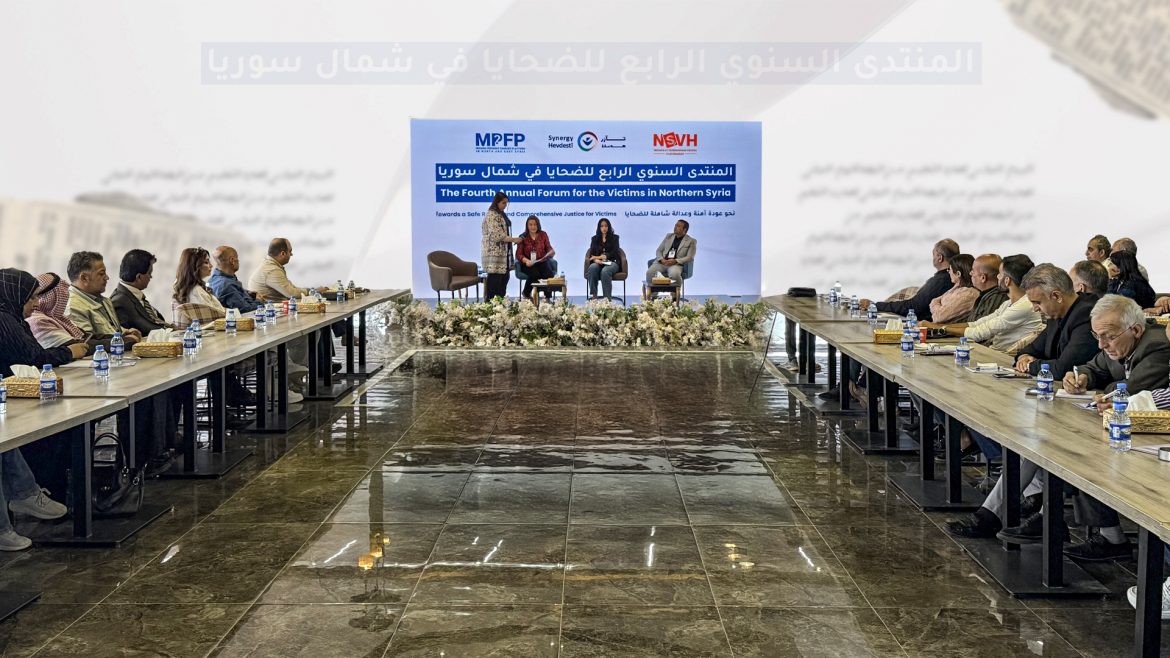
On October 17, 2025, the Fourth Annual Forum for Victims in Northern Syria was held under the theme “Toward A Safe Return and Comprehensive Justice for Victims.” The Forum marked a significant milestone in amplifying the victims’ voices and strengthening their role as active partners in shaping the next stage and envisioning a future grounded in justice and accountability.
Held both online and in person—in Qamishli/Qamishlo City, the Forum was jointly organized by Synergy Association for Victims, the Missing Persons’ Families Platform in North and East Syria (MPFP-NES), and the Network of Statelessness Victims in al-Hasakah (NSVH).
The Forum came at a pivotal moment of Syria’s contemporary history, as it was held for the first time following fall of the Assad regime, amid a sensitive transitional phase whose ultimate contours remain undefined.
Despite the passage of more than ten months since this major turning point — the fall of the Assad regime — hundreds of thousands of forcibly displaced people remain unable to return to their original places of residence, particularly in Ras al-Ayn/Serê Kaniyê, Tall Abyad/Girê Spî, and Afrin. This continues amid the absence of a safe environment, the lack of genuine conditions for a voluntary and dignified return, and the delay in initiating authentic transitional justice processes that uphold victims’ rights and enable their meaningful participation in shaping the country’s future.
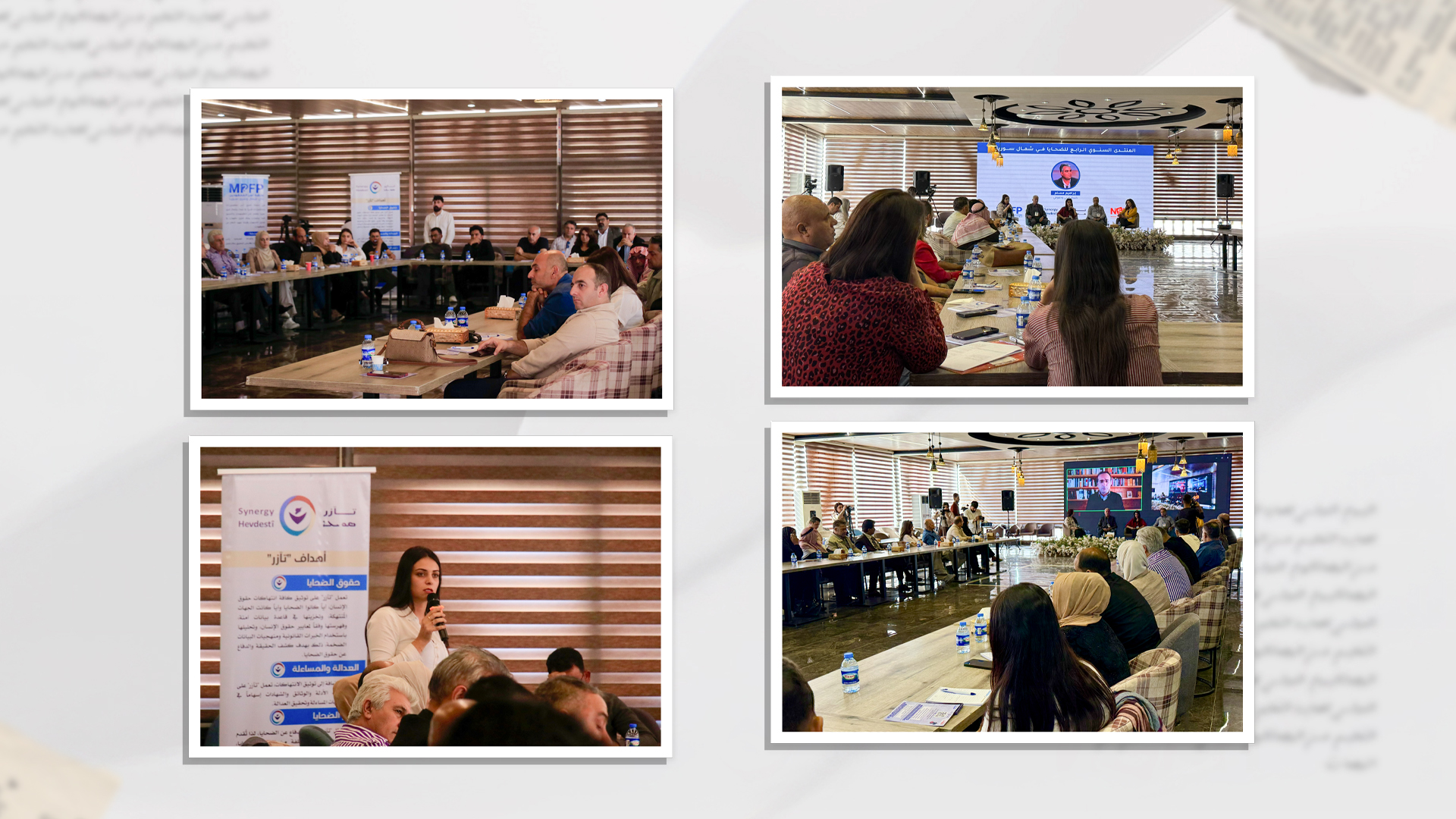
The Forum hosted 11 panelists and brought together over 70 participants, including victims and survivors, activists, human rights defenders, and representatives of civil society organizations. It also received coverage from more than 14 local and regional media outlets.
The Forum hosted 11 panelists and brought together over 70 participants, including victims and survivors, activists, human rights defenders, and representatives of civil society organizations. It also received coverage from more than 14 local and regional media outlets.
Discussions throughout the Forum addressed key issues shaping the future of justice and victims’ rights in Syria, focusing on three central themes:
- Safe, Voluntary, and Dignified Return: Examining the necessary requirements and practical steps to achieve safe return, including ending ongoing violations, ensuring safety and protection, prohibiting discrimination, restoring rights and property, and providing reparations.
- Transitional Justice and Victims’ Leadership: Assessing the progress made in transitional justice pathways — from accountability and litigation to the rights to truth, memory, reparation, institutional reform, and guarantees of non-recurrence — while underscoring the importance of placing victims in leadership roles and empowering them to influence priority-setting.
- Gender and Affected Groups: Highlighting the specific situations of women survivors, families of the missing, and victims of statelessness, while emphasizing the need to ensure inclusive and equitable participation of all victims in shaping programs and policies.
The Forum reaffirmed that the path to justice in Syria cannot be achieved without the leadership and meaningful participation of the victims, who are not merely affected individuals but rightful claimants and essential partners in shaping the country’s future.
The discussions concluded with a set of recommendations and practical visions addressed to decision-makers and both local and international actors, aimed at paving the way for the safe, voluntary, and dignified return of displaced persons and developing a roadmap for a victim-centered transitional justice process in Syria — led by and for the victims.
The Forum is held annually to highlight the victims’ issues and advocate for their rights. Previous editions have marked key milestones in strengthening the victims’ presence as key actors in advancing their cause. The First Forum was held on October 9, 2022, under the theme “The Right in Truth and Justice,” the Second Forum was held on October 27, 2023, under “Together, Our Voice Is Stronger” slogan, while the Third Forum on November 15, 2024, under the theme “Equity and Justice for All.”

Background:
The Fourth Annual Forum for Victims in Northern Syria takes place within a complex national context characterized by a fragile transitional phase following the collapse of the previous regime. This occurs amid the absence of a safe and stable environment and a slowdown in the establishment of transitional justice mechanisms.
Hundreds of thousands of forcibly displaced people remain unable to return to their original areas of residence, while violations and discrimination persist and living and service-related vulnerabilities continue to deepen — particularly among the most affected groups, including women survivors, families of the missing, and victims of statelessness.
Comparative experiences demonstrate that comprehensive transitional justice extends beyond legal accountability to include the right to truth and memory, reparations, institutional reform, and guarantees of non-recurrence. The absence of an inclusive, victim-led roadmap risks prolonging suffering and weakens the prospects for establishing a sustainable and inclusive peace grounded in justice and accountability.
In this context, the announcement of the “National Commission for Transitional Justice”, issued by the Interim Transitional Government under Decree No. (20) on May 17, 2025, was met by victims’ associations, civil society organizations, and human rights defenders with a mix of hope and concern. Hope, because it opens a long-awaited window toward a national transitional justice process; and concern, because in its current form it could result in selective justice that excludes certain categories of victims and limits accountability to a single party, while disregarding violations committed by multiple actors over the years of conflict.
If this approach persists, it risks deepening discrimination among victims and undermining the foundations of comprehensive justice and national reconciliation, contrary to the principles of the Constitutional Declaration and obligations under International Human Rights Law (IHRL) and International Humanitarian Law (IHL).
Another challenge is the lack of awareness among victims regarding their rights and the mechanisms available to claim them, which leaves them vulnerable to repeated violations amid ongoing impunity.
The Forum, hence, aims to amplify the victims’ voices to represent themselves, while providing a space for coordination and networking among affected groups, with a view to formulate a unified vision for justice and return.
Previous forums have developed practical approaches, strengthened coordination and advocacy, and reinforced the visibility of victims’ issues in both human rights and media arenas. In this context, the Fourth Forum stands as a renewed affirmation of the collective commitment to the principles of comprehensive justice, reparations, and guarantees of non-recurrence.
The First Session: The Right to Safe, Voluntary, and Dignified Return for Forcibly Displaced Persons
The First Session of the Fourth Forum for Victims in Northern Syria focused on the right of forcibly displaced persons to a safe, voluntary, and dignified return, recognizing it as an inalienable right and a fundamental prerequisite for achieving genuine transitional justice that restores justice to victims and ensures that violations do not recur.
The session brought together six panelists, participating both in person and virtually, who discussed the legal and practical conditions required to create a safe return environment, including ending violations, ensuring security and protection, prohibiting discrimination, restoring rights and property, and providing fair compensation. The panelists also explored the challenges of achieving stability and sustaining efforts to guarantee a decent life for both displaced persons and host communities.
Moreover, the participating researchers and human rights activists provided political and legal analyses of the situations faced by displaced populations and indigenous residents in areas affected by displacement, including Afrin, Ras al-Ayn/Serê Kaniyê, and Tall Abyad, while highlighting the ongoing violations and obstacles hindering a safe and voluntary return.
The participants also addressed the gendered scopes of these violations, focusing on the experiences of displaced women and survivors of detention, their specific needs in the context of return and reintegration, and the responsibilities of various actors — including the Transitional Government, the Autonomous Administration of North and East Syria (AANES), and Turkey — in safeguarding the rights and dignity of displaced persons.
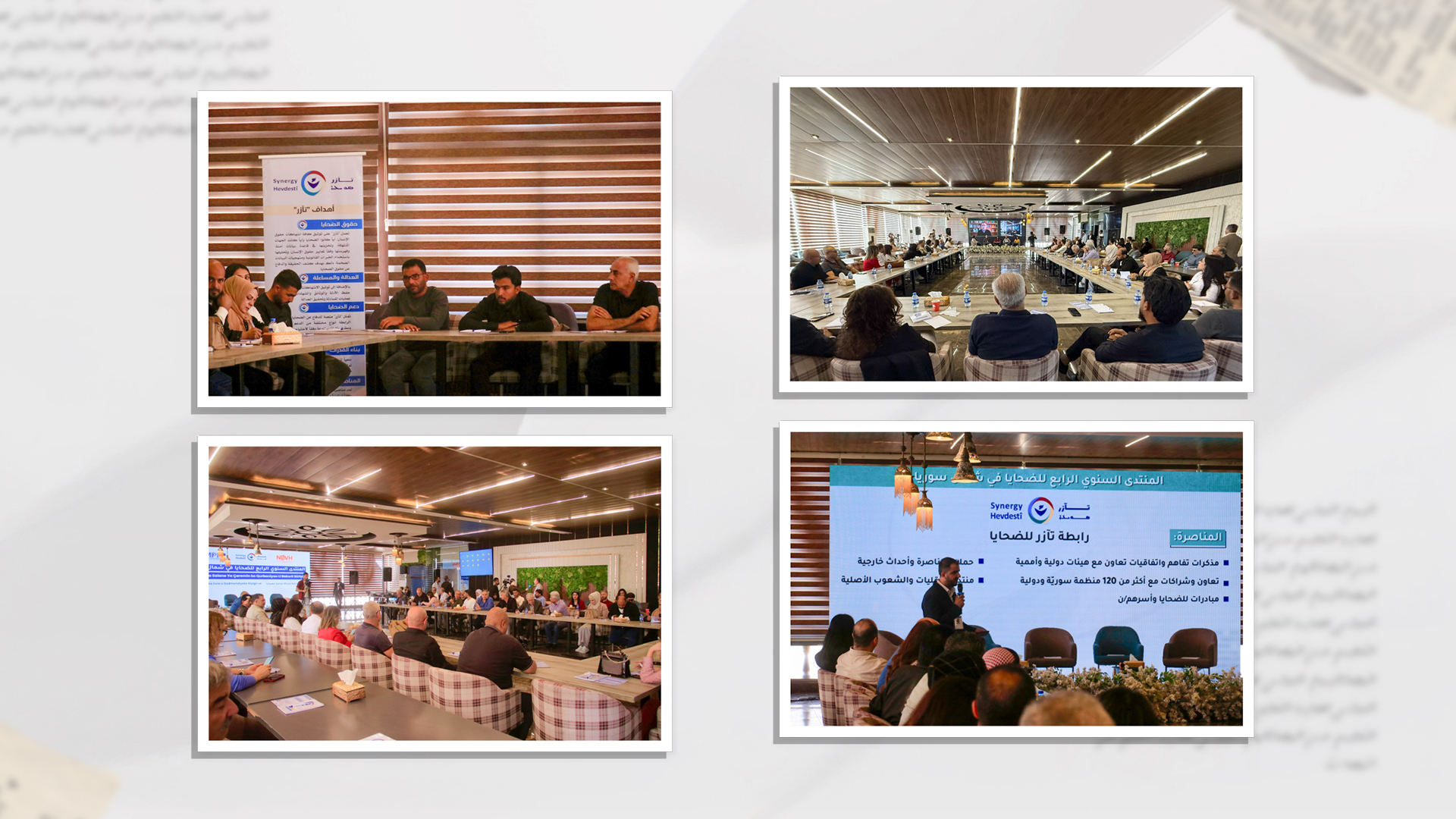
- The Role of Synergy Association for Victims
Orhan Kamal, Programs Coordinator at Synergy Association for Victims, presented the Association’s strategy, which focuses on engaging victims directly in setting priorities and shaping policies. He confirmed that the recommendations from previous forums have served as a key reference in preparing the Association’s plans, strategies, and advocacy efforts at the national and international levels.
Kamal explained that the Association has developed a secure human rights database containing over 35,000 data units, issued more than 100 human rights reports, submitted 35 complaints and reports, published 60 press statements, carried out 25 advocacy campaigns, and participated in dozens of national and international events.
He also highlighted the Association’s extensive partnerships with over 120 Syrian and international organizations, including international justice mechanisms such as the Independent International Commission of Inquiry in Syria (COI), the International, Impartial and Independent Mechanism (IIIM), and the Independent Institution on Missing Persons in Syria (IIMP).
Kamal affirmed that Synergy is committed to strengthening the culture of victim-led initiatives and highlighted two key initiatives supported by the Association:
- The Missing Persons’ Families Platform in North and East Syria (MPFP-NES): Which organizes families of the missing and forcibly disappeared persons, empowering them to represent themselves and actively participate in search, truth-revealing, and justice efforts.
- The Network of Statelessness Victims in al-Hasakah (NSVH): Led by victims stripped of Syrian nationality born unregistered due to the 1962 Special Census and subsequent exclusionary policies. NSVH defends the right to nationality and recognition of legal personality, based on equality and non-discrimination.
- Safe Return as an Inalienable Right
The panelists emphasized that the right to a safe, voluntary, and dignified return is a legal right that cannot be compromised or politicized, and should not be used as leverage in negotiations in regional or international power struggles.
On the other hand, Shorash Darwish, a writer and political researcher, demonstrated that the displacement policies in Northern Syria are an extension of systematic exclusionary practices predating 2011, such as the Special Census 1962 in al-Hasakah and the “Arab Belt” Project, that aimed to alter the demographic structure and restrict rights to property, residency, and employment.
Darwish noted that the Syrian conflict has exacerbated these policies through Turkey-led military operations in Afrin (2018), and Ras al-Ayn/Serê Kaniyê and Tall Abyad (2019), resulting in widespread forced displacement. Landowners were forcibly prevented from returning to their homes, and the right to return has been treated as leverage in political negotiations rather than as a legal obligation owed to victims.
He further pointed out that current mechanisms, such as the March 10 Agreement, do not guarantee a safe and comprehensive return, as they lack international standards for voluntary return based on protection, accountability, and non-discrimination. Under these mechanisms, return is subject to selective criteria, determining who may return and under which authority, instead of being recognized as a legal duty of all relevant parties.
Shorash also emphasized that safe return is an inalienable and unconditional right, which must guarantee minimum essential protections, including protection from arrest and reprisals, restoration of property or fair compensation, civil and political rights, and the prohibition of using return as a tool for political domination or demographic change.
In her turn, Shereen Ibrahim, Programs Director at Dar Association for Victims of Forced Displacement, emphasized that the return of displaced persons to Afrin, Ras al-Ayn/Serê Kaniyê, and Tall Abyad is central to any future political or negotiation process, and not a secondary humanitarian issue. She stressed that return must be grounded on an environment free from ethnic, religious, or political discrimination, ensuring the cessation of violations, protection of property rights (HLP rights), restoration of essential services, and the establishment of a clear legal framework for accountability and compensation.
Ibrahim also asserted that any negotiation process must be linked to the return of displaced persons, while empowering local populations to manage their own affairs through elected and inclusive local structures that build trust and strengthen the rule of law.
The discussions concluded that no current or future government can be serious about peace-building unless it implements, since day one, the mechanisms for property restitution, victim compensation, and the integration of forced displacement violations into transitional justice programs, in a way that ensures accountability and non-recurrence. Safe return is not a privilege—it is a measure of a genuine commitment to justice and peace.
- Forced Displacement and Its Consequences
Mahmoud Jamil Abdul Halim, the Spokesperson for the Committee of Displaced Persons from Ras al-Ain/Sêrê Kaniyê, presented on the situation of forced displacement and human rights violations in the area since its occupation by Turkey in 2019, highlighting the main challenges and requirements for return.
In his turn, Ibrahim Sheikho, Director of the Human Rights Organization in Afrin–Syria, spoke about the human rights situation in Afrin from 2018 through the post-regime period, focusing on issues of return and property restitution.
Finally, Dr. Ibrahim Muslim, a human rights activist from Tall Abyad, reviewed the violations committed against the indigenous population by the Turkish-backed Syrian factions since their takeover of the area in 2019.
The participants explained that tens of thousands of indigenous people were forced to flee to overcrowded camps or temporary shelters in al-Hasakah, Raqqa, and Aleppo, amid extremely difficult living conditions and losing access to income, housing, and personal documentation.
Human rights organizations have documented that serious violations continue, including property seizure, arbitrary detention, kidnapping for ransom, extortion, and forced demographic change, making the currently proposed “return” more a form of political subjugation than a restoration of rights.
More than 350,000 original residents of Afrin, Ras al-Ayn/Serê Kaniyê, and Tall Abyad remain forcibly displaced due to the Turkish operations “Olive Branch” and “Peace Spring”, without any real guarantees for their return.
- Gendered Aspects of Violations
Zilan Ali, Founder and Researcher at Lelun Association for Victims, emphasized that the suffering of displaced women and survivors of detention and sexual violence is not a peripheral issue, but lies at the core of violations in the Syrian conflict, often amounting to war crimes and crimes against humanity under international law.
According to Ali, many women have become the sole providers for their families after losing their husbands or children. They also endure restrictions on movement and inadequate protection. Numerous survivors have been subjected to torture, sexual violence, and rape, and continue to endure a social stigma and community ostracism, rather than being recognized as victims of serious crimes.
Ali stressed that genuine justice can only be achieved through the effective protection of women, including personal security, prevention of gender-based violence, restoration of property, elimination of stigma, and provision of legal, medical, and psychological support for survivors.
- Session Summary
The participants unanimously agreed that the safe, voluntary, and dignified return of forcibly displaced persons is an inherent, non-negotiable right, and that any return falling short of safety, accountability, and restoration of rights constitutes coercion rather than justice.
They also highlighted the importance of involving victims in shaping policies on return and transitional justice, ensuring that gender and human rights concerns are central, and putting in place clear measures for accountability, compensation, and non-recurrence.
The Second Session: Transitional Justice and Victims’ Leadership
The Second Session of the Forum focused on the pathways of transitional justice in Syria, viewing it as an inalienable right of victims and a fundamental tool for building a comprehensive and sustainable peace, rather than merely a legal or symbolic process.
Five panelists participated in the session, both in person and online, discussing with participants the progress made in transitional justice pathways—from accountability and litigation to the right to truth and memory, reparations, institutional reform, and guarantees of non-recurrence. They emphasized that transitional justice must be comprehensive and grounded in the full diversity of the Syrian reality, and that victims should occupy a leadership role in setting priorities and shaping policies, rather than being mere recipients or observers.
The discussion also highlighted the role of civil society in advancing genuine and practical pathways to justice, strengthening accountability, ensuring access to truth and preservation of memory, officially acknowledging harm, and activating effective mechanisms for reparations and restoring dignity.
Participants emphasized the importance of recognizing the suffering of historically marginalized groups, such as victims of statelessness, families of forcibly disappeared persons, and those affected by structural discrimination, stressing that transitional justice cannot be partial or selective.
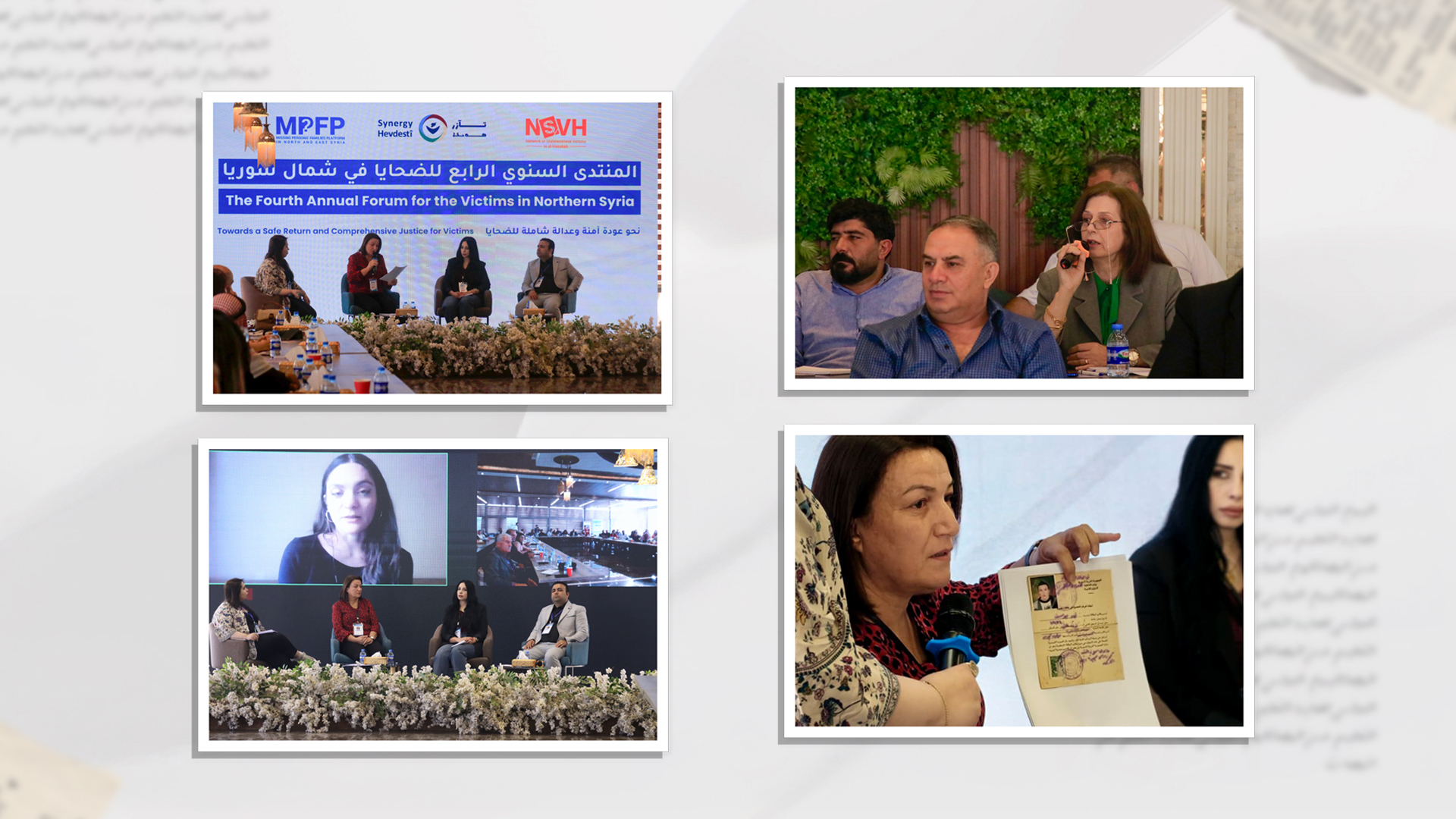
- Transitional Justice in Syria: Current Reality and Key Requirements
Riyad Ali, Judge and Legal Expert with Syrians for Truth and Justice (STJ) discussed the current status of transitional justice in Syria, noting that efforts so far remain largely political discourse and lack genuine accountability institutions.
Despite the fall of the Assad regime, an alternative justice system has yet to be established, and some perpetrators continue to hold key positions within the Transitional Government and de facto authorities. Victims remain unable to seek accountability due to fear of retaliation.
Ali stated that limiting transitional justice to holding only one party accountable—focusing solely on the crimes of the former regime while ignoring violations committed by other actors, and portraying those involved as political or military leaders—undermines the principle of equality among victims and turns justice into a tool for perpetuating political control rather than dismantling it.
Ali emphasized that genuine justice begins with official recognition of all victims’ suffering, without discrimination or assigning a “value” to different experiences of pain, and with identifying those responsible in order to prevent impunity rather than seek retaliation.
Participants highlighted that justice must include both material and moral reparations, such as restoring rights and property, ending the stigma associated with detention or displacement, and providing long-term psychosocial support as an essential component of justice rather than a supplementary service.
Transitional justice was associated with the need for a radical reform in security and judicial structures, which have historically been used as instruments for oppression, with participants emphasizing that simply reproducing the same people and institutions does not constitute a transition, but rather prolongs the cycle of violations.
- Victims’ Participation as a Fundamental Condition for Justice
Veronica Bellintani, Head of the International Law Support Unit at the Syrian Legal Development Program (SLDP), emphasized that victims’ participation in transitional justice processes is crucial—not merely a formality. She highlighted that it is an inherent right under international law, requiring states and all relevant actors to respect, protect, and guarantee it.
Bellintani stressed that the design and implementation of transitional justice processes must be guided by the needs, demands, and visions of the victims themselves, to ensure the achievement of genuine and transformative justice.
Moreover, she stated that recognizing individuals as victims, regardless of the identity of the perpetrators, is a fundamental pillar for building sustainable civil peace and restoring confidence between the state and society.
On the other hand, Sawsan Rashid, a human rights activist and a researcher at PÊL– Civil Waves Organization, emphasized that victims refuse to remain passive recipients of processes conducted in their name. She called for their active engagement as direct partners at every stage of transitional justice—from defining harm and setting reparation priorities to shaping guarantees of non-recurrence.
She further noted that such meaningful participation requires a safe environment that protects victims from retaliation, as well as formal and practical recognition of victims’ associations as legitimate representatives at decision-making tables.
- Victim-Led Initiatives and Truth and Justice Pathways
The discussions concurred that addressing serious violations in Syria—such as enforced disappearances and deprivation of nationality—is no longer possible without the active presence of victims as organized and informed actors. Victims are no longer merely a “humanitarian file” discussed by others; they are shaping the justice discourse, setting conditions, and demanding recognition, truth, accountability, and guarantees of non-recurrence.
Abbas Ali Mousa, Coordinator of the Missing Persons’ Families Platform in North and East Syria (MPFP-NES), shared the Platform’s founding experience in June 2024, supported by Synergy Association. Today, the Platform brings together more than 750 families of forcibly disappeared and missing persons from all parties to the conflict and from diverse backgrounds.
Mousa illustrated that the issue of the missing persons is not just a matter of past memory, but a daily reality of pain and a life suspended between hope and despair. He confirmed that the MPFP-NES provides a safe and organized space for families to unify demands and convey their voice to national and international actors, including the National Commission for the Missing and the UN Independent Institution on Missing Persons in Syria (IIMP).
He asserted that if the issue of missing persons is turned into a selective tool to target one party while absolving another, true justice cannot be achieved. The right to truth belongs to every family, regardless of who is responsible. In other words, families refuse to be treated as passive recipients—they are active political and moral stakeholders in defining who is considered “missing,” determining how the truth is addressed, and ensuring accountability.
Avin Youssef, a journalist, a civil activist, and a member of the Network of Statelessness Victims in al-Hasakah (NSVH), presented the Network, which was launched on October 4, 2025, marking the passage of 63 years since the Special Census of 1962 in al-Hasakah.
She explained that the revocation of citizenship was a systematic policy aimed at creating a “legally lesser” class within their own homeland, and its effects persist to this day despite changes in the political landscape. Thousands of people remain without official recognition or basic rights, including access to education, employment, and civil registration of marriages and children.
She emphasized that the Network functions as an organized body for victims, documenting violations, providing legal assistance, building collective memory on statelessness, and monitoring any new attempts to produce cases of stripping of citizenship. It also leads public political and legislative advocacy to secure the right to legal recognition.
Youssef highlighted that disregarding the Special Census of 1962 amounts to building justice with a fractured memory, stressing that genuine transitional justice must begin with acknowledging this historical injustice. Statelessness, she asserted, should be treated as a central issue within any transitional justice process, not as a peripheral or marginal appendix.
Discussions concluded that transitional justice in Syria won’t be achieved without:
- Comprehensive recognition of all victims, without selectivity or discrimination;
- Direct involvement of victims in decision-making and leadership;
- Inclusive material and moral reparations, along with radical institutional reform to ensure non-recurrence;
- Associating the issues of the missing and statelessness within the transitional justice agenda as central elements.
Transitional justice is not a formal response to the past; it is an ongoing process for building a future grounded in truth, accountability, and human dignity.
Recommendations:
The sessions of the Fourth Annual Forum for Victims concluded with a set of practical recommendations aimed at ensuring justice for victims, guaranteeing the right to safe, voluntary, and dignified return, clarifying the fate of the forcibly disappeared and missing persons, and strengthening victim-led transitional justice pathways.
Implementing these recommendations requires coordinated action among relevant local and international actors, guided by clear timelines and monitoring mechanisms led by victims and their representatives.
First: Ensuring Safe, Voluntary, and Dignified Return
1. Right to Return: Guarantee the safe, voluntary, and dignified return of all forcibly displaced persons from Ras al-Ayn/Serê Kaniyê, Tall Abyad/Girê Spî, Afrin, and other Syrian areas in accordance with International Humanitarian Law (IHL) and International Human Rights Law (IHRL).
2. Security and Administrative Guarantees: Ensure the cessation of all violations and arbitrary arrests, lift restrictions on freedom of movement, demilitarize civilian life, and provide protection through neutral civil authorities and independent oversight mechanisms.
3. Restitution of Rights and Property:
- Restore confiscated or seized property and land to their legitimate owners;
- Establish mixed local- judicial committees to resolve property disputes according to principles of justice and equity;
- Adopt effective and expedited compensation and reparation systems when restitution in kind is not possible.
4. Strengthening Essential Services: Ensure the availability and continuity of basic services (water, electricity, healthcare, and education) and livelihoods to secure stability of the returnees.
5. Political Guarantees and Local Governance: Link any future negotiation or political settlement to the guarantee of the right to return, and empower local communities to manage their affairs through elected and inclusive structures that represent all groups, foster trust, and reinforce the rule of law.
Second: Transitional Justice and Comprehensive Accountability
1. Independent National Framework: The National Commission for Transitional Justice should have jurisdiction over all the violations committed by all parties to the conflict without exception and operate in accordance with international human rights standards.
2. Right to Truth and Memory:
- Ensure access to information and archives related to violations;
- Document and publicly archive the violations in a manner that respects human dignity and safeguards victims;
- Support initiatives of collective memory (exhibitions, memorials, educational curricula) as integral components of collective reparations programs.
3. Recognition of Past Violations: Acknowledge that the Syrian revolution emerged from decades of repression and violations, and that this legacy must be addressed within transitional justice processes. Formulate a national narrative that ensures justice for all victims, regardless of their affiliations or regions.
4. Judicial Accountability: Support national and international prosecutions of perpetrators, and enhance cooperation with UN mechanisms and other relevant bodies.
5. Reparation: Develop comprehensive national programs for individual and collective reparations, including material compensation, restoration of dignity, and rehabilitation while ensuring active participation of victims in both design and implementation of such programs.
Third: Empowering Victims and Their Leadership in Decision-Making
- Institutional Representation: Support victims-led initiatives and groups, ensuring their meaningful participation in designing, implementing, and monitoring justice and return programs.
- Capacity Building: Provide training programs for victims and their groups in rights awareness, advocacy, community leadership, and civic engagement.
- Protection and Accompaniment: Ensure a safe environment for victims and human rights defenders, providing legal and psychosocial support to protect them from retaliation or intimidation.
Fourth: Addressing Enforced Disappearances and Missing Persons
- Independent National Mechanism: Strengthen the National Commission for the Missing in Syria in cooperation with the IIMP, ensuring active participation victims’ families at every stage.
- Right to Truth: Obligate all parties to reveal the fate of missing persons and burial sites, and guarantee access to related information.
- Families Support: Provide legal, psychological, and social services to families, facilitate recognition of death or absence for civil status purposes, without compromising their right to litigation and accountability.
Fifth: Addressing Statelessness as a Transitional Justice Entitlement
- Immediate Executive Measures:
- Enact a rule prohibiting statelessness at birth;
- Ensure full gender equality in the transmission of nationality;
- Open a “collective correction window” for the Maktumeen al-Qayd (unregistered), allowing acceptance of alternative evidence and recognition of documents issued abroad;
- Establishing free specialized judiciary for civil status matters, separating security agencies from civil registry operations.
- Recognition and Transitional Measures:
- Integrate the issue of statelessness into transitional justice pathways as a systematic historical injustice;
- Issue official recognition of victimization and implement collective reparations programs for affected communities;
- Adopt legislative and institutional reforms to guarantee equality and prevent recurrence.
Sixth: Institutional Reform and Guarantees of Non-Recurrence
- Institutional Audit: Conduct comprehensive integrity reviews of security, judicial, and administrative bodies, excluding all individuals implicated in violations from positions of authority.
- Civil Oversight: Conduct an effective civilian oversight for security and justice institutions to maintain judicial independence and transparency in appointments and promotions.
- Rights Culture: Incorporate mandatory training on IHL and IHRL into programs for public sector employees.
Seventh: Gender Justice and Protection of Survivors
- Integrate Gender Perspective: Include gender analysis in all justice and return policies and programs, with performance indicators disaggregated by gender, age, and disability.
- Women Protection and Empowerment: Establish comprehensive support centers for survivors of violence, including legal assistance, psychosocial support, and economic empowerment programs.
- Female Representation: Ensure active participation of women in technical committees, complaint mechanisms, and victim-representative frameworks.
Eighth: Support Documentation and Advocacy
- Comprehensive Documentation: Monitor and document all human rights violations, regardless of perpetrators, including extrajudicial killings, arbitrary detention, torture, enforced disappearance, and forced displacement.
- Evidence Referral: Submit reliable documents and evidence to national and international justice mechanisms and competent courts.
- Victim-Led Advocacy: Empower the victims and their families to lead advocacy campaigns and represent their issues locally, regionally, and internationally.
Ninth: International and Regional Liabilities
- Support, Protection, and Monitoring: Call on the UN and international organizations to accompany and monitor the transitional phase, ensuring respect for and protection of human rights.
- Neutralizing Humanitarian Assistance: Guarantee impartial and equitable access to humanitarian aid, preventing its use as a tool for political or military leverage, particularly for essential resources such as water.
To view the full paper (16 pages) in PDF format, please click this link.