
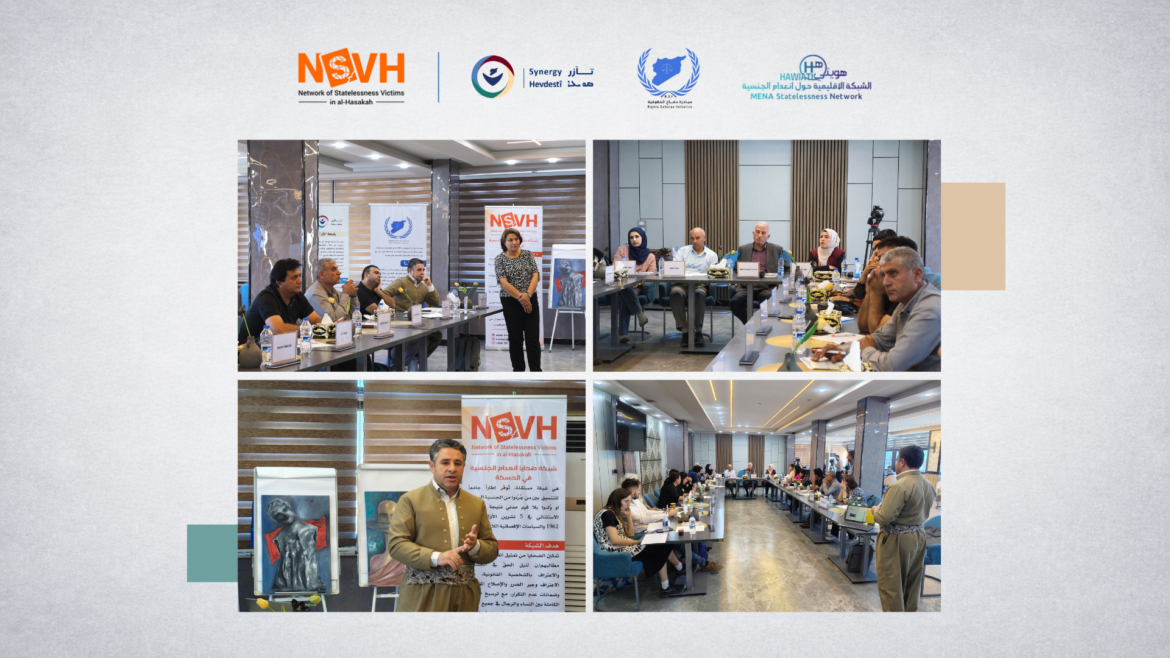
Qamishli – 4 October 2026
The Network of Statelessness Victims in al-Hasakah (NSVH), in cooperation with the MENA Statelessness Network (Hawiati), Rights Defense Initiative (RDI), and Synergy Association for Victims, organized a workshop in Qamishli to mark the 64th anniversary of the 1962 Exceptional Census, conducted in al-Hasakah Governorate on 5 October 1962. The census had far-reaching legal, social, and humanitarian consequences that have persisted for decades, affecting thousands of Kurdish families and subsequent generations in Syria.
The workshop brought together 24 participants, including 11 women, with participation from the Protection and Legal Unit of the United Nations High Commissioner for Refugees (UNHCR) in Qamishli, as well as representatives of Hawiati and the organizing partners. It provided a space for direct dialogue and an exchange of experiences and perspectives on the legacy of the Exceptional Census, its impact on affected persons, their families, and subsequent generations, and the importance of addressing this legacy as part of Syria’s transitional justice process.
The discussions emphasized the need to move beyond addressing the immediate legal consequences of nationality deprivation and to address the underlying causes of the violation and its long-term effects, including truth-seeking and acknowledgment, preservation of memory, reparations, and guarantees of non-recurrence.
Decree No. 13 of 2026 and Challenges in Implementation
A substantial part of the discussion focused on Decree No. 13 of 2026, particularly Article 4, which abolished the laws and exceptional measures resulting from the 1962 Census in al-Hasakah Governorate and provided for the granting of Syrian nationality to Kurdish-origin individuals residing in Syria, including Maktoumeen al-Qayd (unregistered persons), with equal rights and obligations.
Participants discussed the new opportunity provided by the Decree to address statelessness among Kurds in Syria, while focusing on the legal, practical, and procedural challenges associated with its implementation. The discussions also addressed the situation of persons deprived of nationality residing outside Syria, in light of the current absence of channels or procedures allowing them to submit their applications from outside the country. The workshop explored ways to ensure that all persons deprived of nationality are able to benefit from the new procedures, and developed recommendations for submission to the Syrian government, the Ministry of Interior, and other relevant authorities.
The discussions also emphasized that the consequences of the 1962 Exceptional Census extend beyond nationality deprivation and the resulting legal status. They are linked to a longstanding legacy of deprivation of rights, discrimination, and marginalization that has affected successive generations. Addressing this legacy therefore requires, alongside the implementation of the Decree and efforts to ensure its effectiveness, a comprehensive approach within Syria’s transitional justice process that addresses both the causes of the violations and their long-term effects.
Inputs from Affected Persons into the Transitional Justice Process
The workshop then moved into participatory working groups aimed at placing the experiences, needs, and aspirations of affected persons at the center of discussions on addressing the legacy of the Census and statelessness, and developing priorities and recommendations that could be submitted to the relevant committees of the National Transitional Justice Commission (NCTJ).
The working groups focused on four interconnected areas:
- Truth-Seeking and Acknowledgment:
Participants discussed what should be known and documented about the Exceptional Census and its consequences, what acknowledgment of the truth means for affected persons, and how such a process could be carried out.
- Preservation of National Memory:
The group explored ways to preserve the memory of the Census and the experiences of affected persons and the generations impacted by it, as well as ways to commemorate this history, ensure that the issue remains part of Syria’s national memory, and prevent it from being erased or marginalized.
- Reparations and Compensation:
The discussions addressed the forms of harm resulting from decades of nationality deprivation, the needs of affected persons in relation to reparations, and possible measures and forms of compensation and redress, while emphasizing the need to take into account the impacts extending across generations.
- Guarantees of Non-Recurrence:
The group discussed the legal and institutional reforms needed to prevent arbitrary deprivation of nationality from recurring, the measures that should be adopted in the future, and the safeguards needed to assess their implementation, ensure their effectiveness, and prevent the recurrence of violations.
The working groups featured substantive and participatory discussions centered on the experiences, priorities, and needs of participants, seeking to translate these experiences into practical recommendations and inputs that reflect the perspectives of affected persons themselves. This was part of the effort to strengthen the direct participation of affected persons in discussions related to transitional justice and in shaping policies and measures addressing the legacy of the Census and statelessness.
Towards Ensuring the Voices of Affected Persons Are Heard
At the conclusion of the workshop, the key issues, priorities, needs, and recommendations emerging from the working groups were presented, followed by feedback and reflections from participants. The discussion underscored the importance of bringing the perspectives and recommendations of affected persons to the relevant committees of the National Transitional Justice Commission and other relevant authorities.
This step forms part of the broader transitional justice process led by the National Transitional Justice Commission, which includes truth-seeking, accountability, reparations, preservation of national memory, institutional reform, and guarantees of non-recurrence, while emphasizing the participation of victims and other stakeholders in this process.
The Network of Statelessness Victims in al-Hasakah (NSVH) will build on the outcomes of the workshop by developing its discussions into inputs and recommendations reflecting the priorities and needs of affected persons. The Network will work to bring these inputs to the National Transitional Justice Commission and other relevant authorities, while continuing its advocacy to protect the rights of affected persons and promote a comprehensive approach to addressing the legacy of the 1962 Exceptional Census and statelessness through transitional justice, including truth and acknowledgment, preservation of memory, reparations, and guarantees of non-recurrence.
For more information, please visit our website or contact us directly:
- Phone (WhatsApp/Signal): +964 751 0483 382
- Email: contact@nsvh.network