
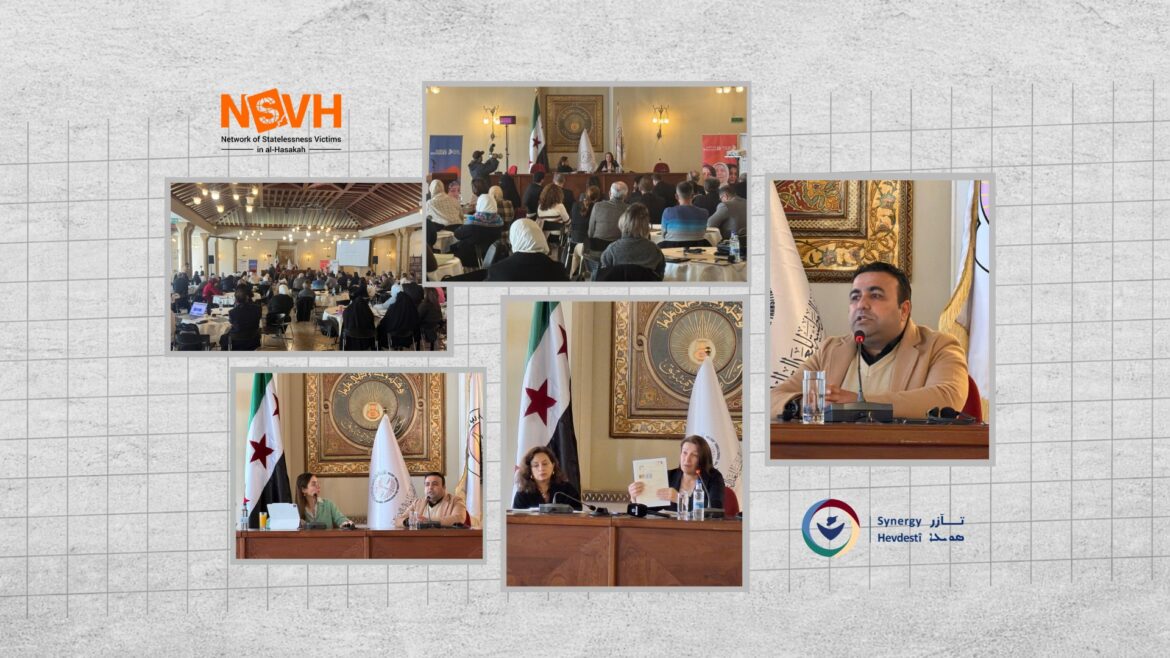
On Monday, 30 March 2026, The Network of Statelessness Victims in al-Hasakah (NSVH) and Synergy Association for Victims participated in the conference titled “Gaps in the Syrian Nationality Law: Achieving Gender Equality”, organized by The MENA Statelessness Network (Hawiati) in cooperation with UN Women and the National Transitional Justice Commission, at the Reda Saeed Conference Hall at the University of Damascus.
The conference brought together a diverse range of participants, including decision-makers, legal experts, human rights activists, journalists, researchers, and representatives of civil society organizations, international and regional bodies, and UN agencies, in a dialogue space dedicated to examining existing gaps within the Syrian Nationality Law. Discussions focused in particular on the impact of gender-based discrimination in nationality matters and the resulting violations affecting the right to legal identity and equal citizenship.
The conference provided an important platform for addressing statelessness from interconnected legal, humanitarian, and political perspectives, with the participation of individuals and groups directly affected by these policies.
Discussions addressed the situation of stateless persons across different categories, including victims of the 1962 exceptional census in al-Hasakah Governorate, individuals affected by statelessness arising from conflict-related circumstances, as well as the consequences of legal provisions that deny Syrian women the equal right to confer their nationality on their children. Participants also highlighted how these legal gaps have contributed to the emergence and expansion of statelessness cases since 2011.
The conference also underscored the link between ongoing discussions on reforming the Syrian Nationality Law and recent developments related to Decree No. 13 of 2026, particularly Article 4 concerning measures aimed at addressing the consequences of the 1962 exceptional census in al-Hasakah.
In this context, the Network of Statelessness Victims in al-Hasakah (NSVH) stressed that any meaningful effort to address this issue must be grounded in the restoration of Syrian nationality to those who were arbitrarily deprived of it, including Maktoumeen (unregistered persons), without exclusion or discrimination. The Network further emphasized the importance of translating this commitment into clear, fair, and effective implementation measures.
Session One: The Humanitarian Consequences of Statelessness
During the first session, titled “The Humanitarian Consequences,” Avin Youssef, a journalist, civil society activist, and member of The Network of Statelessness Victims in al-Hasakah (NSVH), delivered an intervention highlighting the profound humanitarian dimensions of statelessness, drawing on her personal experience as one of those affected by policies of nationality deprivation linked to the 1962 exceptional census in al-Hasakah Governorate.
Her testimony offered a vivid account of the long-term impact of these policies on the daily lives of tens of thousands of Syrian Kurds who have been deprived of their nationality for decades, including restrictions on access to education, employment, freedom of movement, and basic rights and services. Her intervention reflected the scale of the humanitarian and social harm caused by these discriminatory policies.
She further emphasized that Legislative Decree No. 49 of 2011 addressed the issue only partially and inadequately, amid procedural complexities that prevented large numbers of affected individuals from restoring their rights. She stressed the importance of drawing lessons from that experience when engaging with Decree No. 13 and its current implementing instructions.
Her participation underscored the importance of conveying first-hand knowledge rooted in lived experience and linking legal and policy discussions to their tangible humanitarian impact on affected communities.
Session Two: Historical and Political Context
During the second session, titled “Historical and Political Context,” Abbas Ali Mousa, from Synergy Association for Victims, delivered an intervention examining the structural roots of discriminatory laws and policies related to nationality in Syria, as well as previous efforts undertaken to address this injustice and the role of human rights advocacy in advancing more just and equitable legal reform.
The intervention emphasized that statelessness resulting from the exceptional census in al-Hasakah constitutes one of the most extensive forms of collective harm in Syria, having deprived hundreds of thousands of Syrian Kurds of their nationality over the course of more than six decades. It further noted that previous measures, particularly those introduced in 2011, remained insufficient to comprehensively resolve this injustice, especially with regard to the Maktoumeen, who continued to be excluded from effective remedies.
The intervention also stressed that the significance of Decree No. 13 of 2026 lies in the fact that it has explicitly reopened the issue within a new legal and administrative framework, potentially creating an opportunity to address categories that had previously remained excluded. However, the success of this process remains contingent upon the existence of clear, comprehensive, and effective implementation measures, as well as the adoption of an approach that situates the issue within a broader framework of transitional justice and recognition of the collective injustice resulting from the exceptional census and the discriminatory policies associated with it, while ensuring legal safeguards against the recurrence of such violations in the future.
Participants also emphasized the importance of involving persons directly affected by nationality deprivation policies in discussions concerning legal reform, as holders of lived experience and knowledge that cannot be overlooked in the development of sustainable and equitable solutions.
The Network of Statelessness Victims in al-Hasakah (NSVH) reaffirmed that its participation in this conference forms part of its ongoing efforts to amplify the voices of affected persons, advocate for the right to nationality and legal recognition, and contribute to public and human rights discussions aimed at reforming the Syrian Nationality Law in line with the principles of equality, non-discrimination, equal citizenship, and the rule of law.
For further information, please visit our website, or contact us directly via:
- Phone/WhatsApp: +964 751 048 3382
- Email: contact@nsvh.network