
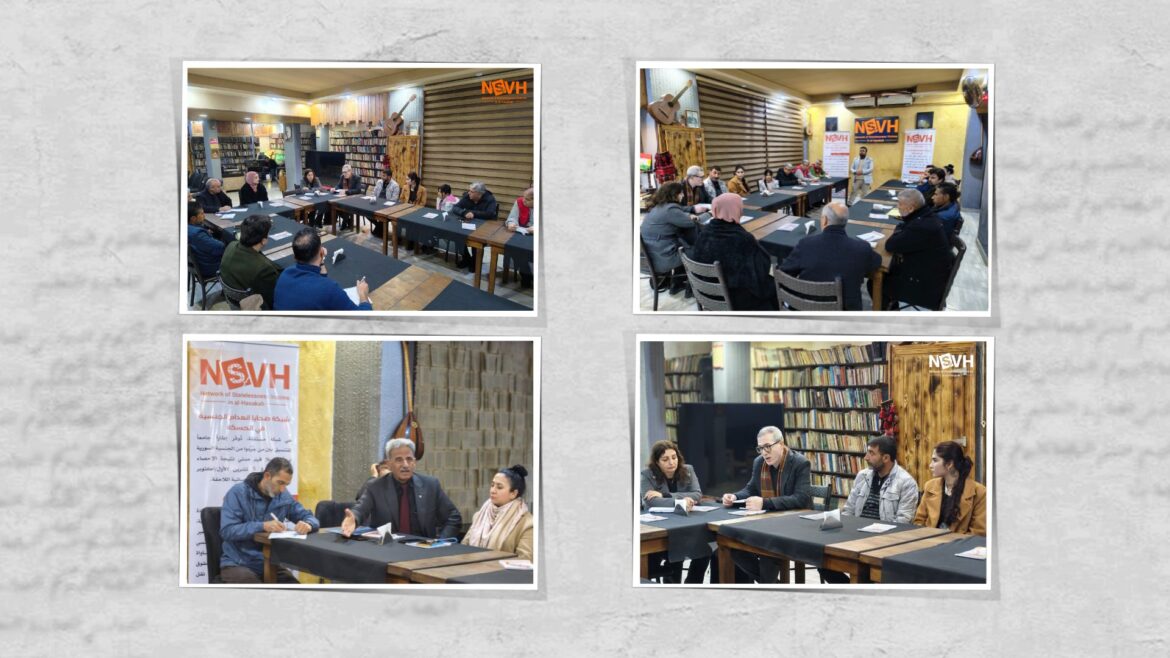
On Monday, 16 March 2026, the Network of Statelessness Victims in al-Hasakah (NSVH), in collaboration with the Protection and Legal Unit of the United Nations High Commissioner for Refugees (UNHCR), held a dialogue session in Qamishli. The session focused on recent developments related to Article 4 of Decree No. 13 of 2026, which addresses the legacy of the 1962 exceptional census and provides for the restoration of Syrian nationality to affected Kurdish citizens.
The session brought together stateless individuals and civil society activists, who reviewed the key provisions of the implementing instructions governing access to Syrian nationality for Kurdish citizens covered by the decree. The discussion also addressed practical challenges in applying these procedures on the ground, aspects that may require revision, and several issues that remain in need of legal interpretation or administrative clarification.
Participants also addressed frequently raised questions among stateless individuals, particularly regarding application procedures, requirements for in-person attendance and ten-fingerprint biometric registration, and the timeframe for submitting applications.
Many individuals deprived of nationality were noted to have only limited awareness of the procedural details related to the decree, highlighting the need for broader dissemination of clear and accessible legal information. The session concluded with a set of practical recommendations aimed at facilitating affected individuals’ access to their rights.
The discussion emphasized that addressing this issue must begin with restoring Syrian nationality to its rightful holders who were unjustly deprived of it, including those classified as “Unregistered Persons” (Maktoumeen al-Qayd), without exception or discrimination. It was also stressed that the decree’s provisions should be translated into clear, binding procedures, accompanied by safeguards to prevent administrative obstruction or arbitrary security discretion—issues that had hindered previous attempts to resolve the matter.
Within this context, the session recalled the experience of Legislative Decree No. 49 of 2011, which had been partially and selectively implemented, and was accompanied by complex procedures and security-related obstacles. As a result, many affected individuals were left out, and thousands of families continue to face statelessness even today. The session highlighted that this experience must inform and guide the implementation of the current decree to avoid repeating past shortcomings.
Participants further highlighted the need to ensure that implementation measures extend to Kurdish expatriates and refugees abroad. This includes enabling them to apply for the restoration of nationality or the correction of civil records through diplomatic missions or alternative legal mechanisms, without requiring their return to Syria or imposing prohibitive conditions.
Interventions during the session emphasized that addressing statelessness requires a broader approach within a transitional justice framework. This includes formal recognition of the injustice resulting from the 1962 census, fair and inclusive collective reparations, meaningful institutional reform, and legal guarantees to prevent recurrence.
The session forms part of NSVH’s ongoing efforts to monitor developments related to Decree No. 13, issued on 16 January 2026. The decree consists of eight articles, with Article 4 repealing all exceptional laws and measures stemming from the 1962 Special Census in al-Hasakah Governorate. It also provides for granting Syrian nationality to citizens of Kurdish origin residing in Syria, including those classified as “Unregistered Persons” (Maktoumeen al-Qayd), ensuring full equality in rights and obligations.
Subsequently, Ministerial Decisions No. 4862 and No. 144 were issued by the Minister of Interior to clarify the procedures for applying for Syrian nationality under the decree.
While this marks an important step forward, the limited timeframe for submitting applications, along with certain procedural requirements, may pose significant challenges for some affected individuals, highlighting the need for continued monitoring to ensure that implementation is fair, inclusive, and effective.
The Network had previously issued a statement on 17 January 2026 welcoming the provisions of Article 4 of Decree No. 13 as an official acknowledgment of the need to address the consequences of the 1962 Exceptional Census in al-Hasakah Governorate, which arbitrarily stripped tens of thousands of Kurdish citizens of their Syrian nationality.
NSVH reiterates that the right to nationality is a fundamental and inalienable human right, and that its full realization represents a critical test of the state’s commitment to justice, equal citizenship, the rule of law, and respect for human rights.
For further information, please visit our website, or contact us directly via:
- Phone/WhatsApp: +964 751 048 3382
- Email: contact@nsvh.network