

Synergy Association for Victims and the Missing Persons’ Families Platform in North and East Syria (MPFP-NES) warmly welcomed the return of Azad Abdul Karim Othman and Mohammad Alaa Ibrahim to their families on 17 July 2026, after more than six years and nine months of enforced disappearance.
Their return brings to a close years of uncertainty, relentless searching, and sustained advocacy to uncover their fate and whereabouts. It also offers renewed hope to thousands of Syrian families who continue to await answers about the fate and whereabouts of their missing loved ones.
Their return is particularly meaningful for Synergy Association for Victims and the Missing Persons’ Families Platform in North and East Syria, as the families of both Azad and Mohammad Alaa are active members of the Platform. For years, they have participated in advocacy campaigns, vigils, and public events calling for the truth about the fate and whereabouts of the missing, driven by the conviction that every family has the fundamental right to know the truth.
Just weeks earlier, on 25 June 2026, Abdul Karim Othman stood outside the United Nations office in Qamishli, holding a photograph of his son, Azad, and a placard demanding that his fate be revealed. The vigil, organized by the Missing Persons’ Families Platform in North and East Syria, called for the disclosure of the fate and whereabouts of all missing persons, the protection of their families’ right to truth and justice, and their meaningful participation in all initiatives and mechanisms addressing this issue.
Speaking on the sidelines of the vigil, he said:
“My son Azad is not the only one. There is hardly a household that has not been affected by the disappearance or detention of a loved one. We demand that the fate and whereabouts of all missing persons be revealed. Every one of them is someone’s son, just like mine.”
Less than a month after that vigil, Azad returned to his father and family, while Mohammad Alaa was reunited with his mother and relatives, bringing an end to more than six years and nine months of waiting, during which both families endured profound hardship while never losing hope.
Arrested on the Same Day as the Assassination of Hevrin Khalaf
According to their families, Azad Abdul Karim Othman (born in 1991) and Mohammad Alaa Ibrahim (born in 2001) were arrested by the Ahrar al-Sharqiya armed group on 12 October 2019 along the M4 highway while accompanying a Kurdish Red Crescent ambulance transporting medicines and medical supplies during the fighting in Ras al-Ain/Serê Kaniyê and Tel Abyad, in the early days of Türkiye’s military operation, Operation Peace Spring.
On the same day, on the very same highway, members of Ahrar al-Sharqiya assassinated Hevrin Khalaf, Secretary-General of the Future Syria Party, along with her companions and driver. The killing became one of the most widely documented crimes of the conflict, recorded by the United Nations and numerous human rights organizations. The Office of the United Nations High Commissioner for Human Rights (OHCHR) stated that the incident may amount to a war crime.
The families later received information indicating that the two men were being held by Ahmad Ihsan Fayyad al-Hayes (Abu Hatem Shaqra), then commander of Ahrar al-Sharqiya, who currently serves as commander of the 86th Division of the Syrian Army. In 2021, the United States imposed sanctions on Abu Hatem Shaqra in his capacity as commander of Ahrar al-Sharqiya, citing his alleged involvement in serious human rights violations. These included overseeing a detention facility where hundreds of detainees were reportedly executed, as well as kidnappings, torture, and other abuses attributed to the armed group under his command.
Although the families knew which armed group had detained the two men, their fate and whereabouts remained unknown for more than six years and nine months. During that entire period, the families received no official information and had no contact with them, leaving both men among Syria’s victims of enforced disappearance.[1]
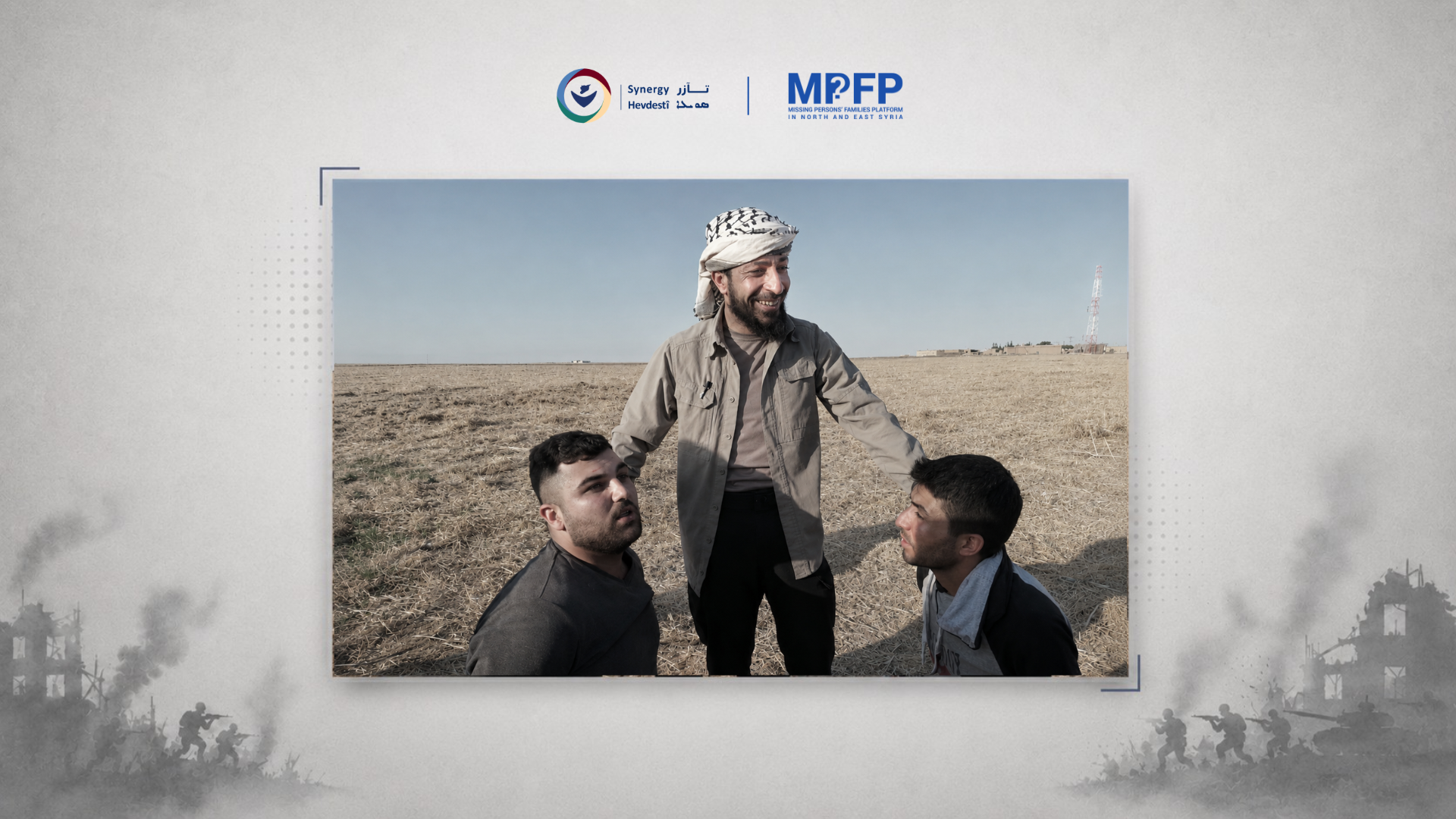
A photograph documenting the first moments following the arrest of Azad Abdul Karim Othman and Mohammad Alaa Ibrahim on the M4 highway on 12 October 2019. The photograph shows (Abu Hatem Shaqra), then commander of Ahrar al-Sharqiya. According to the families’ testimonies, the two men remained in his custody following their arrest. Source: Social media.
Years of Advocacy in the Pursuit of Truth
Synergy Association for Victims, together with the Missing Persons’ Families Platform in North and East Syria, documented the cases of Azad Abdul Karim Othman and Mohammad Alaa Ibrahim, working closely with their families to document the circumstances surrounding their arrest and subsequent enforced disappearance. They also continued to advocate for the disclosure of their fate and whereabouts, ensuring that their cases remained at the forefront of advocacy campaigns, vigils, and public events calling for truth about the missing, as part of broader efforts to uphold the right of all families to know the truth.
Throughout those years, Azad’s father and Mohammad Alaa’s mother became two of the most recognizable voices at the vigils and activities organized by the Missing Persons’ Families Platform in North and East Syria. They remained steadfast in their advocacy for families’ right to know the truth, guided by their conviction that this right does not diminish with the passage of time.
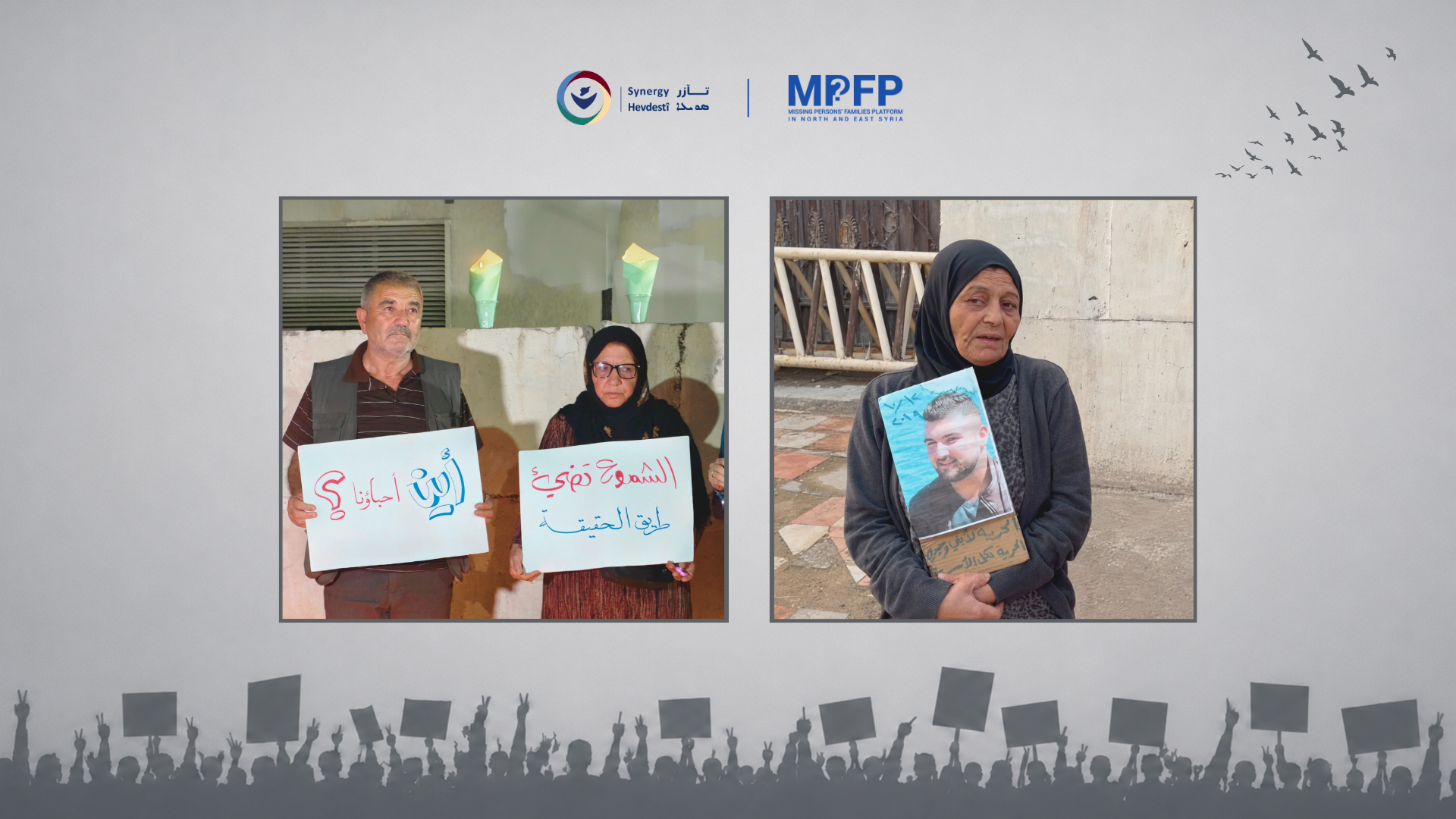
Mohammad Alaa Ibrahim’s mother (right) and Azad Abdul Karim Othman’s father (left) during vigils held in 2026 to demand the disclosure of the fate and whereabouts of missing persons, before the two men were released and returned to their families.
Azad Meets His Youngest Daughter for the First Time
In recent months, new signs of hope emerged for the families of Azad Abdul Karim Othman and Mohammad Alaa Ibrahim following the launch of prisoner exchange operations under the agreement signed between the Syrian Transitional Government and the Syrian Democratic Forces (SDF) on 30 January 2026.
According to the families, they began receiving messages from Azad and Mohammad Alaa shortly after Eid al-Adha, delivered through a former detainee who had recently been released. The messages confirmed that both men were alive. Their long wait finally came to an end on 17 July 2026, when the two men were released and returned to their families.
The news of their return was met with widespread celebrations in the neighborhoods of Qamishli, where their families live, as relatives, friends, and neighbors gathered to welcome them home after years of absence.
Their return was marked by deeply emotional reunions. Among the most moving was Azad’s first meeting with his youngest daughter, who was born shortly after his arrest. She had spent her entire childhood during his enforced disappearance without ever seeing her father. On 17 July 2026, he held her in his arms for the first time after more than six and a half years apart. He was also reunited with his two older daughters, who had grown up during his absence.
A Homecoming Marked by Both Joy and Loss
For Mohammad Alaa, however, the long-awaited homecoming was accompanied by profound loss. He returned home to find that his father had not lived to see his return. After battling illness for several years, he passed away while his son remained forcibly disappeared, having spent those years clinging to the hope that he would one day learn his son’s fate and whereabouts. He died before that hope could be fulfilled.
Mohammad Alaa’s mother, meanwhile, endured years of uncertainty, anguish, and emotional hardship. The prolonged wait took a heavy toll on her health. Yet she remained an active voice in advocacy efforts, standing alongside other families to defend their right to know the truth and the fate and whereabouts of their missing loved ones. She never abandoned her search for answers about her son until they were finally reunited.
A Return That Brings Hope While Thousands of Families Continue to Wait
The return of Azad Abdul Karim Othman and Mohammad Alaa Ibrahim offers renewed hope to countless families who continue to wait for news of their missing loved ones. At the same time, it illustrates the profound and enduring impact of enforced disappearance on families, whose suffering extends into every aspect of their lives, leaving them to cope with its psychological, social, health, and economic consequences for years.
Synergy Association for Victims and the Missing Persons’ Families Platform in North and East Syria believe that these reunions underscore the importance of sustaining efforts to establish the fate and whereabouts of all missing persons in Syria, guarantee their families’ right to know the truth, and ensure accountability for those responsible for the crime of enforced disappearance, in accordance with international law.
The two organizations reaffirm their commitment to continuing their work and advocacy alongside families until the fate and whereabouts of every missing person in Syria have been established and the right of every family to know the truth—an inalienable right that does not diminish with the passage of time—is fully respected.
As Synergy Association for Victims and the Missing Persons’ Families Platform in North and East Syria celebrate the return of Azad and Mohammad Alaa with their families, they also stand in solidarity with the thousands of Syrian families who continue to wait for news of their loved ones after years of absence and uncertainty.
The waiting will not end, and neither will the call for truth, until the fate and whereabouts of every missing person are known.
—
For further information, please contact The Missing Persons’ Families Platform in North and East Syria (MPFP-NES):
- WhatsApp/Signal: +964 751 048 3382
- Email: contact@mpfp-nes.org
[1] U.S. Department of the Treasury, Treasury Sanctions Syrian Regime Prisons, Officials, and Syrian Armed Group, 28 July 2021 (Available at: https://home.treasury.gov/news/press-releases/jy0292).