
I. Executive Summary
Nearly seven years after the forced displacement of the residents of Ras al-Ayn/Serê Kaniyê and Tall Abyad/Girê Spî, discussions and initiatives concerning the return of forcibly displaced persons to their places of origin have gained increasing momentum. Against this backdrop, there is a pressing need to better understand the challenges that continue to impede return, while ensuring that the perspectives, needs, and priorities of forcibly displaced persons inform the development of policies and programmes that reflect their realities and aspirations.
To contribute to these efforts, Synergy Association for Victims conducted a field assessment to establish an evidence base grounded in the experiences and perspectives of forcibly displaced persons. The assessment is intended to support future research, inform programme design, and strengthen advocacy efforts related to return.
This report presents the findings of 607 surveys conducted with forcibly displaced persons originating from Ras al-Ayn/Serê Kaniyê and Tall Abyad/Girê Spî. The assessment examines the principal barriers preventing return, the conditions respondents consider essential before deciding to return, and their needs and priorities across six key areas: security; housing, land and property (HLP); basic services; livelihoods; transitional justice; and reparations.
The findings reveal a strong desire among respondents to return to their places of origin. However, return remains conditional upon the availability of a safe and secure environment, effective protection of their rights, and the restoration of their housing, land, and property rights. The assessment further demonstrates that protracted displacement is driven by a combination of security, human rights, economic, and service-related challenges that continue to prevent many families from returning.
Creating an enabling environment for return requires, first and foremost, addressing persistent security concerns, including fears of arbitrary arrest, retaliation, and other human rights violations, the continued lack of security, the presence of military bases, and contamination by landmines and explosive remnants of war (ERW). Equally important are the protection and restoration of housing, land and property (HLP) rights, the rehabilitation of essential services and infrastructure, expanded livelihood opportunities, effective legal safeguards, access to reparations, and guarantees of non-recurrence.
Based on these findings, the report calls on all relevant stakeholders to adopt a rights-based approach that places the rights, needs, and priorities of forcibly displaced persons at the centre of all return-related policies and programmes. It further urges decision-makers to prioritize addressing the barriers that continue to prevent voluntary, safe, dignified, and sustainable return, in accordance with the priorities identified by forcibly displaced persons themselves.
II. Introduction
Türkiye’s military offensive in October 2019 triggered the large-scale forced displacement of the residents of Ras al-Ayn/Serê Kaniyê and Tall Abyad/Girê Spî. Nearly seven years later, large numbers of people from both areas remain forcibly displaced, both within Syria and abroad. Current estimates indicate that more than 125,000 residents of Ras al-Ayn/Serê Kaniyê and approximately 30,000 residents of Tall Abyad/Girê Spî continue to live in displacement, while the conditions required for voluntary, safe, dignified, and sustainable return to their places of origin remain absent.
Since the fall of the Assad government on 8 December 2024, political and security developments in Syria have renewed attention to the issue of return, giving rise to a range of initiatives and proposals concerning the return of forcibly displaced persons. At the same time, persistent security, human rights, and humanitarian challenges continue to undermine the prospects for safe and sustainable return. These developments underscore the importance of ensuring that the views, priorities, and lived experiences of forcibly displaced persons are placed at the centre of any discussions, policies, or programmes concerning return.
International standards affirm that return must be voluntary, safe, dignified, and sustainable. It must be based on a free and informed decision and take place only when conditions ensure the safety of returnees, safeguard their rights, and enable them to rebuild their lives in dignity. As the primary rights-holders and principal stakeholders in any return process, forcibly displaced persons must play a central role in shaping efforts to achieve durable solutions to displacement.
Against this backdrop, Synergy Association for Victims conducted this baseline assessment to examine the barriers preventing return, identify the conditions that forcibly displaced persons consider essential before deciding to return, and assess their needs and priorities in the areas of security; housing, land and property (HLP); basic services; livelihoods; transitional justice; and reparations.
This report presents the assessment findings and analyses the key factors shaping return intentions and decisions. It is intended to support the development of evidence-based policies and programmes that place the priorities and perspectives of forcibly displaced persons at the centre of efforts to facilitate voluntary, safe, dignified, and sustainable return.
III. Methodology
This assessment was undertaken to examine the barriers preventing the return of forcibly displaced persons from Ras al-Ayn/Serê Kaniyê and Tall Abyad/Girê Spî and to identify the conditions they consider essential for achieving voluntary, safe, dignified, and sustainable return.
The assessment was based on a structured questionnaire developed by Synergy Association for Victims. The questionnaire explored respondents’ intentions to return, the barriers preventing return, the conditions required for return, housing, land and property (HLP), access to basic services, livelihoods, transitional justice, reparations, and the anticipated post-return needs of forcibly displaced persons.
Data were collected in accordance with the principles of voluntary participation, informed consent, confidentiality, and data protection. No personally identifiable information was collected at any stage of the assessment.
The assessment draws on responses from 607 forcibly displaced persons originating from Ras al-Ayn/Serê Kaniyê and Tall Abyad/Girê Spî, including 313 respondents from Tall Abyad and 294 from Ras al-Ayn/Serê Kaniyê. Women represented 17% of the sample, while 10 respondents were residing outside Syria at the time of data collection.
Prior to analysis, all questionnaires underwent data quality checks to verify completeness and consistency. The dataset was then analysed using descriptive statistical methods, and the findings were used to produce the figures and tables presented throughout this report.
IV. Respondent Characteristics
The sample was almost evenly distributed between respondents originating from Tall Abyad (51.5%) and Ras al-Ayn/Serê Kaniyê (48.5%), ensuring balanced representation of the two areas.
Men accounted for 83% of respondents, while women represented 17%. At the time of the assessment, 72.5% of respondents were residing in cities and towns, 25.9% in displacement camps, and approximately 1.6% outside Syria, reflecting the diverse displacement settings and living conditions of forcibly displaced persons.
The findings also highlight significant economic vulnerability. More than one-third of respondents (35.6%) reported being unemployed at the time of the assessment, underscoring the continuing impact of forced displacement on access to employment and sustainable livelihoods.
V. Barriers to Voluntary, Safe, Dignified, and Sustainable Return
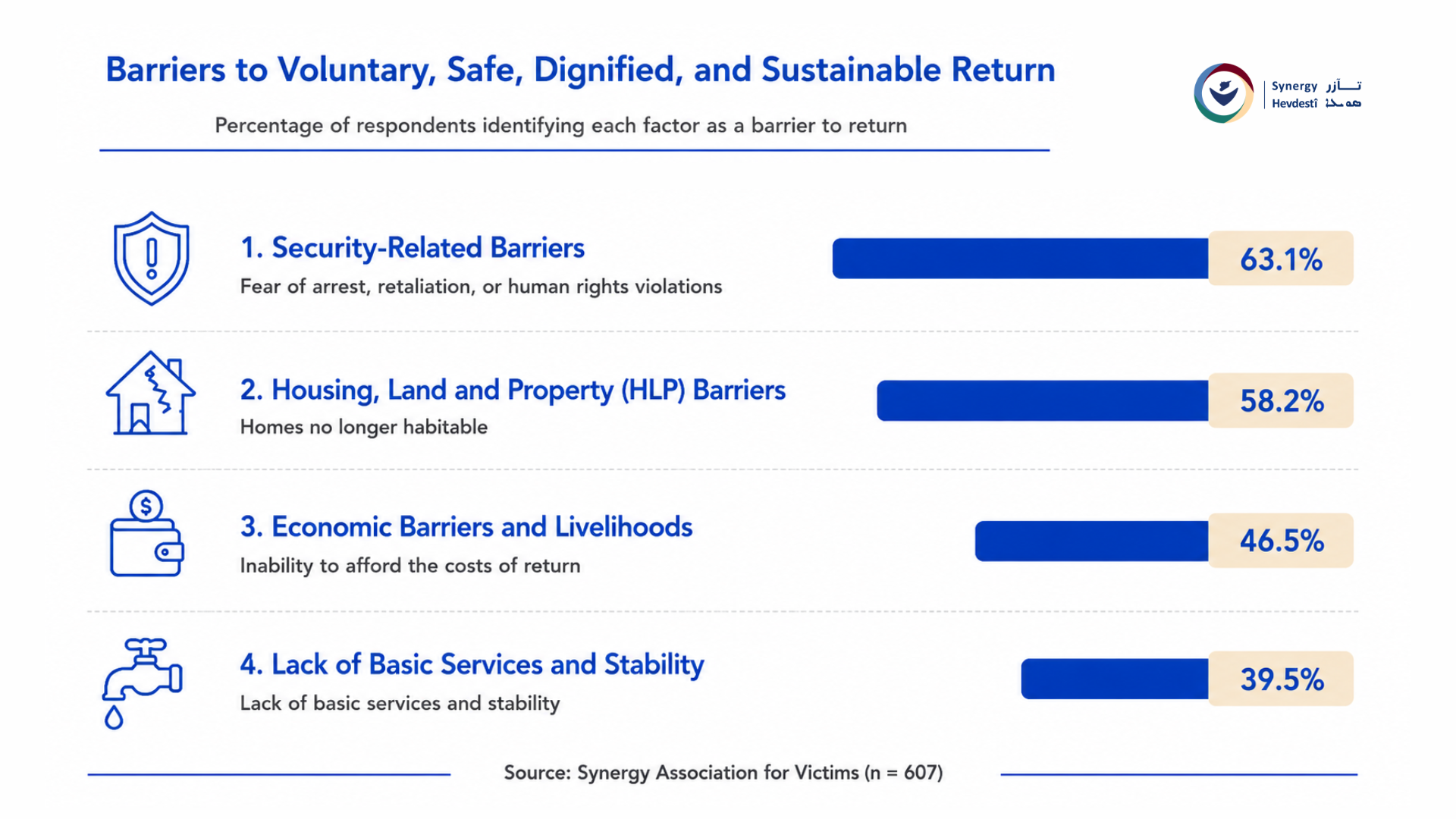
The assessment demonstrates that the displacement of residents of Ras al-Ayn/Serê Kaniyê and Tall Abyad/Girê Spî continues to be driven by a combination of interrelated security, human rights, economic, and service-related barriers. Together, these factors shape decisions on return and, under current conditions, prevent many forcibly displaced persons from returning to their places of origin. For analytical purposes, these barriers are grouped into four main categories.
-
Security-Related Barriers
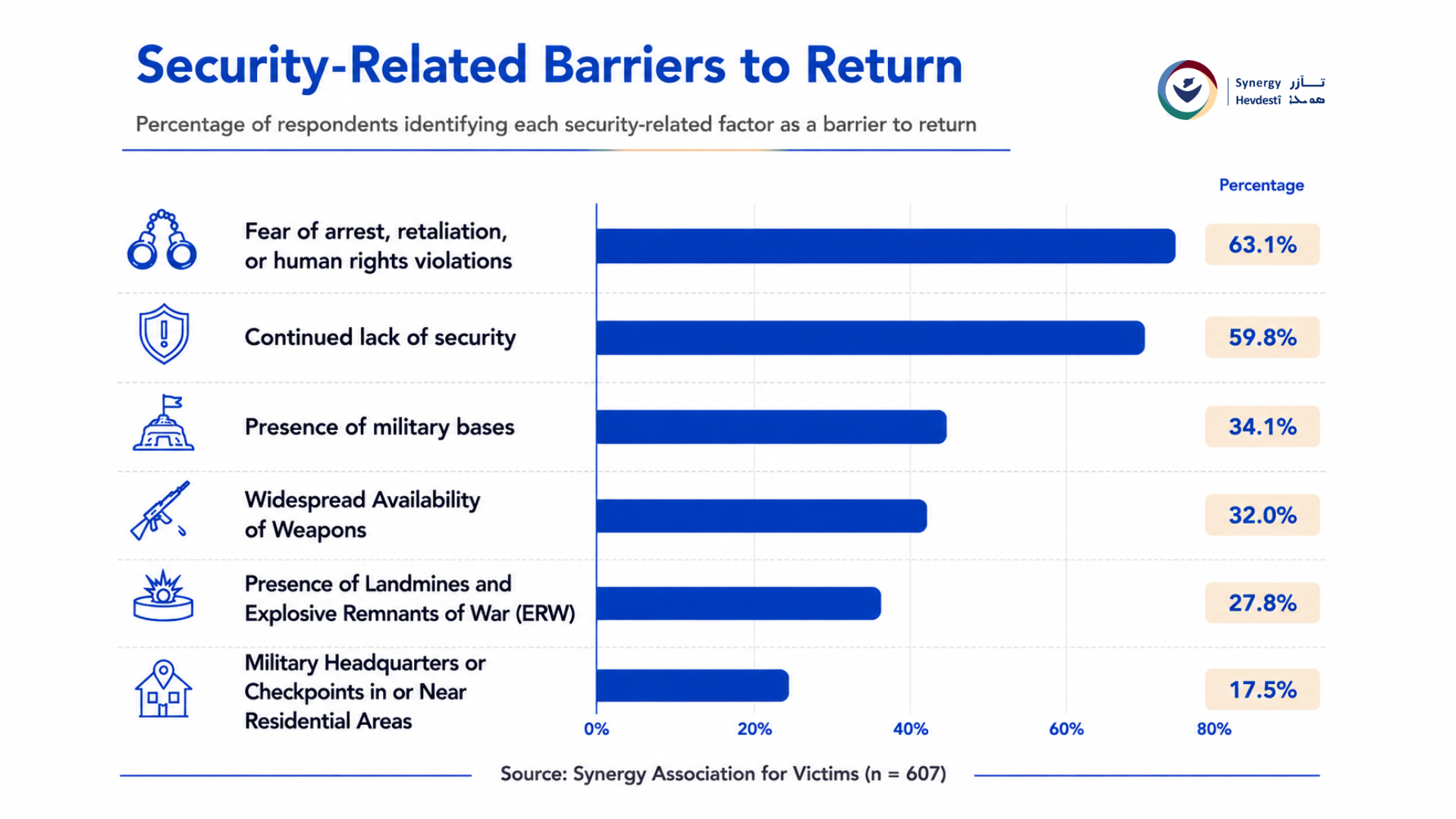
Security concerns emerged as the most significant factor influencing decisions on return. Overall, 63.1% of respondents identified fear of arrest, retaliation, or other human rights violations as the principal obstacle preventing their return, while 59.8% cited the continued lack of security in their areas of origin. In addition, 34.1% reported the presence of military bases, 32.0% highlighted the widespread availability of weapons, 27.8% pointed to the presence of landmines and explosive remnants of war (ERW), and 17.5% indicated that military headquarters or checkpoints were located within or in close proximity to civilian neighbourhoods.
These findings suggest that respondents’ concerns extend beyond the risk of renewed hostilities. Rather, they reflect the persistence of the same security environment that originally forced them to flee. The continued risk of human rights violations, the absence of effective legal safeguards, and the presence of armed actors in civilian areas all contribute to a pervasive sense of insecurity and erode confidence in the possibility of return and durable reintegration.
-
Housing, Land and Property (HLP)
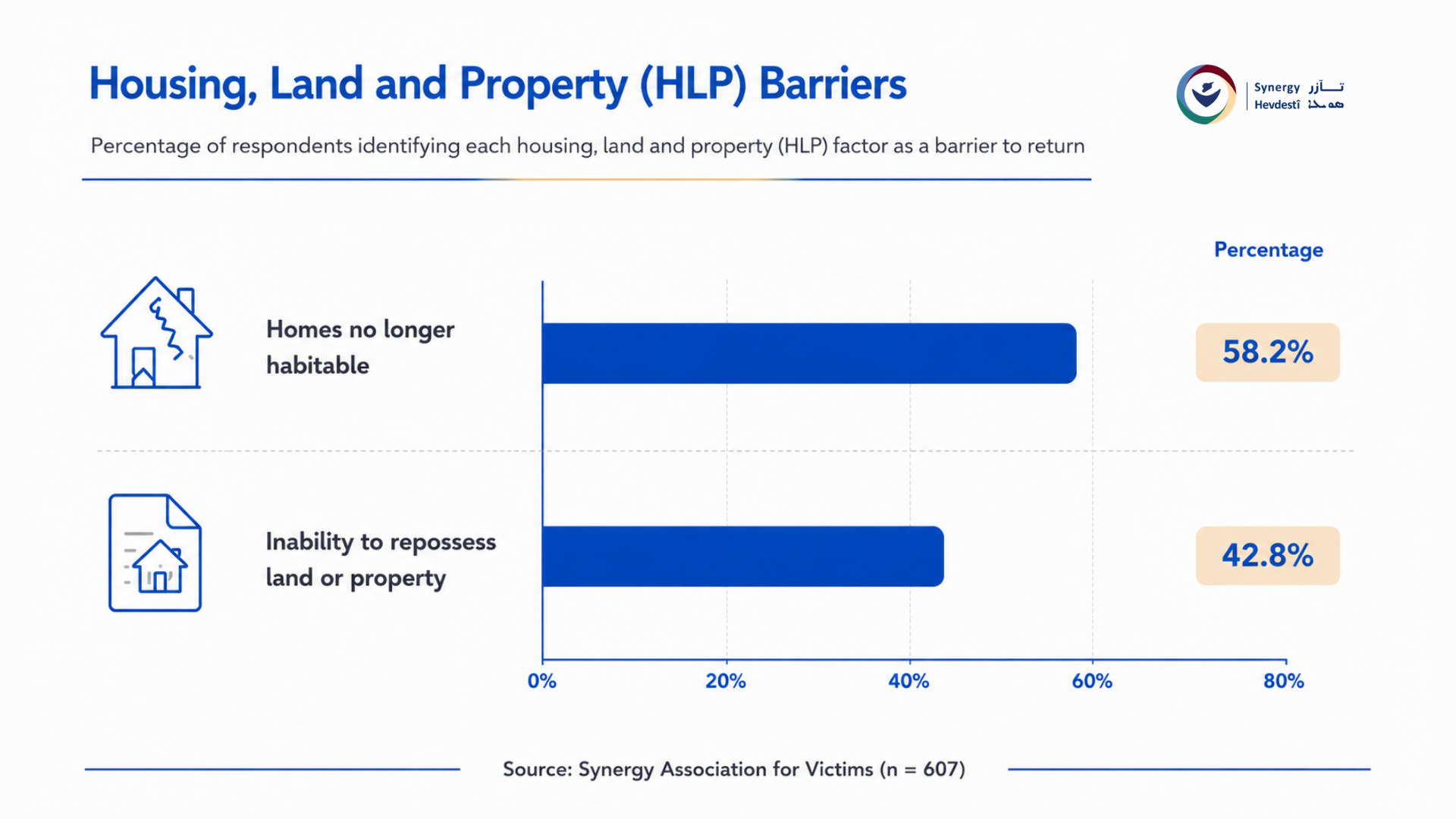
Housing, land and property (HLP) issues emerged as one of the principal barriers to return. Overall, 58.2% of respondents reported that their homes were no longer habitable, while 42.8% stated that their homes, land, or other property had been confiscated, occupied, or otherwise appropriated. Restoring these rights therefore constitutes a fundamental precondition for return.
-
Economic Barriers and Livelihoods
Economic conditions also have a direct bearing on both the feasibility of return and prospects for durable reintegration. 46.5% of respondents indicated that they could not afford the costs associated with returning, while 34.4% reported the absence of employment opportunities in their areas of origin. These findings highlight the importance of ensuring access to sustainable livelihood opportunities that enable families to rebuild their lives after years of displacement.
-
Lack of Basic Services
The lack of basic services was identified by 39.5% of respondents as a significant obstacle to return. In addition, 12.6% reported that employment opportunities in their current place of displacement influenced their decision not to return, 11.0% cited the continuation of a family member’s education, and 4.5% referred to family or social ties. These findings demonstrate that return decisions are shaped not only by conditions in areas of origin, but also by the degree of stability that some households have established during displacement, together with the availability and quality of essential services in their communities of origin.
VI. Prerequisites for Voluntary, Safe, Dignified, and Sustainable Return
Respondents consistently linked their decision to return to the fulfilment of a range of security, legal, service-related, and economic prerequisites that they consider essential before returning to their places of origin. For analytical purposes, these prerequisites are grouped into five main categories.
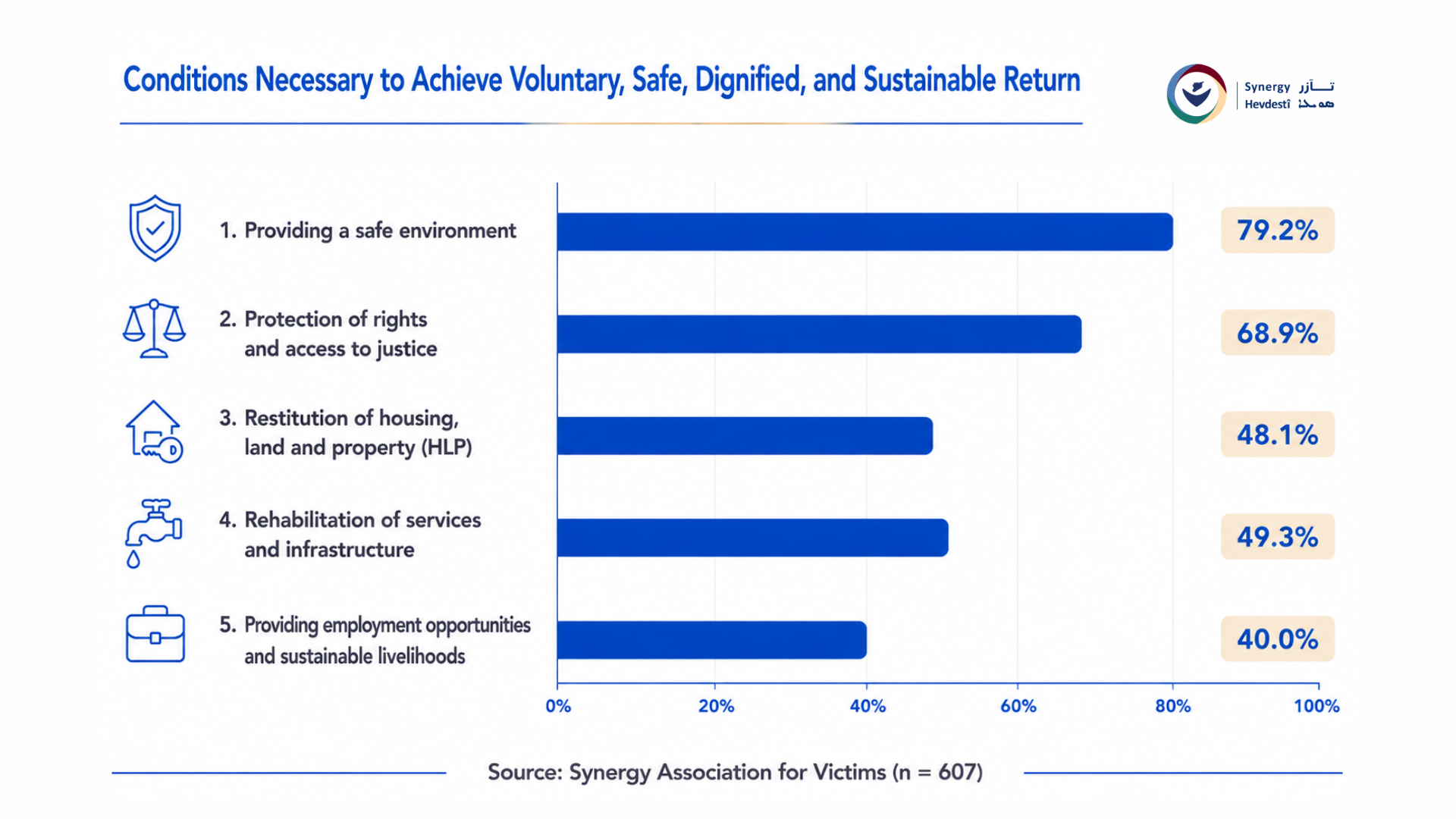
- A Safe and Secure Environment: A stable and secure environment emerged as the foremost prerequisite for return. Overall, 79.2% of respondents identified the restoration of security and stability as essential, while 42.7% stressed the need to remove military presence from civilian areas. A further 31.1% emphasized the importance of clearing landmines and explosive remnants of war (ERW).
- Protection of Rights and Reparations: Nearly seven in ten respondents (68.9%) identified compensation for losses and access to reparations as a key prerequisite for return. In addition, 56.7% emphasized the importance of effective legal safeguards to protect the rights of returnees, while 53.7% called for the establishment of an independent monitoring mechanism to oversee the return process and ensure that the rights of affected communities are respected throughout.
- Restoration of Housing, Land and Property (HLP) Rights: Overall, 48.1% of respondents identified the restoration of their housing, land and property (HLP) rights as a fundamental prerequisite for return.
- Restoration of Basic Services and Infrastructure: Almost half of respondents (49.3%) identified the restoration of essential public services as a prerequisite for return, while 39.5% emphasized the rehabilitation of critical infrastructure, including water and electricity networks, schools, healthcare facilities, and roads.
- Employment and Livelihood Opportunities: 40% of respondents identified access to employment and sustainable livelihood opportunities as a key prerequisite for ensuring household stability following return. Respondents emphasized that secure and sustainable sources of income are essential to rebuilding their lives, achieving self-reliance, and reducing dependence on humanitarian assistance.
VII. Transitional Justice from the Perspective of Forcibly Displaced Persons
The assessment findings indicate that respondents view transitional justice as an integral component of the conditions necessary for voluntary, safe, dignified, and sustainable return. Their priorities centre on the restoration of rights, access to reparations, and guarantees of non-recurrence.
- Reparations and the Restoration of Rights: Access to compensation and reparations emerged as respondents’ highest transitional justice priority, identified by 60.8% of respondents, followed by the restitution of housing, land, and property (HLP), cited by 54.9%. These findings underscore the importance of addressing the losses suffered by forcibly displaced persons through the restoration of their rights or, where restitution is not possible, the provision of fair and adequate compensation.
- Guarantees of Non-Recurrence and Accountability: Overall, 33.6% of respondents identified guarantees of non-recurrence as a priority, while 23.6% emphasized the importance of holding perpetrators accountable. These findings highlight the importance of measures that strengthen confidence in the future, reinforce the rule of law, and provide assurances that past violations will not be repeated.
- Priorities Supporting Recovery and Long-Term Stability: Respondents also identified reconstruction (23.4%), improvements in essential public services (21.9%), and expanded employment opportunities (18.3%) as important priorities for supporting recovery and long-term stability.
VIII. Post-Return Needs
The assessment findings show that respondents’ priorities following return extend beyond physical return itself and focus on the support required to restore stability and rebuild their lives. These needs include the rehabilitation of housing, the restoration of livelihoods, and continued access to essential services and post-return assistance.
- Financial Assistance and Housing Reconstruction: Financial assistance emerged as the most frequently identified post-return need, cited by 84.9% of respondents, followed by support for repairing or rebuilding damaged homes (66.1%). These findings reflect the extensive damage sustained by affected households and underscore the importance of providing adequate assistance to enable sustainable reintegration.
- Livelihood Restoration: Respondents emphasized the importance of support for establishing small businesses (35.5%), assistance in securing employment (28.6%), and agricultural support (27.4%). These findings highlight the critical role of sustainable livelihood opportunities in enabling households to regain self-reliance and rebuild their economic security.
- Essential Services and Complementary Support: Respondents also identified education support for children (38.5%), legal assistance (27.4%), mental health and psychosocial support (MHPSS) (22.7%), and assistance in obtaining civil documentation (11.9%) as important post-return needs. In addition, 14.9% highlighted debris removal in affected areas as an important prerequisite for reconstruction and the restoration of normal community life.
Overall, the findings demonstrate that post-return needs extend well beyond physical return. Sustainable return requires comprehensive support for recovery, stabilization, and durable reintegration, enabling families to rebuild their lives after years of forced displacement.
IX. Voices of Respondents
The open-ended comments provided by respondents at the end of the survey add an important human dimension to the findings presented in this report. Expressed in their own words, they illustrate how forcibly displaced persons perceive return and what they consider essential to restoring their lives and reclaiming their rights.
The following excerpts reflect some of the key priorities identified throughout this assessment:
“Ensure that return truly means returning to a safe and dignified life. Provide security and essential services, compensate those who have suffered harm, and respect every displaced person’s right to decide freely, and without any pressure, whether or not to return.”
“We call for the restoration of civilian property that has been unlawfully seized, and for compensation that enables returnees to rebuild their homes and live in them once again.”
“Return must be entirely voluntary, free from any form of pressure or coercion. It must be accompanied by security, protection for returnees and their property, and the restoration of essential services.”
X. Conclusions
The findings of this assessment demonstrate that the return of forcibly displaced persons depends on the existence of an environment that ensures security, protects rights, and supports long-term stability. They further confirm that return decisions are shaped by a combination of interrelated security, legal, economic, and service-related factors, underscoring the need for a comprehensive, rights-based approach grounded in the priorities and perspectives of forcibly displaced persons themselves.
Based on the assessment findings, the following conclusions can be drawn:
- The desire to return remains strong among the majority of forcibly displaced persons. However, return is contingent upon credible guarantees that provide safety, stability, and effective protection of their rights.
- Security and the protection of civilians remain the foremost prerequisites for return. Security-related concerns continue to be among the most significant factors influencing return decisions.
- Sustainable return depends on the protection and restoration of housing, land and property (HLP) rights, access to reparations, and effective remedies that restore rights, strengthen confidence, and reduce the risk of renewed displacement.
- The long-term stability of returning households depends on access to essential services, adequate housing, employment opportunities, and the support required to restore sustainable livelihoods.
- Respondents’ priorities reflect a practical understanding of transitional justice, placing particular emphasis on reparations, the restoration of rights, and guarantees of non-recurrence as essential foundations for building confidence in the conditions for return.
- Ensuring that return policies and programmes are responsive to the priorities of forcibly displaced persons will enhance the prospects for voluntary, safe, dignified, and sustainable return.
XI. Recommendations
A. To the Syrian Government
- Ensure that all returns are voluntary, safe, and dignified, and are based on the free and informed decisions of forcibly displaced persons, in accordance with applicable international principles and standards.
- Ensure the clearance of landmines and explosive remnants of war (ERW), remove military presence from civilian areas, and strengthen the rule of law.
- Protect housing, land and property (HLP) rights by establishing effective mechanisms for property restitution, resolving HLP disputes, and ensuring access to compensation and reparations.
- Rehabilitate critical infrastructure and restore essential public services, including water, electricity, education, and healthcare, while supporting the repair and reconstruction of damaged housing.
- Expand employment and sustainable livelihood opportunities and support economic recovery programmes that enable families to rebuild their lives following return.
B. To the United Nations, International Organizations, and Donors
- Ensure that all return-related policies and programmes are fully aligned with international standards governing voluntary, safe, dignified, and sustainable return, and that their implementation is contingent upon the fulfilment of the conditions identified by forcibly displaced persons.
- Draw on the findings of this assessment, together with other comparable assessments, in the design of return policies and programmes to ensure that interventions reflect the priorities and needs of forcibly displaced persons and are grounded in evidence and the meaningful participation of affected communities.
- Prioritize early recovery and reconstruction initiatives that support housing rehabilitation, the restoration of essential public services, and the recovery of sustainable livelihoods.
- Support independent mechanisms to regularly monitor the situation of returnees, document human rights violations, and oversee respect for their rights following return.
- Ensure the meaningful participation of forcibly displaced persons and victims’ associations in the design, implementation, monitoring, and evaluation of return-related policies and programmes.
- Support programmes that advance reparations, the restoration of rights, and the protection of housing, land and property (HLP) rights, recognizing these as key priorities identified through this assessment.
C. To the National Commission for Transitional Justice
- Integrate issues relating to forced displacement and return into all transitional justice processes to ensure that violations and their consequences for forcibly displaced persons are comprehensively addressed.
- Prioritize reparations, the restoration of rights and property, and guarantees of non-recurrence, in line with victims’ priorities and as essential foundations for sustainable return.
- Ensure the meaningful participation of forcibly displaced persons and victims’ associations in the design, implementation, and monitoring of transitional justice mechanisms.
D. To Civil Society Organizations and Victims’ Associations
- Continue to document the situation, needs, and priorities of forcibly displaced persons on a regular basis to support the development of evidence-based policies and programmes.
- Strengthen legal assistance for forcibly displaced persons, particularly in matters relating to housing, land and property (HLP), and support the documentation of HLP rights and related violations.
- Intensify advocacy efforts to ensure that return policies and programmes are grounded in the priorities of forcibly displaced persons and remain consistent with international principles and standards governing voluntary, safe, dignified, and sustainable return.
- Promote the meaningful participation of forcibly displaced persons in dialogue and decision-making on return-related policies and programmes, ensuring that their priorities, perspectives, and needs are effectively represented.
The full report (12 pages) is available in PDF format at the following link: