
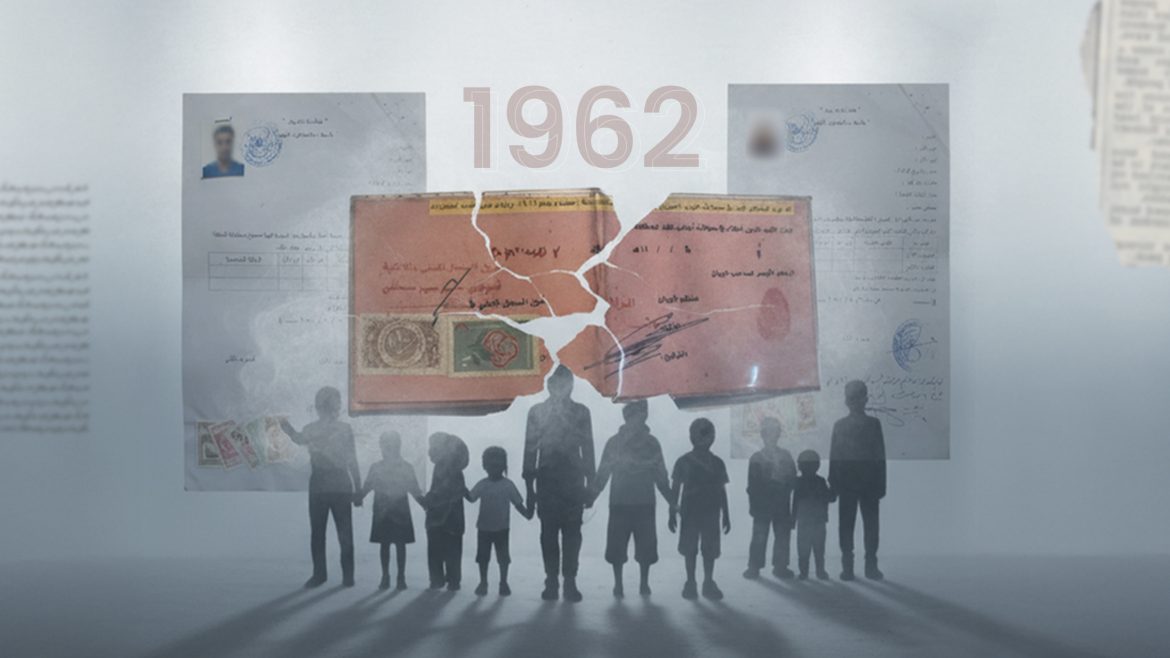
the Network of Statelessness Victims in al-Hasakah (NSVH) welcomes the inclusion of Article (4) in Presidential Decree No. (13) of 2026, viewing it as an official acknowledgment of the need to address the consequences of the Special Census conducted in al-Hasakah Governorate in 1962, which arbitrarily stripped tens of thousands of Kurdish citizens of their Syrian nationality.
Nevertheless, from a human rights perspective, the NSVH emphasizes that the current wording remains insufficient to address the structural and systemic roots of statelessness in al-Hasakah. The events of 1962 did not constitute an administrative mistake, but rather a deliberate and systematic violation of a fundamental human right. Accordingly, what is required today is not the “granting” of nationality, but the restoration of Syrian nationality to its rightful holders who were unjustly deprived of it, including unregistered persons (Maktumeen al-Qayd), without exception or discrimination.
Despite its significance, the decree remains inadequate unless it is promptly translated into binding legislation and clear, enforceable implementation measures. The text fails to specify any concrete implementation mechanisms, timelines, or independent oversight bodies. The lack of explicit implementation mechanisms, binding timelines, and independent oversight bodies raises serious concerns regarding the potential repetition of previous implementation failures, including administrative obstruction and arbitrary security interference that characterized previous attempts to address this issue, including Legislative Decree No. (49) of 2011.
The NSVH recalls that Legislative Decree No. (49) of 2011, despite the official promises that accompanied it regarding a comprehensive resolution of the issue of persons deprived of nationality, was implemented in a partial and selective manner. It was burdened by complex procedures and security-related obstacles, creating an environment that enabled brokerage practices and the exploitation of victims. As a result, large numbers of affected individuals—particularly unregistered persons and their children—were excluded, and statelessness has persisted in practice for thousands of families to this day. The NSVH stresses that this legacy of implementation failure must serve as a clear lesson in applying the current decree, rather than a model to be repeated.
Accordingly, the immediate priority must be the full and prompt implementation of Article (4) of the decree, particularly in al-Hasakah Governorate, through simplified and accessible procedures based on a comprehensive and collective approach. This must ensure the restoration of nationality to all those deprived of it, both inside and outside Syria, including refugees and members of the diaspora, without burdensome conditions or security interference. It should also enable for the completion of procedures through diplomatic missions abroad or through alternative legal mechanisms.
The NSVH emphasizes that resolving statelessness cannot be reduced to correcting civil registry records alone. Rather, it requires a broader approach based on two complementary tracks:
First, an immediate executive track that prevents future cases of statelessness; protects children from being born without nationality; guarantees equality in the transmission of nationality; enables collective regularization of the status of unregistered persons; recognizes documents issued abroad; and allows Syrian refugees and expatriates to restore their nationality or correct their civil status without being required to return to Syria. This track must also ensure effective civil registration systems that safeguard the rights to education, healthcare, and employment, and remove security agencies from involvement in civil status affairs.
Second, a transitional and acknowledgment-based track that includes explicit and official recognition of the injustice resulting from the 1962 Census, fair and collective reparations, genuine institutional reform, and legal safeguards to prevent the recurrence of such violations in the future.
Any approach that fails to incorporate recognition, redress, and guarantees of non-repetition will remain incomplete and will not effectively resolve one of the longest-standing cases of statelessness in Syria.
The Network of Statelessness Victims in al-Hasakah (NSVH) reiterates that the right to nationality is an inherent and inalienable human right. Its full restoration constitutes a genuine test of the state’s commitment to justice, equal citizenship, the rule of law, and respect for human rights in practice—not merely in rhetoric.
17 January 2026
The Network of Statelessness Victims in al-Hasakah (NSVH)
For further information, please visit our website, or contact us directly via:
- Phone / WhatsApp: +964 751 048 3382
- Email: contact@nsvh.network