
Tuesday – 7 April 2026
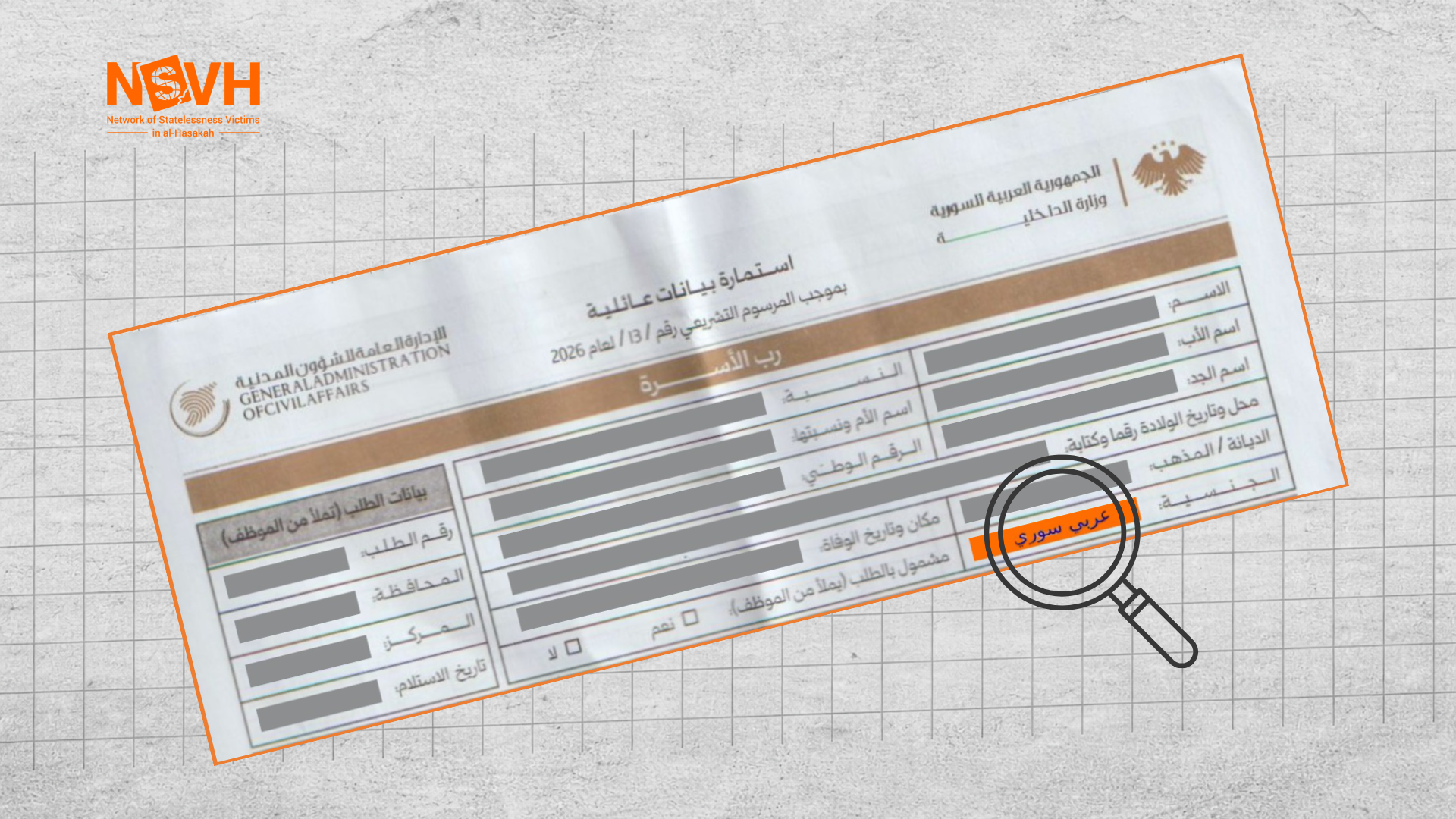
The Network of Statelessness Victims in al-Hasakah (NSVH) has documented, through field monitoring at nationality application centres across the governorate, recurring cases in which Kurdish applicants are registered in official forms as “Syrian Arab.” These incidents have sparked widespread concern among Kurdish applicants and raised serious questions regarding compliance with Decree No. 13 of 2026.
These practices, documented at designated centres (Qamishli/Qamişlo, al-Hasakah, al-Malikiyah/Dêrik, al-Darbasiyah, and al-Jawadiyah/Çil Axa), contravene both the intent and the objectives of Decree No. 13 of 2026. The decree explicitly recognizes Kurds as an integral component of the Syrian people, affirms the protection of their cultural and linguistic identity, and seeks to redress the discriminatory legacy of the 1962 Special Census.
First: Contradiction with the Core Principles of the Decree
The inclusion of inaccurate or imposed ethnic classifications contradicts the very purpose of the decree and undermines its central objective—namely, to remedy past injustices rather than reproduce them through new administrative practices. It also constitutes a direct infringement on individuals’ right to freely self-identify with dignity.
Second: Risk of Indirect Administrative Discrimination
The Network considers that these practices may amount to indirect administrative discrimination, whereby ostensibly neutral procedures result in the effective marginalization of Kurdish identity in Syria. This is inconsistent with the principle of non-discrimination under International Human Rights Law (IHRL). The granting of nationality, as a fundamental legal right, must be carried out within a fully neutral framework, free from any imposed or inferred ethnic or cultural reclassification.
Third: The Network warns that the continuation of such practices may:
- Undermine trust in the process and discourage applicants;
- Expose the process to future legal challenges regarding the legitimacy of its procedures and outcomes;
- Reinforce long-standing patterns of discrimination and exclusion experienced by Kurds;
- Undermine the decree’s value as a genuine measure of reform and justice.
Fourth: The Network calls on the Syrian transitional government to take immediate and concrete measures, including:
- Immediately revising the approved application forms to remove any pre-imposed classifications;
- Issuing a clear and binding administrative directive to all centres prohibiting the imposition of any ethnic designation, and requiring staff to record informationstrictly as declared by applicants, without modification or assumption;
- Establishing an independent and effective complaints mechanism to enable applicants to challenge and correct any data recorded without their consent;
- Ensuring full transparency throughout all stages of the process, including interviews, biometric registration, and the announcement of results;
- Strengthening independent oversight by involving civil society organizations in monitoring the process and documenting any violations.
Fifth: The Network calls on the United Nations, its relevant agencies, and international organizations concerned with human rights and statelessness to:
- Closely monitor the implementation of Decree No. 13 of 2026;
- Advocate for full compliance with international human rights standards, particularly the principle of non-discrimination;
- Support legal awareness efforts targeting applicants, especially the most marginalized groups;
- Contribute to the establishment of independent monitoring mechanisms overseeing the process.
The Network of Statelessness Victims in al-Hasakah (NSVH) reaffirms that the right to nationality is a fundamental and indivisible human right, intrinsically linked to legal recognition and the enjoyment of all other rights. Any partial or distorted approach to this issue risks perpetuating injustice rather than resolving it.
This moment represents a critical test of the authorities’ commitment to transitional justice, equal citizenship, and respect for diversity. The success of this process depends on safeguarding the dignity and identities of applicants and ensuring that no classification is imposed upon them under any circumstances. Any failure in this regard risks undermining the credibility of the process as a whole.
Network of Statelessness Victims in al-Hasakah (NSVH)
For further information, please visit our website, or contact us directly via:
- Phone/WhatsApp: +964 751 048 3382
- Email: contact@nsvh.network