
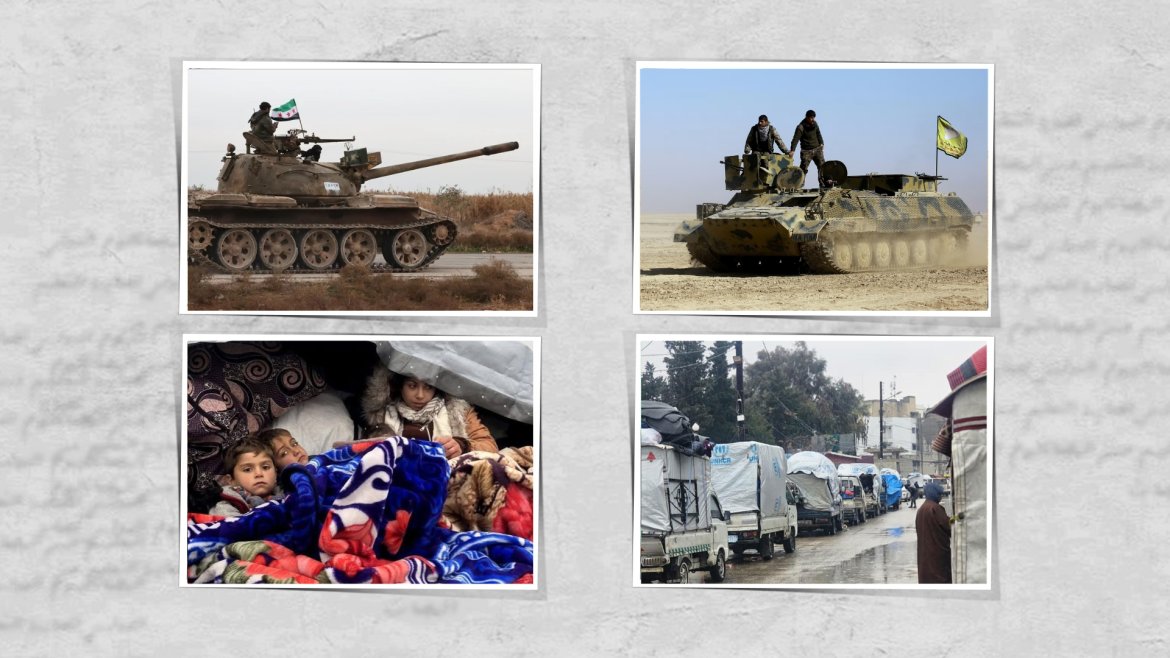
Northeast Syria is witnessing a dangerous military and security escalation, accompanied by a rapidly deteriorating humanitarian situation. Within only a few days, these developments have triggered a large-scale wave of displacement from the cities of Raqqa and Tabqa toward al-Hasakah Governorate, particularly the cities of al-Hasakah and Qamishli.
According to verified field data, more than 25,000 people were displaced in less than 48 hours, including over 20,000 individuals who arrived in al-Haksalah and Qamishli. Displaced families reached these areas under extremely harsh conditions, facing acute shortages of shelter, food, humanitarian assistance, and essential services. These conditions place civilians at serious risk to their health, safety, and livelihoods.
Repeated Displacement and Heightened Vulnerability:
Field assessments indicate that a significant proportion of displaced families have already experienced repeated instances of forced displacement in recent years and remain unable to return to their areas of origin—particularly families originally displaced from Afrin. Repeated displacement has compounded their economic and social vulnerability, exhausted coping mechanisms, and significantly intensified humanitarian needs.
The displaced population includes large numbers of children, women, and elderly persons, increasing the risk of disease outbreaks, malnutrition, and unmet medical needs—especially in overcrowded shelters, fragmented displacement sites, and amid limited humanitarian response capacity.
Conditions in Collective Shelters:
Displaced persons are currently accommodated in 111 collective shelters across al-Hasakah Governorate as follows 18 in al-Hasakah City, 77 in Qamishli, 10 in Derik, 5 in Amuda and 1 in Tell Hamis.
These shelters—primarily schools and public buildings not designed for prolonged habitation—are severely overcrowded and lack privacy, adequate water, electricity, and sanitation. The use of educational facilities as shelters has also disrupted schooling and other essential public services.
At the same time, many displaced families are being hosted by local residents, despite the hosts’ own severe economic hardship. This has placed additional strain on limited resources and complicated efforts to register displaced populations and assess humanitarian needs.
Displaced families face critical shortages of:
- Food and essential non-food items;
Adequate shelter, bedding, and winter supplies;
- Health services, including medicines and maternal and reproductive healthcare for pregnant women, children, and people with chronic illnesses;
- Water, electricity, and sanitation facilities, with most shelters falling far below minimum humanitarian standards and an urgent need for water storage solutions.
Escalating Military Operations and Risks to Civilians:
This mass displacement is occurring amid intensified military operations and clashes between forces affiliated with the Syrian transitional government and the Syrian Democratic Forces (SDF). These hostilities have involved shelling, security threats, and the direct or indirect targeting of civilian areas, generating widespread fear and forcing thousands to flee in search of safety.
Hundreds of families remain trapped in high-risk areas, unable to escape due to the absence of safe humanitarian corridors and the continued deterioration of the security situation. Field sources have also documented attacks on convoys carrying displaced civilians, resulting in civilian deaths and injuries and triggering secondary displacement within al-Hasakah Governorate.
De Facto Siege and Denial of Essential Services:
Available evidence indicates that al-Hasakah Governorate and Kobani City are facing conditions amounting to a de facto siege, amid credible fears of further military escalation. Water and electricity supplies to Kobani have been cut, significantly worsening humanitarian conditions and exposing civilians—particularly children, older persons, and patients—to serious risks.
Al-Hasakah Governorate is already hosting tens of thousands of forcibly displaced persons from Ras al-Ayn/Serê Kaniyê and Afrin, including residents of the Washokani/Twaina and Serê Kaniyê/Al-Tala’i camps, which together accommodate more than 25,000 people, in addition to numerous collective shelters. The governorate also hosts thousands of displaced persons from Tell Abyad, Raqqa, and Tabqa, further overwhelming already strained resources and essential services.
Existential Fears Among Communities in al-Hasakah and Kobani:
The current escalation has generated profound existential fears among residents of al-Hasakah and Kobani, particularly among Kurds and other religious and ethnic communities. These fears stem from the potential entry of government-affiliated forces previously implicated in grave human rights violations and massacres in multiple areas of Syria, including Kurdish neighborhoods in Aleppo, as well as violations reported during the ongoing operations in northeast Syria.
These concerns are compounded by growing reports of the escape of hundreds of ISIS detainees amid the escalation in Raqqa, al-Hasakah, and Deir ez-Zor. This raises serious alarms regarding identity-based targeting of civilians and the risk of mass violence against minorities, echoing past atrocities in Syria’s coastal region and in As-Suwayda.
Documented Grave Violations:
Credible and verified information confirms the occurrence of grave violations against civilians during military operations, both in the neighborhoods of Sheikh Maqsoud and Ashrafieh in Aleppo and across parts of northeast Syria. Documented violations include public humiliation, threats, arbitrary detention, and degrading treatment, supported by eyewitness testimonies and verified video evidence.
Military operations have also resulted in the killing of dozens of civilians, including women and children.
Synergy Association for Victims continues to document and verify approximately 500 cases of missing or forcibly disappeared persons, including 28 women, whose fate and whereabouts remain unknown. To date, no official information has been provided, and families lack effective mechanisms to obtain answers of their loves ones.
These developments are linked to military operations that began on 6 January 2026 in Sheikh Maqsoud and Ashrafieh and culminated on 10 January 2026 with the takeover of the two predominantly Kurdish neighborhoods by forces affiliated with the Syrian transitional government, following clashes with the Internal Security Forces (Asayish) of the SDF. These clashes resulted in dozens of killed and wounded.
Military operations subsequently expanded to northeast Syria and continue to produce devastating consequences. Despite the announcement of a ceasefire on 18 January 2026, available information indicates that the agreement effectively collapsed following a meeting held in Damascus the next day.
Legal Assessment and Recommendations:
The documented violations, and the recurring and systematic patterns they reveal, point to a serious failure to uphold International Humanitarian Iaw and international Human Rights Law. Accordingly, we call for:
- An immediate and unconditional ceasefire, with the protection of civilians and civilian infrastructure as an absolute priority;
- The immediate cessation of all violations against civilians;
- Full guarantees against arbitrary detention and enforced disappearance, and respect for human dignity in all circumstances;
- Independent, transparent, and credible investigations into all alleged violations, with accountability for all perpetrators without exception;
- Immediate disclosure of the fate and whereabouts of all missing and detained persons, and regular, clear communication with their families;
- Explicit condemnation of sieges and the denial of water and electricity, rejection of the use of essential services as tools of collective punishment, and the unconditional restoration of these services;
- Meaningful participation of local communities in any security or administrative arrangements affecting their lives and rights;
- Special protection for Kurds and other communities at risk of grave violations, and full respect for their fundamental rights.
We issue a clear and urgent warning that the continuation of the current military escalation risks precipitating mass forced displacement, ethnic cleansing, and the outbreak of renewed internal conflict, with consequences that would extend far beyond northeast Syria and seriously undermine the stability and security of the wider region.
We therefore call on all parties involved, on Syrian society as a whole, and on media institutions and journalists in particular, to categorically reject hate speech, incitement, and all forms of violence. We urge them to uphold their responsibility to prioritize peaceful solutions and meaningful dialogue as the only viable and legitimate path to protecting civilians, preserving coexistence among Syria’s diverse communities, and safeguarding civil peace in northeast Syria and throughout the country.