
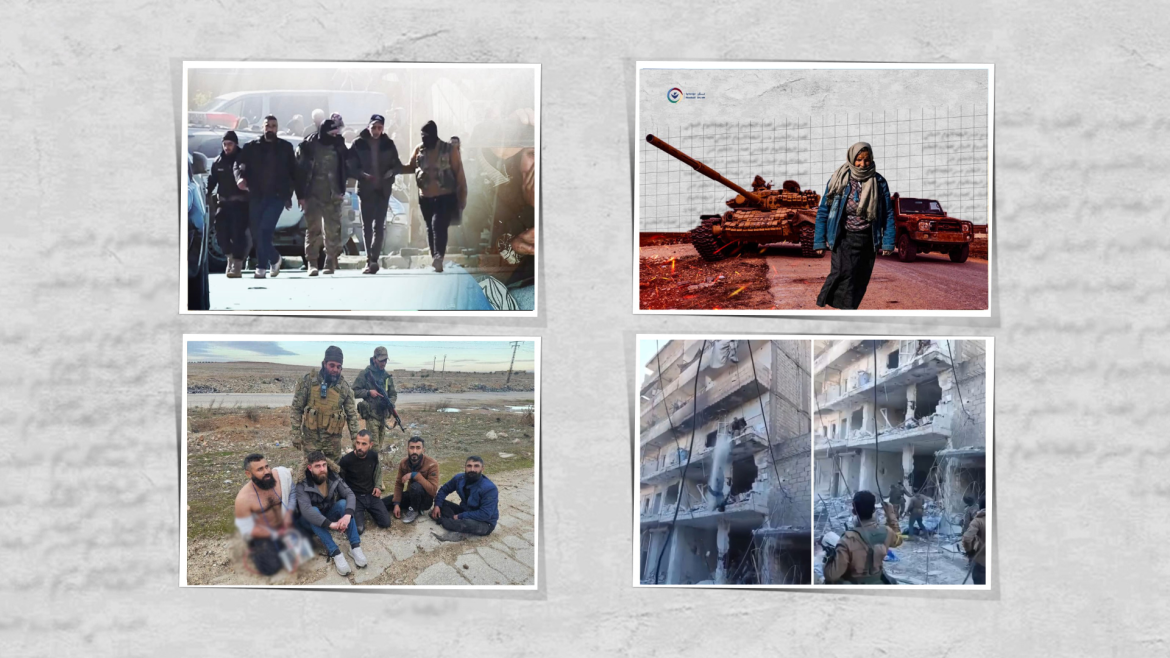
Verified information indicate that civilians in the Sheikh Maqsoud and Ashrafieh neighborhoods of Aleppo have been subjected to serious violations, including public humiliation, threats, arbitrary detention, and degrading treatment. These findings are based on corroborated witness testimonies and verified video evidence.
The footage shows civilians being rounded up and detained while subjected to direct insults, threats, and dehumanizing language that undermines their dignity. In one video, dozens of civilians, including women, are held collectively in a humiliating manner, while the person filming moves among them, making inciting and derogatory remarks such as: “These are pig captives,” “Praise be to God who humiliated them and granted victory to His servant,” “These are federalism projects,” “These pigs, atheists,” and “Qandil dogs.” These statements are accompanied by explicit threats to punish detainees outside any legal framework.
Particularly concerning is the intervention of individuals identified as members of the “Syrian Army,” who attempted to stop the filming, thereby facilitating the continuation of violations and reinforcing a climate of impunity. This reflects a disturbing pattern in which the suppression of documentation is prioritized over the prevention of violations.
Within the same context, other videos document extremely grave violations, including the throwing of the body of a Kurdish woman fighter from a building in Sheikh Maqsoud amid celebratory chants, the dragging of another individual in military attire down stairs, and the public humiliation of detainees. These acts constitute serious breaches of International Humanitarian Law (IHL), violate human dignity, and amount to blatant assaults on the sanctity of the dead and the rights of their families.
In addition, the neighborhoods of Sheikh Maqsoud and Ashrafieh were subjected to shelling targeting civilian objects and structures, resulting in dozens of civilian casualties, including 45 killed, among them women and children, as well as more than 120 injured, and causing extensive damage to homes and property. The shelling was not limited to the locations officially announced, but also struck other civilian sites, in a clear violation of the principles of distinction and protection of civilian objects.
Furthermore, cases of missing persons or enforced disappearance involving 526 individuals, including 29 women, are currently being verified. Their fate remains unknown to date, amid the absence of any official information regarding their whereabouts or destiny, and the lack of any communication channels enabling families to learn the fate of their loves ones.
The military operations and related violations triggered a large-scale displacement. Cross-verified data indicate that over 160,000 people displaced Sheikh Maqsoud and Ashrafieh toward Afrin and other neighborhoods of Aleppo. Moreover, 292 families, totaling over 1,000 individuals, were forcibly relocated to areas in northeast Syria, under harsh conditions and without protection guarantees.
The grave violations committed in Sheikh Maqsoud and Ashrafieh cannot be viewed as isolated or individual incidents. Patterns of degrading treatment, arbitrary detention, and violations of human dignity closely mirror practices previously documented in other parts of Syria, including the coastal region and As-Suwayda, indicating the existence of a systematic approach in the treatment of civilians.
These violations occurred within the context of a military and security escalation that began in the two neighborhoods on 6 January 2026, following the launch of military operations by “Syrian Army” forces in the area. The escalation culminated on 10 January with the takeover of both neighborhoods after violent clashes with the Internal Security Forces (Asayish) of the Syrian Democratic Forces (SDF), resulting in dozens of killed and wounded.
In light of the scale, severity, and recurring patterns of these violations, there is a serious structural failure to uphold International Humanitarian Law (IHL) and human rights law. An urgent, comprehensive response is required prior to any discussions on stability or return, including:
- Immediate cessation of all forms of violations against civilians.
- Ensure the protection of civilians from arbitrary detention and enforced disappearance, and respect human dignity.
- Independent, transparent, and credible investigations into all documented violations in line with international standards.
- Public accountability for all perpetrators, regardless of position or affiliation, and an end to impunity.
- Immediate disclosure of the fate of missing and detained persons, with clear information provided to their families.
- Genuine inclusion of local population representatives in any security or administrative arrangements affecting their lives and rights.
Continued violations without accountability pose a direct threat to social peace, undermine any genuine efforts toward stability and safe return, and entrench impunity as de facto policy.