
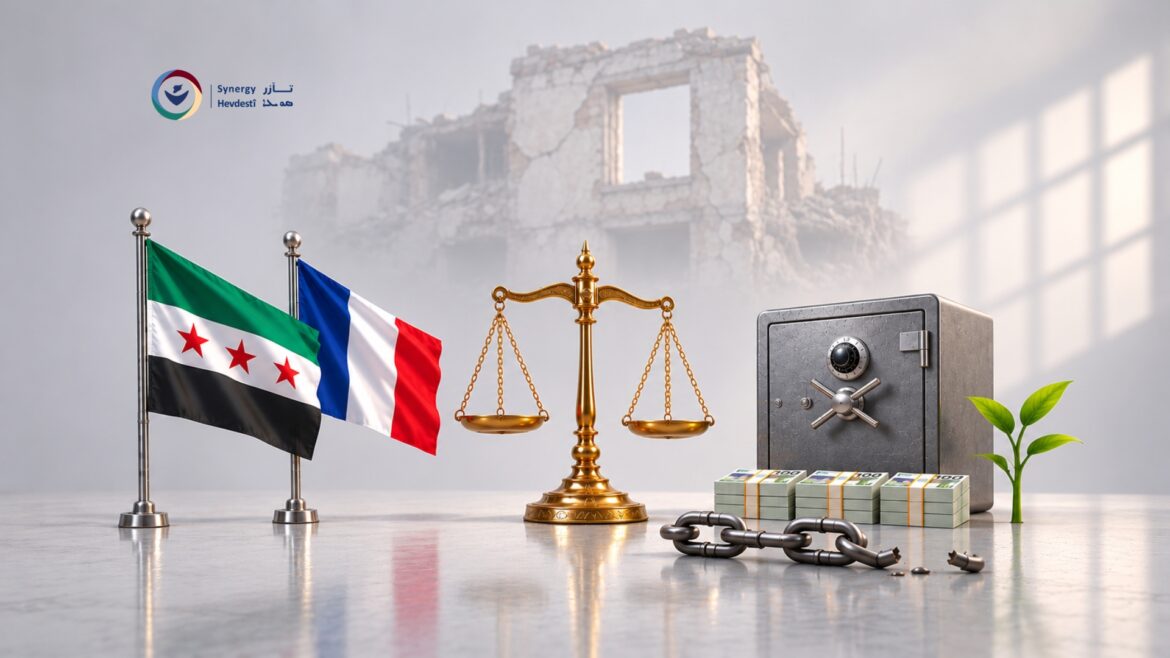
Synergy Association for Victims, together with a number of Syrian and international victims’ associations and civil society organisations, has joined a joint call addressed to the Syrian and French governments, urging them to allocate a portion of the proceeds from assets confiscated from Rifaat al-Assad to provide reparations for survivors and victims of gross human rights violations.
The call stresses that the return of these funds should be an opportunity to advance justice for victims and address their ongoing needs. This includes allocating resources for compensation and rehabilitation, while ensuring their meaningful participation in setting spending priorities, designing programmes and overseeing their implementation, with transparency and accountability at every stage.
It also calls on both governments to involve survivors’ associations and independent Syrian civil society organisations in decisions on how these funds are used, before projects are approved and resources allocated, ensuring that the funds are directed towards addressing the harm suffered by victims and their families.
The full text of the joint call is available below:
To:
Mr Asaad Hassan al-Shaibani, Minister of Foreign Affairs and Expatriates, Syria
Mr Jean-Noël Barrot, Minister for Europe and Foreign Affairs, France
Cc: Mr Jean-François Guillaume, France’s Special Envoy for Syria
Dear Ministers,
We, the undersigned organisations, urge Syria and France to work together to prioritise reparations for victims and survivors of gross human rights violations in the allocation of proceeds from assets confiscated from Rifaat al-Assad. As the two governments prepare to exchange project proposals, we call for a dedicated allocation for reparations and meaningful survivor participation before decisions on the use of these funds are agreed.
Under the Assad regime, corruption and grave human rights violations were mutually reinforcing. Detention and disappearance enabled the confiscation of homes, businesses and savings, while families paid to obtain information about loved ones or secure their release. In its 2022 report, They Took Everything, the Association of Detainees and the Missing in Sednaya Prison (ADMSP) estimated that the regime had confiscated more than US$1.5 billion in detainees’ assets since 2011. This extraction generated revenue for the regime while leaving survivors and families without the resources to recover from abuse. Returning wealth accumulated within this system creates an opportunity to address that connection between illicit enrichment and enduring harm.
The planned return of proceeds from assets confiscated from Rifaat al-Assad marks the first implementation of the restitution mechanism established by France’s Law No. 2021-1031 of 4 August 2021. This framework provides for funds to benefit the populations concerned through cooperation and development activities, with transparency, accountability and civil-society participation. The forthcoming France–Syria return arrangements will therefore set an important precedent, attracting close attention within Syria and internationally.
We welcome France’s action to recover these assets and return their proceeds for the benefit of the Syrian people. However, the asset return process itself can be reparative: by acknowledging the wrongs suffered, giving survivors influence over decisions, and directing funds towards repairing the harms survivors suffered under Assad. Survivors of torture, sexual violence and other grave violations, and families of the disappeared, face daily physical pain, trauma, economic hardship and exclusion. Compensation, rehabilitation, education and livelihood measures can restore their health, security and participation in society. Designed with survivors and grounded in recognition of their rights, these measures would make reparations an integral part of Syria’s recovery and development, and would be a much-needed investment in human capital, social cohesion and peacebuilding. We therefore call on the French and Syrian authorities, to:
- Commit a significant allocation of the Assad assets to reparations: Finance measures responding to urgent harms, including rehabilitation and compensation for survivors, and recognition and redress for families of the disappeared, with a clear timetable for delivery.
- Give survivors an effective role in decisions: Involve diverse survivor groups and independent Syrian civil society in setting priorities, designing programmes and overseeing implementation, beginning before project selection.
- Ensure transparent and accountable use of the funds: Publish allocation criteria, governance arrangements and expenditure, provide independent oversight, and enable survivors to assess whether the measures deliver meaningful redress.
Reporting by The Sunday Times on 8 November 2026 highlights the continuing consequences of the Assad regime’s abuse and the potential use of perpetrators’ assets to finance reparations. This week’s World Bank 3rd Symposium on Supranational Response to Corruption: Turning Illicit Gains into Development Outcomes in Vienna places the development impact of recovered assets on the international agenda. As outlined in this Symposium paper, France and Syria should now establish a precedent for future returns. They should now show that recovered wealth must help repair the harm caused by the systems through which it was accumulated.
We request an urgent meeting with your representatives before allocations are finalised to discuss how these commitments can be reflected in the return arrangements.
Yours sincerely,
Signatory organizations:
- Association of Victims of Chemical Weapons
- Association of Detainees and Missing Persons of Sednaya Prison (ADMSP)
- Syrian Network for Human Rights
- Syrian Center for Media and Freedom of Expression
- Syria Legal Development Programme
- Syria Campaign
- Synergy Association for Victims
- Syrian Alliance Damma Association
- Syria Direct
- Truth Guardians
- Nakhla Foundation
- Media Association for Survivors and the Missing
- Massar Families
- Lawyers and Doctors for Human Rights
- Dar Justice
- Justice for Life
- International Humanitarian Relief
- Karam Shaar Advisory Ltd.
- Global Survivors Fund
- Strategic Litigation Project
- African Center for Governance, Asset Recovery, and Sustainable Development
- CiFAR – Civil Forum for Asset Recovery e.V.
- Michael O’Connell AM APM, Consulting Victimologist
- REDRESS
- Universal Rights Group
- Transparency International France
- Transparency International Bangladesh