
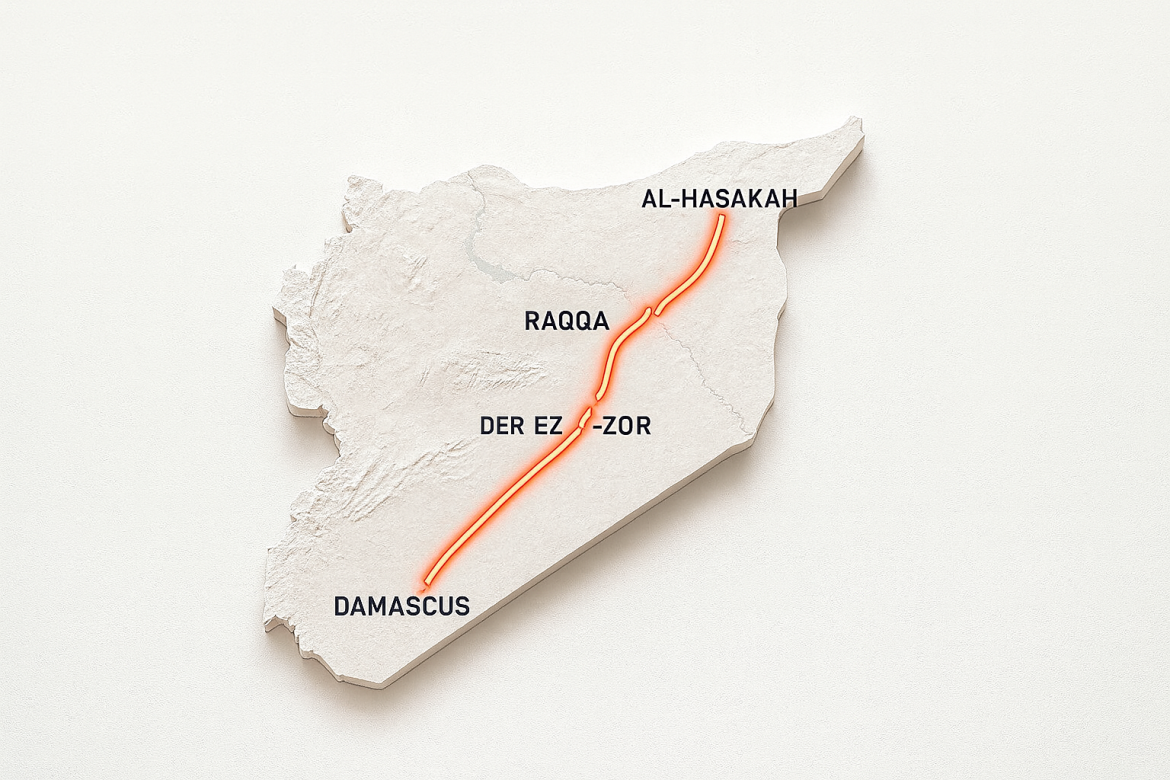
The Syrian organizations signing this statement strongly condemn the repeated detention of civilians traveling to and from areas in Northeast Syria at military checkpoints operated by the Syrian Interim Government. This practice constitutes a serious violation of the fundamental rights of the population, foremost among them freedom of movement, physical safety, non-discrimination, privacy, and the protection of personal data.
Over the past weeks, there has been a notable rise in the number of arrests at checkpoints controlled by the Syrian Interim Government. The Manager of “Haval” Transport Company stated to North Press that approximately 20 people had been detained on the road leading to Damascus and Aleppo. Likewise, Arta FM, a local radio station, reported that two persons from Derik/al-Malikiyah —who were traveling to the capital to obtain passports and register at Damascus University—were detained after the Ethriya Road was closed in mid-October.
The closure of the Ethriya Road forced transport companies and travelers to take a long alternative route through Raqqa, then the Maadan checkpoint, and onward to Deir ez-Zor and Damascus—a journey that took around 15 hours by bus. Meanwhile, direct crossing between the two banks of the Euphrates River was impossible due to maintenance work on the main bridge, making passage through the Maadan checkpoint unavoidable. It was there that most of the arrests were recorded.
Cross-checked testimonies confirmed that members of the Syrian Transitional Government searched the travelers’ phones—including their social media accounts and messaging applications—without any clear legal basis, in a flagrant violation of individuals’ right to privacy and the confidentiality of their personal data. In some cases, the information obtained was used to justify arbitrary arrests or prolonged interrogations.
Furthermore, activists reported that some of the detainees had participated in the “Day of Dialogue” with Syrian civil society, organized by the European Union (EU) in Damascus on November 15. Cross-checked testimonies also indicated that travelers of Kurdish origin were particularly targeted for repeated arrests, raising concerns about selective and discriminatory practices on the basis of nationality, without any legal justification.
At the same time, cases were recorded in which travelers entering areas in Northeast Syria were interrogated at checkpoints run by the Autonomous Administration, particularly during periods of heightened security tension. Although these cases are fewer, they add to the pressure on civilians and contribute to an escalating state of fear and anxiety.
The continuation of these practices by both sides—particularly the serious violations recorded at checkpoints affiliated with the Syrian Transitional Government—exacerbates the suffering of patients, students, and civil society personnel. It hinders their access to health and educational services, as well as to official documents, and restricts their ability to participate in civil and international events held in Damascus. These obstacles negatively impact the work of civil society and the services it provides to the population.
Recalling that freedom of movement is a fundamental right guaranteed by the International Covenant on Civil and Political Rights (Article 12), as well as by the principles of the International Humanitarian Law (IHL), which prohibit the arbitrary targeting of civilians or the restriction of their movement, the organizations emphasize that neutralizing travel roads from political and military disputes and respecting civilians’ privacy constitute non-negotiable legal and moral obligations.
Accordingly, the organizations call on:
First: The Syrian Transitional Government
- Reopen the Raqqa–Ethriya Road urgently, and issue an official statement clarifying the reasons for its closure and its expected duration, ensuring full transparency for residents.
- End the arbitrary arrests immediately, ensure that all checkpoints and crossings comply with the law and the humanitarian standards, and prohibit their use for blackmail, revenge, or harassment purposes against the population.
- Stop searching travelers’ phones and electronic devices, respect their right to privacy and the confidentiality of their data, and prevent the use of any digital information as justification for violating basic rights.
- Organize forces stationed along alternative routes to facilitate bus movement, reduce the duration of journeys, and mitigate risks for civilians.
- Issue obligating instructions prohibiting discriminations or targeting based on nationality, political affiliation, civil activity, or participation in international events; conduct transparent investigations, hold perpetrators accountable, and ensure victims’ rights to lodge complaints and receive compensation.
- Enhance transparency through publishing information and periodic updates on checkpoint conditions, security procedures, and alternative routes, with the aim of reducing fear and rumors among the population.
Second: The Autonomous Administration of North and East Syria (AANES)
- Ensure that its checkpoints do not arbitrarily restrict, or interrogate travelers, and avoid creating an atmosphere of fear or the perception of selective targeting.
- Publish clear guidelines and regular updates on the safe roads and communication channels during emergency, in order to strengthen the citizens’ sense of safety and trust.
Third: International and Regional Actors in the Syrian Affair
- The United States of America
- Continue supporting the implementation of the provisions of the March 10 Agreement, particularly regarding the safe return of displaced persons to their original homes, of which freedom of movement is an integral part.
- Encourage local parties to halt arbitrary arrests at checkpoints and ensure that civilians are kept neutral in political and military rivalries related to the negotiation process.
- The European Union
- Publicly condemn violations against participants in the civil dialogue events or EU-supported activities, and ensure that they are not harassed, arrested, or targeted upon returning to their hometowns.
- Link support and development programs, including funding channels, to the establishment of safe routes and corridors, and to enabling a dignified return, in a manner that guarantees all people access to essential services without obstacles or discrimination.
- The United Nations and International Organizations
- Include the issue of freedom of movement and the right to digital privacy in periodic reports submitted to the Security Council and the UN Mechanisms on Syria, highlighting these as inherent right guaranteed by the International Special Covenant on Civil and Political Rights (Article 12) and (Article 17) of the same Covenant, which protects individuals from arbitrary interference in their private lives.
- Activate the international protection mechanisms in accordance to the Security Council Resolution 2799 through pressuring all Syrian parties to secure impartial humanitarian corridors, and ensuring that military checkpoints are not used to punish the population or hinder their access to essential services.
- Strengthen cooperation with Syrian civil society organizations in documenting violations committed on the roads, including arbitrary arrests, unauthorized digital searches, and the use of personal information for security or political targeting.
The Signatory Organizations (in alphabetical order):
- ACCESS
- Accountability Advocates Organization
- Act for Afrin
- Ahlam Saghira
- Al-Ghaith Sustainable Development
- Amal for Coexistence
- ARAS Association
- Arzo Org
- Ashna for Development
- Ashti Center
- ASO Analysis and Strategic Studies Organization
- Coalition of Civil Society Organizations in North and East Syria (CSO-NES)
- Committee of the Displaced from Sere Kaniye/Ras al-Ain
- Dan for Relief and Development
- Dar Association for Victims of Forced Displacement
- Defacto Platform for Dialogue and Development
- Development Seeds Centre
- Dijla Organization for Development and Environment
- Ella organization for development and peacebuilding
- Emma Organization for Human Development
- Fariq Sunaae al-Mustaqbal
- Green NES Environmental Organization
- GREEN TRESS
- Hevy for Relif and Development
- Hori Organisation for Human Rights
- Human Rights Organization Afrin – Syria
- Humanitarian Development Cooperation Organization
- Jiyan Foundation for Human Rights
- Jiyan Humanitarian Org – JHO
- Kobani for Relief and Development
- Life Step Environmental Association
- Malva for Arts, Culture and Education
- Mary for Culture
- Nûdem
- Nujin Association for Community Development
- Okaaz Org
- Peace Land Organisation
- PÊL – Civil Waves
- Pioneers of Peace Organization
- RÊ for rehabilitation and development
- Reng for development
- Rights Defense Initiative – RDI
- Roj kar Relief and Development
- Roj Mine Control Organization “RMCO”
- Roni Beywend
- Rose for support and empowerment
- Salam for hope foundation
- SCSD
- Shams Organisation for Rehabililation and Development
- SHARE for community development
- Shawshkal Women’s Association
- Synergy Association for Victims
- Syrian Kurdish Journalists Network
- TEVIN
- The Missing Persons’ Families Platform in North and East Syria (MPFP-NES)
- The Network of Statelessness Victims in al-Hasakah (NSVH)
- Together for a better society – TBS
- Union of Yazidis of Syria
- we Care
- White Hope Organization
- Women Initiatives
- Women of tomorrow
- Yazidi house
- ZELA NGO
- Zemin for Development